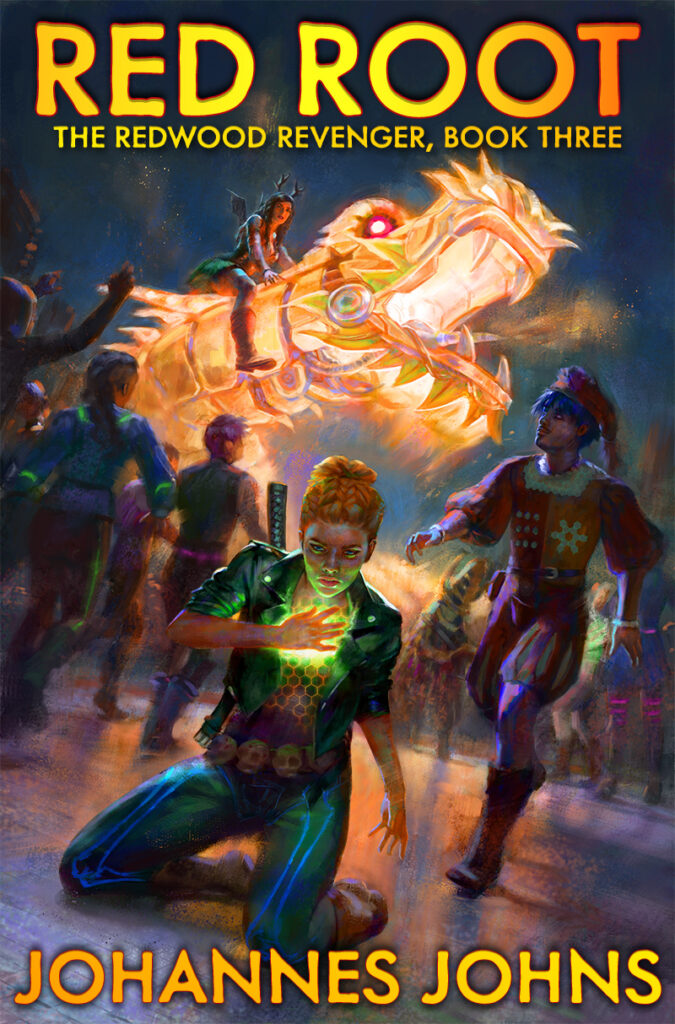
Red Root, The Redwood Revenger trilogy’s fantastic final installment offers an uncannily relevant vision of a post-pandemic future. Alien invasion included.
Since Johannes Johns’ debut sci-fi novel The Redwood Revenger came out in April 2018, a chain of events have occurred in the real world that are just as bizarre. In particular, when news of the Covid-19 virus came out in January, I thought, “Oh shit, it’s the paleomegavirus!” Well, hopefully not, as the plague that predated the events in The Redwood Revenger trilogy had a 70% mortality rate that decimated the planet’s population until a vaccine (95% effective) was developed in Cascadia. In the real world, we’re still waiting for the events that have shaped the book’s 2043 to play out, namely the Great Warming (a climate disaster that leaves the middle of the US barely habitable), and the Great Erasure (some sort of self-replicating quantum computing AI virus event that ends our current digital age, overthrows a tyrannical US “Autarchy,” and balkanizes the f.k.a.-USA). The result being a West Coast “Cascadian Federation,” one of those ever more plausible post-apocalyptic solar-powered “green” utopias.
Meanwhile, IRL on April 13, 2020, the governors of California, Oregon and Washington announced the launch of a Western States Pact in the face of an anti-Federal government unwilling to act on COVID-19 relief. Nevada and Colorado joined a couple weeks later. Social media was soon buzzing with #Cascadia, #Calexit and #Secession tags. Notably, there have been multiple efforts for a Cascadian secession since the 19th century, and if Trump had been re-elected in 2021, it is likely that a slow rolling secession could pick up speed and actually occur along the lines of the one in The Redwood Revenger trilogy. There are echoes of Ernest Callenbach’s Ecotopia (1975) too. It featured a secretive republic that was centrally planned, scaled-down, and had readapted to fit within the constraints of environmental sustainability. Starhawk’s The Fifth Sacred Thing deserves a mention, though it was organized on the level of city-states (SF vs. LA).
It’s certainly not the first time sci-fi has been almost preternaturally prescient. Dean Koontz’ The Eyes Of Darkness (1981) has uncanny similarities to the coronavirus pandemic. Regarding climate change, we have J. G. Ballard’s The Drowned World (1962), John Brunner’s Stand On Zanzibar (1969), Octavia E. Butler’s Parable Of The Sower (1993), and dozens more from recent years, including nearly half of Kim Stanley Robinson’s 20 novels, from The Three Californias trilogy (1984-90), 2312 (2012), Science In The Capital Trilogy (2004-07), New York 2140 (2017), to his latest, The Ministry for the Future (2020). Not all of them are grim dystopias. Robinson tends to have a fairly optimistic, practical approach to the future despite its massive challenges.
In a similar vein, William Gibson’s “The Jackpot Trilogy” is informally named after a cataclysmic point of no return event in Agency (2020), the second book. The “Jackpot” is Gibson’s catch-all description of a long-running major environmental collapse and the various extinction events that occurred in the mid-21st century. While the futures Gibson portray have a dark side, they’re also wildly fascinating, with imaginative solutions that make life after disaster seem like it’s still worth living. In fact, a whole movement of optimistic sci-fi has sprouted in recent years. Taking a cue from cyberpunk, this developing genre is often called “solarpunk.” Interestingly, solarpunk is not straight-up utopian. Within the realistic grit and grim challenges, there’s a sense of optimism and courageousness in the characters and writing. There’s an awareness of the human spirit. The Redwood Revenger books certainly fit the bill.
Nothing I’ve read has addressed serious issues like climate change, pandemics, and corporate-fueled global corruption with such joyously weird humor as The Redwood Revenger trilogy. While it at times shares an absurdist bent along the lines of Douglas Adams, Christopher Moore, or Neil Gaiman and Terry Pratchett’s Good Omens (1990), it’s not primarily a comedy. Nonetheless, there are centuries old toys (the scruffy, levitating, saucer-eyed pink musical pig, and the fancy-ass pirate sock monkey) inhabited by cunning alien intelligences. We have Byron Rosebeetles’ little sister, five-year-old “Chamomile,” who’s possessed by an ancient ET-Sasquatch high priest. She spends much of the third book imperiously hovering inches above the ground with a piercingly unsettling thousand-yard gaze.
Red Root is the trilogy’s fantastic final installment (out 02-12-2021). It dishes out more pointedly vicious satire via “Montanastan,” Cascadia’s crucifixion-crazy neighbor to the East. We explore this territory through Wekesa Rosebeetle, Byron’s sly older brother. He’s been tasked by a Cascadian spymaster-headmaster with a secret mission: investigate terrorist collusion between the evil VanDirks Corp. and various “Truther” militias. Montanastan is a dumpster fire Mad Max, Tank Girl style landscape, but with more good guy gay nuns. Nodding to Zardoz, huge flaming golden crosses float around the land at random gifting the local Truther-militia whackadoos with party buckets of guns, ammo, VanDirks Merry Meals, bags of “prayer-powder,” and VDs-branded merch. Of course, the golden crosses talk: ”JEBUS IS PURITY, THE GUN IS LIFE. GO FORTH AND KILL THE UNBELIEVERS AND MULTIPLY, FOR BLESSED ARE THE BEEFMEATS.”
Meanwhile, the trilogy’s main heroes, Olivia, Byron and Trudy are going all out to save the Earth. They have their hands full dealing with the Sock Monkey, while racing to appease angry ET-Sasquatch who will destroy the Earth, while also racing to prevent the VanDirks Corp. from ruling the Earth. On top of all that and rescuing Uncle Ernie, Olivia is dealing with a double confusion, her legacy as a slayer of evil men, and an intense physical chemistry with a human rival (sparked by a completely bonkers fight in the woodlands turned sapphic sexual tussle). Red Root has Sasquatch, it has romance; thankfully no Sasquatch-romance.
Between the local and interstellar politics and murderous fast food empires, the heart of the trilogy often lies within the simple pleasures of enjoying lemon verbena ginger scones among friends (I’d watch a Rosebeetle Cafe cooking show!), the carnal excitement of new love, and the loyalty of friendship that fuels both an intense lust for life, and the drive to defend them and their society at great personal risk. It should go without saying that the books are best when read as a complete 1,009 page trilogy. Did people complain in 1954 when J.R.R. Tolkien first published The Fellowship of the Ring and it ended with the story arc unresolved? Probably. But, those who went on to read the entire L.O.T.R. appreciated the truly epic nature of the story.
While only time will tell if the bizarre and brilliant Redwood Revenger can ascend from a cult favorite to a full-blown cultural phenomenon complete with pig and monkey plushies and a Netflix series, it has definitely been my favorite work of fiction of late and a source of laughter, excitement, healing and hope. It’s worthy of re-reading, and you can’t ask for better than that from a series.
Read the first two now: The Redwood Revenger (2018) | Red Bush: The Redwood Revenger Book Two (2019) | Pre-order: Red Root: The Redwood Revenger Book Three (2021) | JohannesJohns.com

April 2, 2026
Fester’s Lucky 13: 1986
February 27, 2026
Fester’s Lucky 13: 1976
January 30, 2026
Fester’s Lucky 13: 1966