Join team Fast ‘n’ Bulbous and Submit Your Ballot for your predictions. Winner within team FnB gets a prize!
This is the first year in a long time that I’ve seen all the best picture nominees. Between the pandemic and writer’s strike, the 2020s were slim pickings for great movies. But things are looking up, reflected in the ten choices for Best Picture. In anticipation of the 98th Academy Awards this Sunday, here’s my ranking.
1. Sinners (Ryan Coogler)
Where did Miles Caton come from? His voice (both speaking and singing) is mesmerizing, and his portrayal of Sammie “Preacherboy” elevated the whole movie. When vampire Remmick told him, “I want your stories. And I want your songs. And you can have mine too” I had chills. A masterful symbol of cultural appropriation and all of it’s ebb and flow complexity. As well as Remmick’s false promise of assimilation into a “post-racial” existence that would cost Sammy and others their identity and heritage. There’s also the metaphor of extensive multi-generational trauma that the vampires represent, which is all too real, so not exactly a fun sort of spooky season movie, but rewarding all the same.
While I enjoyed the postscript scene of 80 year-old Sammy in a Chicago blues club in October 16 1992 (the day the horror classic Candyman was released), played by Buddy Guy who interestingly I saw perform myself at the Chicago Blues Fest just weeks after first moving to Chicago in Sep ’92 (spooky, right?), the affectionate and benevolent behavior of the vampires seemed at odds with what happened sixty years previously. I was on board, though, with the juke joint dance scene, postmodern breakdown of linear time into a pastiche of rappers, P-Funk guitarist and dancers from different eras. From choreography to sound design, it was brilliantly done, bravo.
2. Frankenstein (Guillermo del Toro)
I hesitated just a little bit before diving in to this movie. I kind of overdid spooky season, bingeing on far more horror movies and books in four weeks than I’d ever done before, including Mary Shelley’s original 1818 Frankenstein. I didn’t love the book, as there were lots of problems with the original story, where Victor was still an undergrad when he accomplished making his creature far too suddenly and unceremoniously. While the film is more true to the structure of the book than any other adaptation, it definitely fills in the gaps where needed, with Victor approaching middle age, and only succeeding after (literal) trials and tribulations. In the movie, he is far less whingeing and self-pitying, and more single-minded obsessive. del Toro also takes the opportunity to feature a far stronger female character than Shelley could muster, with Mia Goth (what a perfect name) as the formidable Elizabeth. Sure, it was 1818, but Shelley’s mother, Mary Wollencraft, was a feminist who wrote the groundbreaking A Vindication of the Rights of Woman in 1792. I think she’d have been pleased by del Toro’s changes. The ending is also altered in a much more satisfying manner. del Toro’s storytelling and cinematography elevates the gothic source material into a new modern classic. A reminder that I really need to watch everything Guillermo del Toro has done.
3. The Secret Agent (Kleber Mendonça Filho)
Ah, 1977 Brazil, when men at work wore open shirts with their hairy bellies hanging out, 13 years after a military coup d’état (assisted by the U.S.). with seven more long years to go. Despite being the start of General Geisel’s abertura (gradual opening), the evil corruption, violence and surveillance contantly haunted the Brazilian people. Most of the story took place during Carnival, and the newspaper headline reported the incredible death toll of 91 dead. Clearly the chaos of Carnival was used as a smokescreen for political assassinations.
In the opening scenes, I had to laugh when there were close-up shots of Armando’s toes as he’s driving, ICK! That was the first indication that this was going to be no ordinary noir thriller. But still with all the gritty realism, the juxtaposition was shocking when the surrealism was injected via the two-headed cat named Elis/Liza, the self-propelled hairy leg, representing the resistance’s code for state-sponsored violence, and the cinematic ghosts of Jaws and The Omen in the soundtrack (next to Bee Gees disco tunes), two horror movies that were belatedly released to theaters in Brazil that year. The movie takes it’s time to reveal what exactly is going on, but it’s a powerful statement, and an obvious parallel to what is happening in the U.S.
4. One Battle After Another (Paul Thomas Anderson)
No one ever expected anyone to be able to successfully adapt a Thomas Pynchon book, but PTA did a great job with Inherent Vice, which to be fair is the easiest one to tackle. For Vineland, he wisely took a very loose approach, taking only some of the elements from the book. Pynchon’s books tell the story with almost all dialogue and very little exposition or action. The movie is the opposite, with a very bare bones script. The setting is shifted from 1980s to present day, the politics updated and plot simplified, but many of the characters are in line with the book. Just enough of Pynchon’s dark humor comes through to make me happy, and the gritty action cinematography made you feel like you were there, trailing Bob on his frantic scramble to reunite with his daughter. Definitely a unique effort, and a heck of a lot better than The Master, but I don’t get those who watched it four times in the theater. Once is enough, thanks!
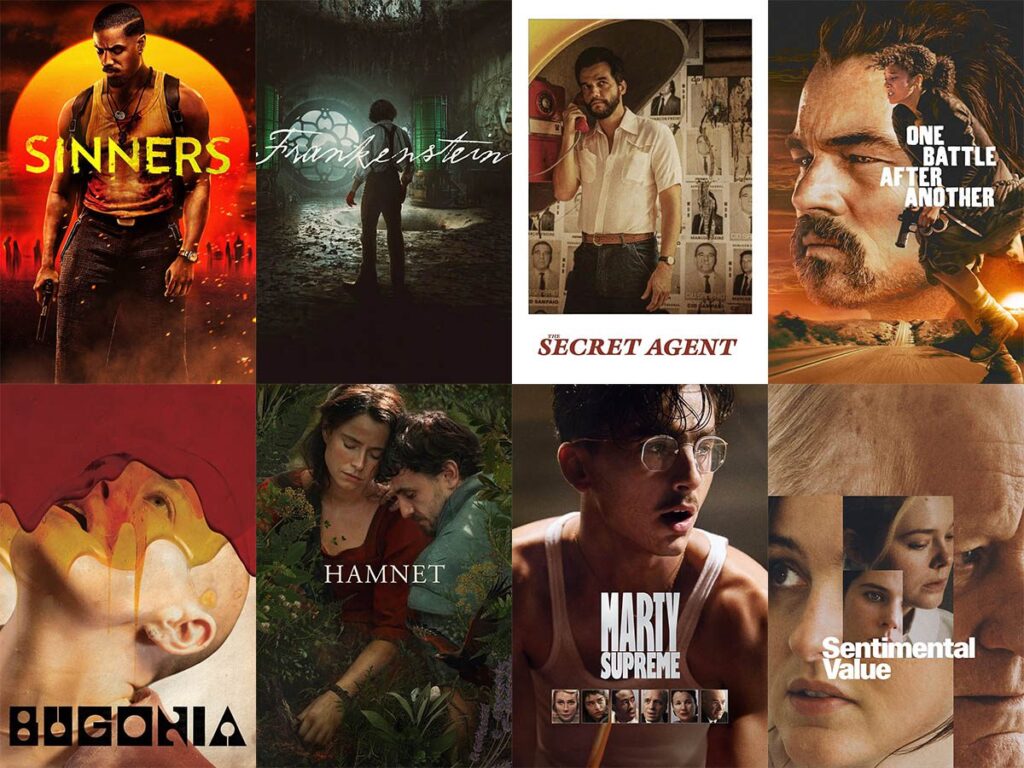
5. Bugonia (Yorgos Lanthimos)
I really liked Poor Things, and while I plan to revisit The Lobster (which I didn’t love the first time), I was excited for this one. Like Weapons, the less said about it the better to avoid spoiling the experience. Even assigning it a genre would be too much. Emma Stone is magnificent in this, truly next level acting, as is Jesse Plemons. This will probably be overlooked in award season, but they’ll be studying this in film schools before long.
6. Hamnet (Chloé Zhao)
Based on Maggie O’Farrell’s historical fiction, which fills in the blanks left by a lack of documentation of what really inspired Shakespeare’s Hamlet, this is nevertheless a moving tribute to the Bard’s family behind the scenes. It’s anchored by Jessie Buckley’s riveting portrayal of Agnes. Also, what lab did they grow Jacobi Jupe? He looked and acted like a minature Orson Welles! And if you thought the casting was well done with the actor playing Hamlet in the play, that’s the older brother, Noah Jupe.
7. Marty Supreme (Josh Safdie)
This is what happens when you take the hectic, sweaty style of the Safdie brothers’ Uncut Gems (2020) and apply it to Josh Safdie’s frantically stressful, sweaty sports movie. Chalamet is impressive here, playing a character who’s a real shit, but despite his manipulative narcissism, there’s still a glimmer of hope that he isn’t a full blown sociopath, and you still root for him to succeed. I love that the sport here is the long-suffering ping pong (e.g. table tennis), and how, despite being set in 1952, has an anachronistic soundtrack of 80s music including Tears For Fears, New Order, Peter Gabriel, Alphaville and Public Image Ltd. Uncut Gems instilled in me the dread that something horrible was going to happen, which added to the tense atmosphere.
It’s hard to believe that Safdie was serious when he said he planned to shoot an ending with Marty at a 1987 Tears for Fears concert, and a unaged, vampiric Milton Rockwell bites his neck. That’s just crazy crackers, and I think he’s putting us on, but might have been kind of awesome.
8. Sentimental Value (Joachim Trier)
I normally avoid two-plus hour family dramas with generational trauma like the plague, but I’m on a mission to see all ten Oscar nominees. This won me over despite the movie starting out badly with a narrator giving a cloying account of the house as a character in the lives of the generations that lived in it. The stage actor daughter Nora has a panic attack before a performance and on the surface she seems like an annoyingly histrionic diva. However, the facts unfold and we’re able to empathize with her, when her and her sister’s estranged father Gustav (Stellan Skarsgård) shows up at their mother’s funeral, and wants to share a script that he seemed to written about her. When she refuses, and he brings an American actress (Elle Fanning) onboard she tries to unpack his motivation for replicating his mother’s suicide in the final scene of the script. Gustav vehemently denies the movie is about his mother, who was imprisoned and tortured during the war, then killed herself when Gustav was just a young boy. He deals with his issues through his art, but it’s kind of sad how he communicates better and is more affectionate with the actress than his own daughters. It is imperfect and too long, but still a worthwhile experience.
9. F1 (Joseph Kosinski)
I haven’t watched a full F1 (or any race) since I was a kid, but this was just some good ass shootin, I’m sure setting all sorts of technical benchmarks for filming autoracing. Brad Pitt avoids the pitfalls of sports movies navigating potentially cheesy, cringeworthy alpha male banter like an old pro, and MVP is Kerry Condon, stealing every frame she’s in. I totally didn’t realize she was also the ranger in Train Dreams. A nice change to just watch a fun movie that isn’t horribly depressing.
10. Train Dreams (Clint Bentley)
It seems movies have finally bounced back from the pandemic/writer’s strike dry spell, with a good group that are challenging and entertaining. However, what’s a batch of Oscar nominees without at least one oppressively bleak movie with a crap story? This time we have Train Dreams, a maudlin slog through the life of an ordinary logger that, save for a brief blip of a marriage, is soul crushingly lonely. At one point I hoped he might have found a second chance with the nice forest ranger, or at least some kind of platonic companionship along the lines of In the Mood for Love (2000). But no, there is only drudgery, guilt, grief, and the sweet relief of death, backed by, of course, a Nick Cave tune. An extra half star for the cinematography and sensitive performance of Joel Edgerton.
Best Visual Effects
Avatar: Fire and Ash (James Cameron)
Best Animated Feature
Kpop Demon Hunters (Chris Appelhans, Maggie Kang)
Not a Kpop fan, but the characters won me over with their personalities. Still, I feel a bit sorry for the demons.
Zootopia 2 (Jared Bush, Byron Howard)
A great sequel that surpasses the original, not an easy thing to do. It’s a pleasant surprise to see Disney continue it’s themes of anti-discrimination/segregation/colonialism, celebrating multiculturalism and ecological themes in this oppressive climate. Woot! Certainly makes Kpop Demon Hunters look shallow in comparison.
Best Animated Short
The Girl Who Cried Pearls (Chris Lavis, Maciek Szczerbowski) / Forevergreen (Nathan Engelhardt, Jeremy Spears)
It’s a close call between these two, as they’re both pretty moving morality fables, both addressing different facets of greed. The Girl Who Cried Pearls has the edge with more complexity and mystery, but Forevergreen is dang cute.
You’ll have to wait until Sunday to see the rest of my picks, if you join team Fast ‘n’ Bulbous and Submit Your Ballot for your predictions. Winner within team FnB gets a prize!
My favorites that were not nominated:

Where to Land (Hal Hartley)
Just as John Hughes movies in the 80s were the perfect backdrop to my teen years, some early indie classics came out during college, like Steven Soderbergh’s uniquely quirky Sex, Lies and Videotape (1989), Whit Stillman’s erudite, loquacious Metropolitan (1990), and Gus Van Sant’s poetic My Own Private Idaho (1991). But my main man, my Jim Jamusch, my Jean-Luc Godard throughout the 90s, was Hal Hartley. His initial trio of movies, The Unbelievable Truth (1989), Sundance winner Trust (1990) and Surviving Desire (1991) introduced me to his philosophical deadpan style, where ordinary working class characters would ponder existentialism, literature and theology in the middle of their mundane routines, always in a stylized flat monotone. Kind of like Charles Schulze’s characters grown up. They’d also at times spontaneously break out into synchronized dance numbers. On paper that might sound cringeworthy, but in the trickster/magician hands of Hartley, who wrote, directed, and composed nearly all the music for his films, they conveyed an intense moral sincerity that was distinctly lacking from many of his peers.
As his influence started to show up in Todd Solondz, Kevin Smith and Alison Anders, Hartley evolved, tackling darker noir in Amateur (1994) and the sprawling, novelistic Henry Fool (1998), regarded by some as his career peak, winning the best screenplay award at Cannes International Film Festival. He continued to experiment in the 2000s with varied success, ending up with somewhat more difficult, convoluted storytelling, but compelling all the same. By 2019, he had slipped under many radars after Ned Rifle (2014) completed the Henry Fool trilogy without much critical fanfare. Focusing on his art rather than the Hollywood hustle (though he did direct seven episodes of the Red Oaks (2015-17) series on Amazon, and developed his own pilot, Our Lady of the Highway, which was published as a novel in 2022), he used Kickstarter to crowdfund his later movies, and when the project for Where to Land was announced in December 2019, I was all in. Here Hal, take our moneys. Within a month, 1,555 of his loyal fans raised over $370,000, and production was set to start in early 2020. Delayed by the pandemic, it finally was launched in a limited run of theaters in September 2025, and Blu-ray and streaming via Vimeo on November 28.
It includes familiar faces from his repertory stable, Bill Sage, Robert John Burke and Edie Falco, along with more freshly hatched younger faces (Kaitlyn Sparks as niece Veronica, Jeremy Hendrik as young filmmaker Mick), along with a standout from Kathleen Chalfant, who plays Elizabeth, a 100 year-old activist/writer friend who offers historical levity as she twirls a cigar between her fingers, expressing regret that she won’t be around to witness the “interesting” societal collapse from the impending climate crisis. Sage plays Joe Fulton, a semi-retired director of romantic comedies who, at 58, applies for a job as an assistant groundskeeper at the local cemetery. His niece, girlfriend and friends don’t think it’s a coincidence that he’s also working on his will and testament, spreading the rumor that he’s dying. Even Muriel (Kim Taff), the annoyingly histrionic girlfriend who plays the superhero The Blue Blaze in a successful TV franchise, wins us over with her charming enthusiasm for a reboot in her career. It’s a proposed series about a convent of outlaw nuns in Williamsburg who form a microbrewery, which is the exact story of Hartley’s Our Lady of the Highway book.
In any other hands, Joe’s late-life contemplations could be dreary and bleak. But as usual, Hartley injects a lovely atmosphere of gentle whimsey and joy that elevates the movie above all others from 2025. Sure, it’s not an epic 2:42 long blockbuster that makes big statements with distinctly horrible characters. Instead, it offers healing, and dare I say hope, that amidst our current dumpster fire, there just might still be people who will continue to hold on to their idealism, empathy, and humanity. At 65, I hope this is just a start of a run of at least a few more fantastic late career movies from one of my all-time favorites.
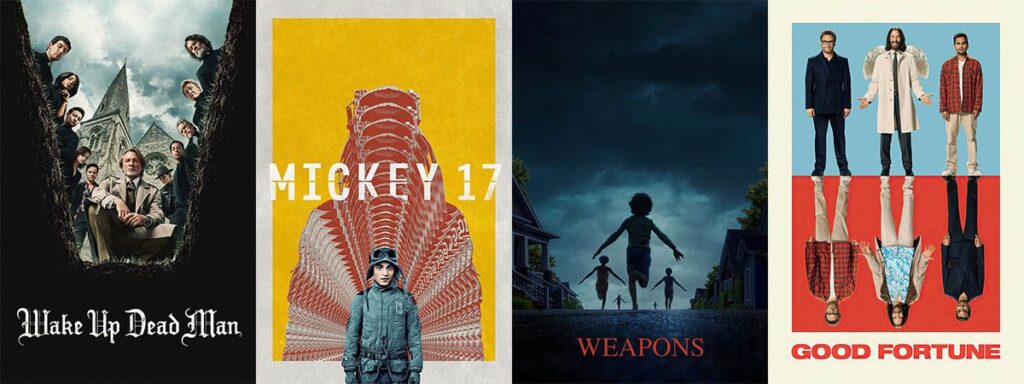
Wake Up Dead Man (Rian Johnson)
Wow, what a rollercoaster! First of all, what a brilliantly reprehensible group of suspects we have here that is the congregation of Monsignor Jefferson Wicks. Such a great satire on social media influencers and those who use religion as a weapon for grooming and radicalizing constituents. Hoo boy, and misogyny so thick you need a scythe to saw through it. But mostly, it’s just a great mystery with some fine acting, especially with Glenn Close, who steals the show with Shakesperian level chops. Hard to say any more without flirting with spoilers, but possibly the best movie of the year.
Mickey 17 (Bong Joon Ho)
I love how Pattinson’s Mickey 17 voice is inspired by Ren & Stimpy. Nothing explains why 18 is so different, and while there’s some dark comedy, this is mostly dark, the satire of the neo-fascist religious psycho couple played by Ruffalo and Collette are grotesquely cringeworthy. Man, since Poor Things, Ruffalo has fully entered the ghoulish villain stage of his career. Many bits don’t make a lick of sense, but it still stands out as a unique and worthy genre experiment.
Weapons (Zach Cregger)
I have not yet seen Barbarian (2022), and friends who raved about Weapons gave no spoilers, so I went in blind. I have to say that most of the viewing experience was frustrating. That sometimes can be a necessity when you’re building suspense and you have no idea what is going on. On the other hand, I started to notice a lot of the black humor and satire coming through, and by the film’s climax the “oh my gerd” payoff, I wasn’t quite sure if it was worth the aggravation at the time or not. But the aftertaste lingers, and pieces continue to fall into place days after watching the movie. It left me craving more context and background, but that’s just the type of movie it is, doing exactly what it set out to do. So yes, I’d say it’s worth the two plus hours.
Good Fortune (Aziz Ansari)
It was a lot of fun watching Keanu play a dumb but sweet angel, reminding me of Christopher Moore’s book The Stupidest Angel (2004). The theme of the hubris of greed goes way back to A Christmas Carol, and also seems to reference one of my all-time faves, Wings of Desire (1988), but adds enough funny twists to make this a must see comedy.
Song Sung Blue (Craig Brewer)
It was getting too feel good, and I knew something horrible was going to happen, but our heroes prevail, through the power and passion of Neil Diamond, woo hoo! Poor casting choice for Eddie Vedder, but otherwise great all the way through. It’s based on a 2008 documentary of the same name, and this is clearly streamlined into a semi-fictionalized biopic, changing facts and timeline and messy situations for more dramatic effect. You wouldn’t know it from the movie, but their partnership stretched 17 years, from 1989 to 2006. It seemed like they got married just months after meeting, with the fashions making it look like 1989, but the wedding was actually in 1994.
May 31, 2026
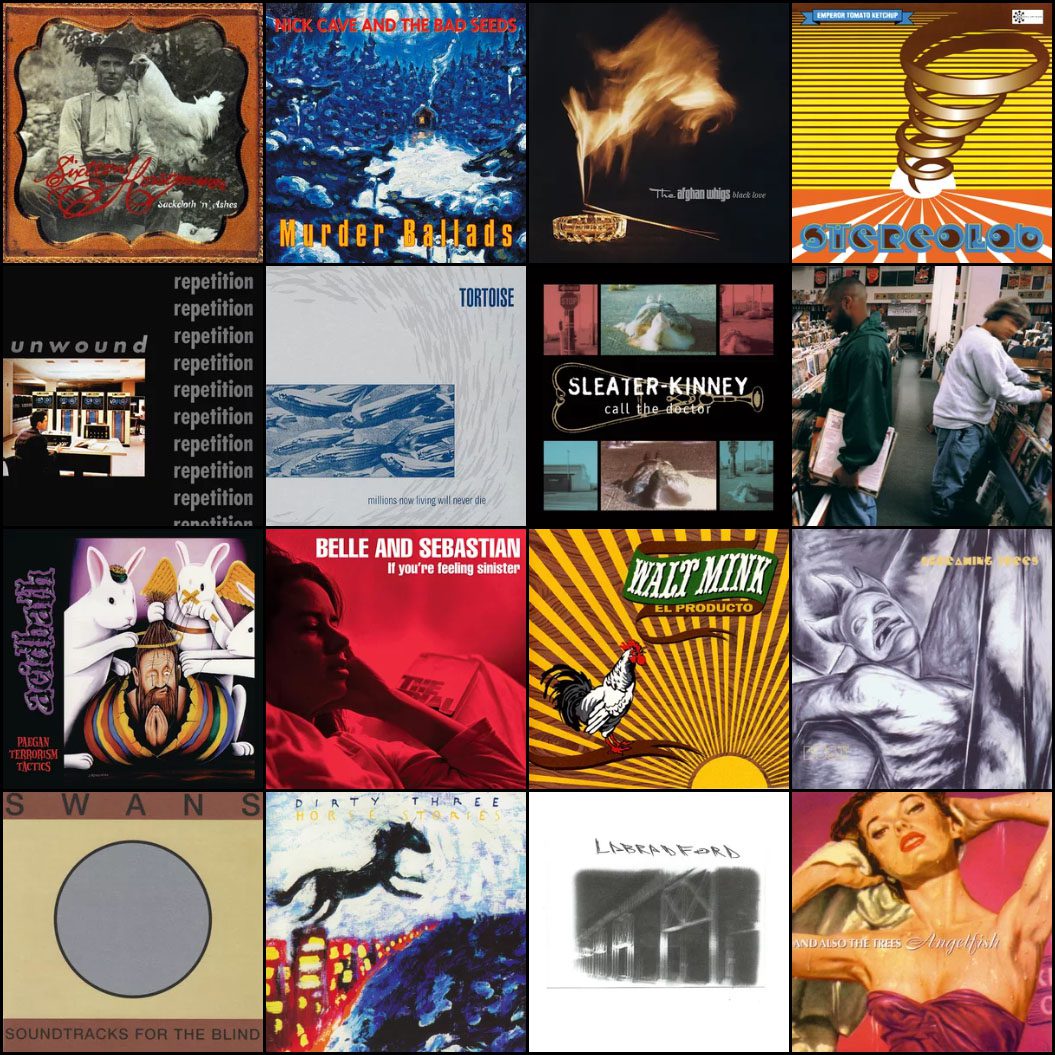
Fester’s Lucky 13: 1996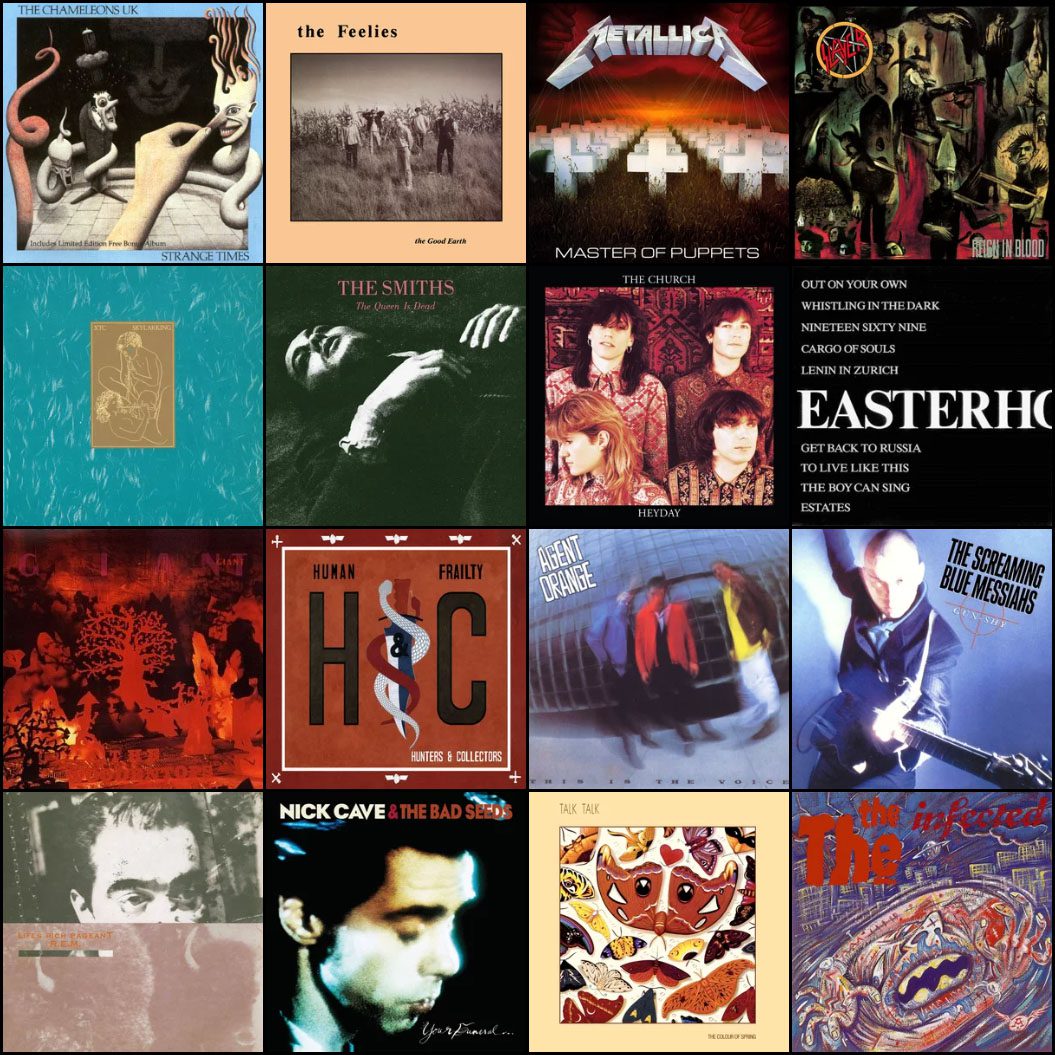
April 2, 2026
Fester’s Lucky 13: 1986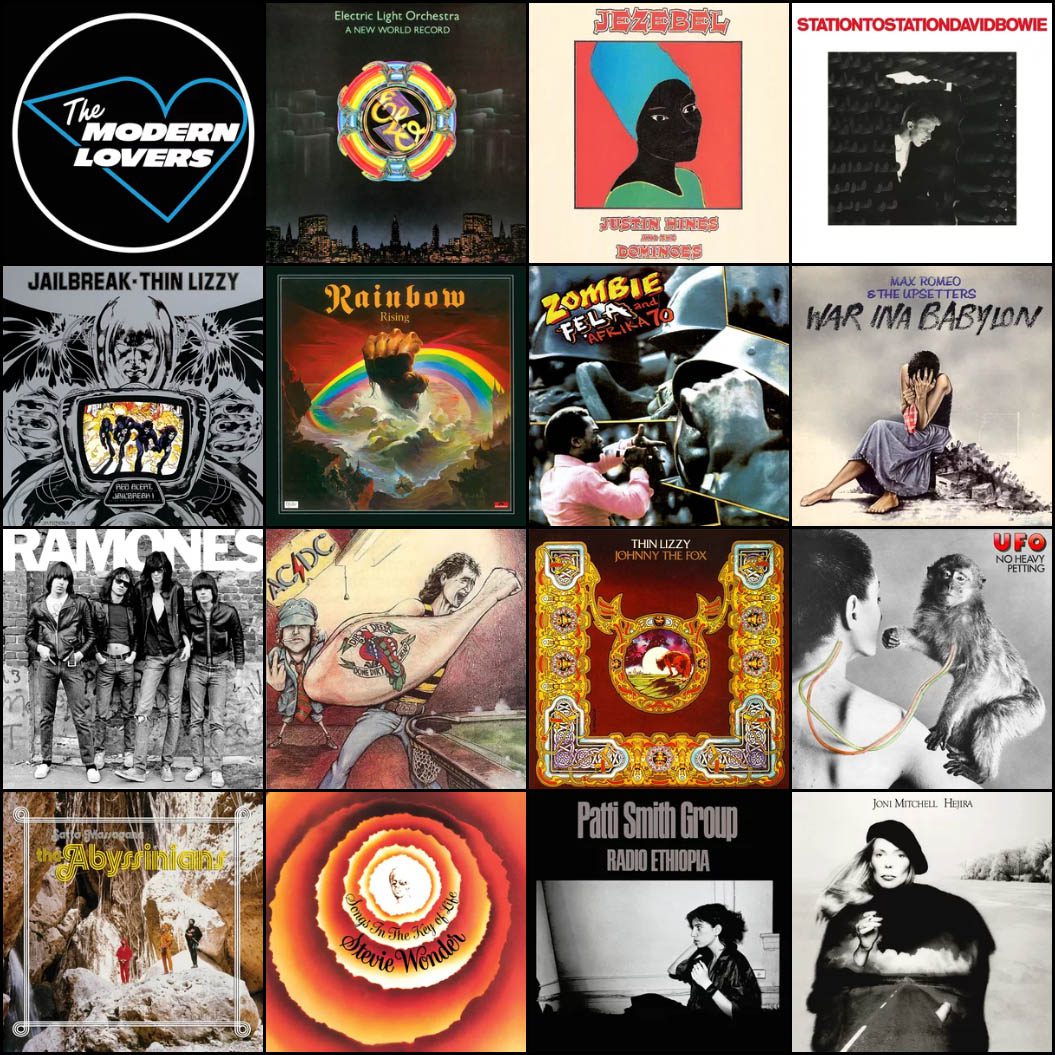
February 27, 2026
Fester’s Lucky 13: 1976