Gnomes and Scandinavians from the land of ice and fire do battle at the Garden Monument of Oblivion. Who will reign as kings of monumental rock mountain, who will tend the garden, and will both be obliterated by their elders?
I knew this was coming for a while, but it seems few have noticed that three significant rock albums were released on April 16, 2021. A lot of people are aware of one of the bands but oblivious to the other two, which is a damn shame. The mainstream band is Greta Van Fleet, currently with about 3,153,000 followers on Spotify, and a million ticket sales on their world tours pre-Covid. The Vintage Caravan, hailing from Reykjavik, Iceland, and lately based in Sonderborg, Denmark, have just 50,244 followers. Trondheim, Norway’s Motorpsycho have just 48,595, despite having released at least 23 albums since 1991, and having a loyal European following significantly larger than their Spotify streamers.
All three bands have hard rock roots that go back to the titans. Not the Greek pre-Olympian gods, but rather the reluctant godfathers of metal, Led Zeppelin, Deep Purple and Black Sabbath. Those bands trod the earth like godzillas throughout the 70s, laying waste to stadiums and their respective brain cells. Various formats of those bands continued to do so in various incarnations in later decades, but it’s safe to say their most influential music peaked between 1969 and 1975. For that reason, many believe music inspired by that era is strictly retro and passe. Yet one could also argue that soul, R&B and funk also peaked in those years, not to mention electronic music, jazz fusion, even singer-songwriters. If you’re reading this site, you are most likely already a rocker, and no further defense of our embattled genre is needed. On to the albums!
Greta Van Fleet – The Battle at Garden’s Gate (Lava)
Forming Greta Van Fleet in their teens in 2012 in Frankenmuth, Michigan (twins Joshua and Jacob were 16, Sam 13), the three Kiszka brothers insist they have widely varying tastes (jazz, blues, world music). But together they mainly sound like Led Zeppelin. They’ve been duly eviscerated in both early and recent reviews for the derivativeness, but that hasn’t stopped them from selling out shows and moving a fair amount of music. Especially on their first EP, From The Fires (2017), they’re 100% a Led Zep tribute act, with Joshua sounding more like Robert Plant than Plant himself has since about 1973. For what it is, it’s a pretty enjoyable guilty pleasure. The hype leading up to their full length debut Anthem of the Peaceful Army (2018) drew more criticisms, but it was a chart topper, selling 80,000 copies it’s first week. I didn’t hurt that they played Elton John’s Academy Award party in March, and had their TV debut on Jimmy Fallon in July, playing a single from the album three months before it’s release. Seems like the band’s management was influenced by the Zep crew too, bulldozing the band to the front of the line Peter Grant style. I doubt anyone was hung by their feet from third story balconies.
So what made Greta Van Fleet a mainstream success practically overnight, out of all the talented bands out there doing what they do better (Graveyard, Witchcraft, Rival Sons, Orango, Spidergawd, Kadavar, Horisont, Radio Moscow, Blues Pills, The Vintage Caravan)? To be fair, they have honed their chops to professional sounding quality. They took Elton John’s advice to dress more flamboyantly to the point of absurdity. They do so without shame and irony, and that can be appealing. They embrace the cheese of overbaked melodrama (strings, vocal acrobatics) well beyond reasonable tastes to the point where they’re a bit shit. And people fucking love that, from The Darkness to Muse to The 1975. A couple bands beyond Led Zeppelin got quite a lot of flack for being over the top in the 70s — Queen and Rush. Both were savaged by critics, had arguably inconsistent albums, but ultimately gained the kind of rabid loyalty that most bands only dream of. Could Greta Van Fleet achieve that? Well, they’ve got a good start in terms of kicking the asses of all their peers in terms of ticket and album sales. That fact can inspire some bitterness that other bands aren’t seeing remotely that kind of success, which can negatively affect the response to the new album.
I still have some reservations about much of their material, but the band is clearly improving. While they haven’t exactly transcended their influences, at least now when a song sounds like Led Zeppelin, such as “Stardust Chords,” it sounds like it might have come from the gap between Houses of the Holy (1973) and Physical Graffiti (1975). It’s been my favorite track during the first rounds of listens. I still cringe now and then when Joshua adds too much warble to some of his vocal lines. And while he teeters on that fine line between genuine passion and showbizzy performance, at least they’re close to the line. I think they easily could have gone full-on pop megawhore mode along the lines of Maroon 5 and The 1975 and been more commercially successful more quickly. So I feel they genuinely do love their chosen genre. So beyond the strong numbers like “Built By Nations” and “Age of Machine,” they stretch the palate a bit and reference The Who on “My Way, Soon.” When they turn up the strings and wails and melodrama to 11 on “Broken Bells,” “Tears of Rain” and “Light My Love,” I don’t mind at all really. I had to go back and refresh my memory, but it seems they’re also taking a page from the pomp rock playbook (mid-70s Journey, Kansas, and especially Styx). Weirdly, I can appreciate them more with that perspective. Maybe my mind needs recalibrating after watching too much The Masked Singer. Whatever the case, it may be a flawed album, but it’s quite enjoyable.
I also like how the epic title, “The Battle at Garden’s Gate,” probably unintentionally pokes fun at itself. As Hermi Flaggelnack wondered, “was there a big battle sequence that happened outside someone’s garden entrance? Was the invasion thwarted by garden gnomes?” That was probably not an intentional crack at Joshua’s gnome-like appearance and stature. That would be mean. Marc Bolan (T. Rex) and Ronnie James Dio (Elf, Rainbow, Black Sabbath, DIO) shared those comparisons, and they became musical giants after their own hard fought battles. Can Joshua and brothers measure up to such daunting legends? Only time will tell.
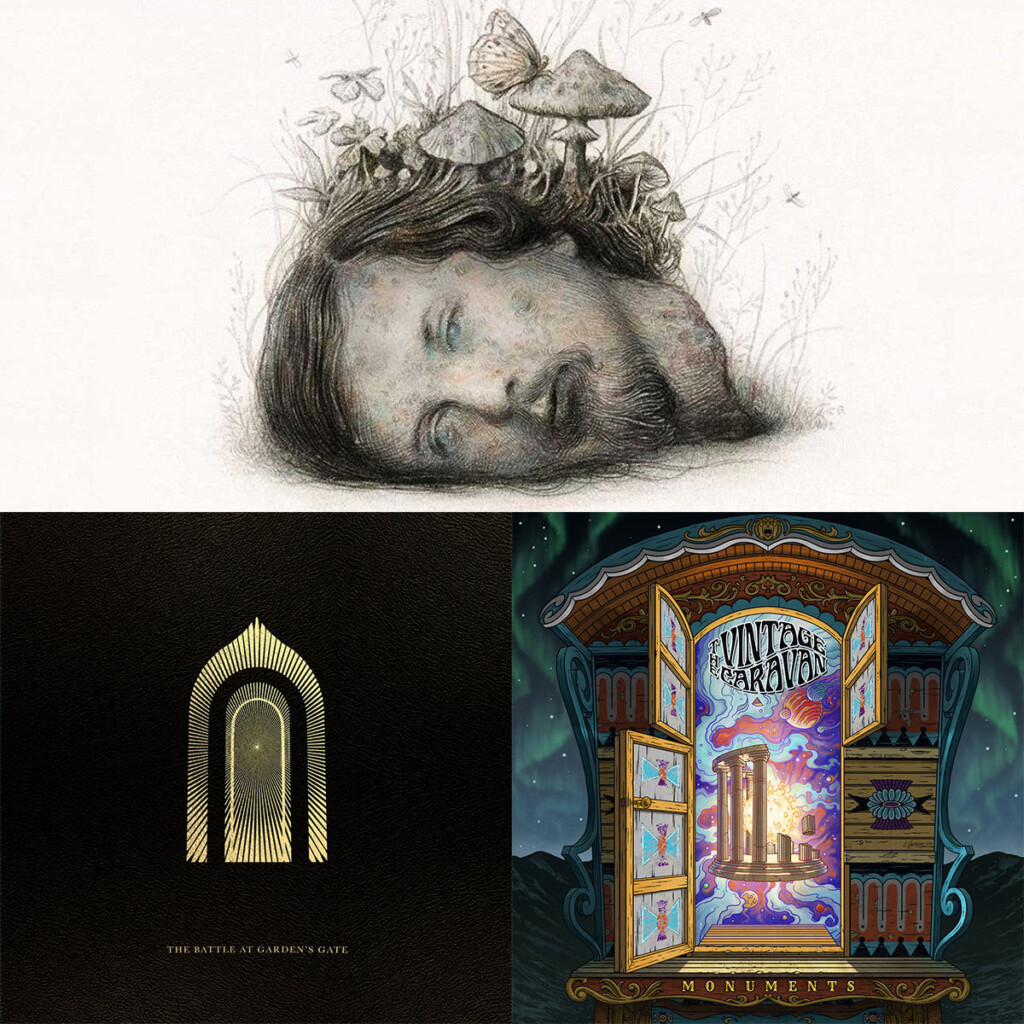
The Vintage Caravan – Monuments (Napalm)
Like Greta Van Fleet, The Vintage Caravan formed at an early age. Singer/guitarist Óskar Logi Ágústsson and bassist Alexander Örn Númason were just tweens in 2006, and self-released their debut in 2011. Deep Purple and Cream were key early influencers for the duo (the band is a power trio, and Stefán Ari Stefánsson replaced the first drummer in 2015), while Óskar sported a smoky, mature sounding voice that evoked a young Paul Rodgers (Free, Bad Company). Their albums have been consistently excellent, though fourth album Gateways (2018) didn’t reach as many peaks as Arrival (2015). The band does a much better job creating a more unique signature sound than Greta Van Fleet, their more diverse influences (Funkadelic, Captain Beyond, Gentle Giant, Queens of the Stone Age, Mastodon) not so easily identified on first listens. The driving quality of prime Deep Purple is the easiest to spot, which isn’t surprising, as it’s been a key influencer on so many bands, like Iron Maiden and the whole NWOBHM scene. I also hear bits of Graveyard and Witchcraft, particularly the great production on their 2012 albums Lights Out and Legend.
Their fifth album is looking like their best yet. Previously I kind of hoped the band would explore their prog roots more, but while there are occasionally longer cuts like 8:11 “Forgotten,” they refrain from overly ambitious, complicated multi-part arrangements — just enough to keep them multi-faceted and engaging, while foregoing the kind of dramatic embellishments Greta Van Fleet favors. Instead they bring their songwriting to a laser focus, piling hooks upon riffs atop the driving rhythms. Case in point, the album explodes out the gate with three of their best tunes, “Whispers,” “Crystalized” and “Can’t Get You Off My Mind.” All three were treated with entertaining videos.
The band has always been good at sequencing their albums with well-placed, leisurely slow-burners (“Hell”) and ballads (“This One’s For You”). This time around, they don’t serve as highlights that “Do You Remember,” “Innerverse” and “On the Run” did. However, album closer, the 8:15 long “Clarity” evokes the lushly produced harmony laden soft rock of 70s Laurel Canyon with surprisingly beguiling results.
Most remarkably for a band associated loosely with retro classic rock, there isn’t a single song in their entire catalog that has made me cringe. While Greta Van Fleet certainly offer some enjoyable highlights between the cheese, the pleasures found here come guilt free.
Motorpsycho – Kingdom of Oblivion (Rune Grammofon/Stickman)

The fact that there is no real consensus on what kind of band Motorpsycho is speaks to their uniqueness. Some call them psychedelic, others progressive, but no one calls them retro. Formed in 1989, their 90s albums were somewhat of their time in the context of the post-grunge, noise, shoegaze and indie rock scenes. But even then they were hard to nail down — they even did a soundtrack of country rock (The Tussler, 1994). Over a weekend I tried to glean all their influences, and determine if any particular one stood out. I came up with Black Sabbath, Beatles, Led Zeppelin, Deep Purple, Pink Floyd, Grateful Dead, Mahavishnu Orchestra, Hawkwind, Stooges, MC5, Popol Vuh, Rush, Dinosaur Jr, My Bloody Valentine, Husker Du, Butthole Surfers, Sonic Youth, Swans, Soundgarden, Screaming Trees, Monster Magnet, Mercury Rev and Yo La Tengo. I can safely say that they don’t sound like any of those bands.
While there is a devoted contingent of their fanbase that favors their 90s albums, my interest in them perked up as they explored psych pop in the early 2000s, and gradually inched toward a more majestic psych prog arena. After completing the loosely connected Gullvåg trilogy that includes three and a half hours of music, some of their best work, most bands would take a breather for a couple years or decades. Not Motorpsycho. All engines remain in overdrive, as they release another consecutive double album less than eight months after The All Is One. Kingdom of Oblivion is either their 22nd or 25th album, depending on what you count. Normally artists this prolific (Frank Zappa, King Gizzard & the Lizard Wizard) release a lot of garbage. Again, not these Norsemen. It’s a daunting catalog, and it’s not necessary to hear all of it to appreciate them, but is certainly rewarding if you do dig in. Their creative run continues, with highlights that often surpass parts of their recent acclaimed albums.
While the Gullvåg trilogy addressed the dark era of the Trump/Brexit years, Kingdom of Oblivion recognizes that the aftermath could be even darker if we don’t make drastic changes, hence the dead head (har) on the cover with the mushrooms growing out of it. Heavy times call for heavy music, and Motorpsycho reads the room superbly, cranking out their heaviest batch of rock since, heck, I’m not sure, it’s hard to keep these 22-25 albums sorted atop my head, perhaps Behind The Sun (2014) or Heavy Metal Fruit (2010). The title track feels like being faceplanted on a concrete wall, and “The United Debased” rolls like a tank as they have stern words for us Yanks’ previous administration. Sandwiched between those songs, “Lady May” features acoustic picking and vocal harmonies, like CSNY with an extra dose of apocalyptic dread. “The Watcher” is a rare event, a cover of Hawkwind’s “The Watcher,” written by one Lemmy Kilmister in 1972. This quietly simmering treatment practically drips liquid acid. The Viking lords are watching the shenanigans of us puny, stupid humans, and they are not pleased. “Dreamkiller” (great title) starts with quiet strumming and incidental room noises before exploding at 1:50 into a savage pounder with what sound like giant kettledrums straight from Valhalla. The attack reminds me a bit of Swans when they’re feeling feral. “At Empire’s End” is another epic highlight, and in line with overall theme of an impending collapse of civilization/extinction event. “The Hunt” and “After The Fair” provide more acoustic driven instrumental mood setting for a nicely paced dynamic palate, setting us up with my favorite track, “The Transmutation of Cosmoctupus Lurker,” which simultaneously evokes possible Lovecraftian horrors, but also perhaps some whimsey. Yeah, they’re not all stern business, these blokes like a good time too. It’s just that their party music includes multitentacled monsters, and some fantastic licks worthy of prime Red-era King Crimson.
Good grief, could it be that Motorpsycho have topped themselves with another career highlight? There’s been some rumblings amongst the Psychonauts that this could be the case, though I’d need to grok on this more before deciding if it’s a match for the mighty The Tower (2017) and The Death Defying Unicorn (2012). Either way, it’s a serious contender for album of the year so far, and another really excellent entrypoint into the vast, deep world of Motorpsycho music.
The Battle at the Garden Monument of Oblivian
Greta Van Fleet have secured the garden, providing solid entertainment for the punters, unselfconsciously absorbing ALL THE CAMP that will undoubtedly lead them toward festival headlines. The Vintage Caravan has left the garden behind and scaled hard rock mountain, standing imperiously atop their monument, daring the world to continue to ignore their finely crafted songs. Meanwhile, the three Norsemen of the apocalypse, Motorpsycho, glare down balefully at the youngsters from their more cosmic viewpoint, and see the real trouble the planet is in for. For now, there’s room for all three bands. But any royal titles will be fleeting. Someday the humans will be gone, the music will stop, and nature will slowly adapt and recover from the wreckage. The kingdom of rock will become the Kingdom of Oblivion.
Coming Soon
Snail – Fractal Altar (Snail, Apr 30)
Fifth album from Seattle band formed in 1992. Album #2 came after a 16 year hiatus, and they just keep getting better. Recent single included a cover of Pink Floyd’s “Fearless” on the B-side.
Spidergawd – VI (TBA)
The single from this Trondheim, Norway band’s sixth album included a cover of Rainbow’s “Man on the Silver Mountain.”