For over fifteen years I’ve been expecting a book to turn up on heavy music, particularly the long suffering, under-represented heavy music that loosely lounges under the umbrella of stoner doom psych. This is not quite that book. What I was looking for apparently came out back in February 11, 2020, when Doomed to Fail: The Incredibly Loud History of Doom, Sludge, and Post-Metal by J.J. Anselmi was published. My bad, I’ll get to that one next. JR Moores is a regular contributor to The Quietus (Columfortably Numb column) and The Wire. Which is why I assumed he would colossally fuck this project up. Why? Titles from two albums by lesser known Midwestern noise rock bands Killdozer and Cows come to mind — Intellectuals Are the Shoeshine Boys of the Ruling Elite (1984) and Effete & Impudent Snobs (1990). The Quietus and The Wire are fine publications with good writers who cover a wide array of music. They are also gatekeepers that have generally excluded the majority of the music that was, or more importantly, should have been covered by this book.
Moores is no dum-dum. He cleverly used the word “tapestry” in his title instead of “history,” in order to excuse himself from needing to cover anything he has disdain for. Which is basically anything remotely related to heavy metal aside from reluctant godfathers Black Sabbath. Thankfully, he rightfully recognizes Sabbath as the center of it all, calling out their influence repeatedly, even titling certain chapters “Sabbath Phase I-IV.” While he gives underrated proto-metal band Budgie some space, he completely skips over early architects Deep Purple and Uriah Heep. That’s no biggie to me, since they’re exhaustively covered in dozens of books on heavy metal. So I kind of agree with Moores in that respect — metal generally has been thoroughly covered elsewhere. Instead, he starts with The Beatles, as one does, specifically “Helter Skelter.” He goes deep on that single track, and it’s unreleased extended version, in a way that he mostly fails to do in the rest of the book. It’s somewhat understandable, as there’s already been plenty of brilliant analysis to spark ideas, most importantly Ian MacDonald’s Revolution in the Head: The Beatles’ Records and the Sixties. He then begins to skip around the timeline in order to weave his own particular tapestry, going back to Link Wray’s “Rumble,” and obscure San Francisco band The Maze, The Groundhogs, Pink Fairies, Jimi Hendrix, Steppenwolf, Iron Butterfly and Blue Cheer. There’s another dozen minor proto-metal bands that could have been added, but it’s hard to say they were influential. So far so good, though Moores missed the opportunity to explore how exactly bands suddenly got so much heavier in 1968. A large part was due to the collaboration between musicians like Hendrix, Page and Townshend and amplifier makers like Jim Marshall. While Moores points out that there is a major difference between loud and heavy, no one can be heavy without the proper technology.
I was surprised to see how much time Moores spent on AC/DC. I love AC/DC, but I never necessarily thought they pushed the envelope of heavy forward. Rather, they developed their own unique, economical version of boogie rock that used space in a way that increased the impact of their simple riffs. He also spends quite a bit of time on French PhD student of postmodernist philosophy, Richard Pinhas, and his and his band Heldon. I’ve long been a fan of his groundbreaking mix of progressive electronic, kosmische, art rock and prog. Great band, not particularly heavy. Nyl’s self-titled 1976 debut is an interesting mention that I hadn’t heard before. Pretty cool, not that heavy. Christian Vander’s Magma and his Zeuhl universe complete with made up language is fascinating, but certainly no heavier than say, UK proggers Van Der Graaf Generator, who are passed over. He even goes into how The Slit’s second album of global dub, Return of the Giant Slits (1981) is an underrated masterpiece, which it may be, but isn’t remotely heavy. These are the first of numerous detours that I wouldn’t have minded as much if Moores didn’t completely drop the ball in the end. I’ll get to that later.
Next we go to Japan for the elusive Les Rallizes Dénudés, who never recorded any official studio albums, so we have to rely on live bootlegs, and the massively brilliant Flower Travellin’ Band, who covered not only “Black Sabbath,” but King Crimson’s “21st Century Schizoid Man” on their debut album Anything (1970). Back in Detroit, The Stooges, MC5 and Alice Cooper get their brief obligatory mentions, but he goes deeper into Funkadelic, and how a gig where they borrowed Vanilla Fudge’s amps and experienced a revelation at the power they missed out on previously. Case in point the importance of amplification technology.
After a meander through The Pop Group, P.i.L., Crass and Minor Threat, we end up spending some time with Motörhead. Lemmy’s bass-driven style that he forged while in Hawkwind, taking John Entwistle’s guitar-style playing and making it exponentially more distorted and nasty, is definitely worth a chapter. Industrial music though? Meh, if you must. Sure, it’s important to cover Killing Joke, SPK, Einstürzende Neubauten, Skinny Puppy and Legendary Pink Dots, as they lead to Ministry and even better, the mighty Godflesh. But the amount of words wasted on Nine Inch Nails, and even Marilyn Manson, was completely unnecessary. Moores clearly is not a fan anyway, so it was extra pointless, and all the more maddening when he could have spent the time on more relevant artists.
I was surprised by how thoroughly noise rock was covered. The Butthole Surfers, The Jesus Lizard, Unsane and Helmet are definitely important, but I didn’t expect mentions of Scratch Acid, Cows, Blind Idiot God, High Rise, and Cherubs, music I listened to a lot at the time, but hadn’t thought about a lot in 30 years. Another pleasant surprise was Melvins getting credit that has been well overdue. I noted their importance in my Stoner Rock Primer from a decade ago, but it’s nice to see them properly worshipped in book form. Some of the best quotes can be found here.
When Dylan Carlson of Earth first heard Gluey Porch Treatments, he was so impressed that it threw him into the pits of despair. He decided that there was no reason for any other bands to exist because they’d never make anything as good as Melvins.
This lesson was learned by Tool guitarist Adam Jones when grilling Osborne over the song ‘Boris’: It’s from Bullhead [1991], which is a very innovative and phenomenal record. I remember listening to the lyrics and being like, ‘This is the purest, most meaningful and heaviest shit I’ve heard in a long time.’ Later on, after I befriended Buzz, I said, ‘That song really means a lot to me.’ And he says, ‘Oh, that song’s about my cat.’ So it’s good to not get too analytical about this stuff.
Melvins have influenced everybody from cult grindcore groups like Pig Destroyer to drone metal pioneers Earth, Sunn O))) and Japan’s Boris, the latter being named after the opening track from Bullhead, plus just about every grunge, alt-rock and noise rock band that ever formed.
Cobain is not the only one to have been on the receiving end of Osborne’s wrath. He appears to hate most fellow musicians, repeatedly asserting that ‘rock people are whore-mongering drug addicts, who can’t even make good music.’
Reluctantly, Moores touches on early grindcore and death metal pioneers Napalm Death, but emphasizes that they got much of their inspiration from “vintage Japanese punk groups such as GISM, Kuro and Crow.” It seems weird to talk about them without any mention any other bands from that scene, but that’s well covered in Albert Mudrian’s Choosing Death: The Improbable History of Death Metal & Grindcore. Too bad it’s not available digitally.
Dinosaur Jr. get some attention as one of the heaviest indie bands in 1987 with the classic You’re Living All Over Me, and kind of a sneak preview of grunge, which Moores prefers to largely skip over in favor of one particular band, Tad, arguably the heaviest of the batch. I’ll buy that, having seen them back in ’89. I revisited their albums while reading this section, and ya, they’re heavy, though the songs really don’t hold up. Steve Albini gets his own chapter, which is strange. Sure, Big Black, Rapeman, Shellac and his recording work with The Jesus Lizard is worth mentioning, but not necessarily the slobbering love fest we get here. While his work with certain artists — The Pixies, Slint, Nirvana, PJ Harvey, Mclusky, Joanna Newsom, Neurosis — is of consistently high quality, I really don’t think he had much influence in terms of their relative heavyness. So another unnecessary detour.
Next up is “zzzzzzzz. . . snore . . . zzz . . snort.” What were we talking about? Oh, drone. Yes, Earth and Sunn O))) are worth mentioning, though Boris deserved much more than a passing mention. Is this MFer going to skip over Sleep, Monster Magnet and Kyuss? I feel like he was tempted to, but no, they’re dutifully covered, wrapped up with this nice nugget, “You don’t have to be on board with Sleep’s weed worship to appreciate Dopesmoker. What you must subscribe to is the beauty, strength and capacity of The Riff.” Doom metal bears only passing mention: “England’s Witchfinder General, Sweden’s Candlemass and, in America, the unholy trinity of Saint Vitus, Trouble and Pentagram.” The Obsessed doesn’t even get a mention, which is absurd, given how important Scott “Wino” Weinrich is in terms of entire body of heavy work that includes The Obsessed, Saint Vitus, Spirit Caravan, The Hidden Hand, Place Of Skulls, Shrinebuilder, and Premonition 13. The Hidden Hand’s Mother Teacher Destroyer (Southern Lord, 2004) is probably the heaviest album he’s done. No mention of any of those important bands, but somehow Paradise Lost, My Dying Bride and Anathema are worth mentioning despite “going flouncy.” *Face in palm* At least the deliciously misanthropic Electric Wizard do get the attention they deserve, focusing on the groundbreaking Dopethrone (2000). No surprise, as they are right there in the title, but still, I was nervous. Predictably, no mention is made of fellow UK pioneers Acrimony or Orange Goblin.
In the Kyuss section, Josh Homme comes off as a bit of a lyin’ ass dick, poo-pooing any influence of Black Sabbath, even though it’s clearly in the band’s DNA, along with Black Flag. “Kyuss’s low-tuned riffs and basslines can clearly be traced back to Sabbath. Towards the end of their career, Kyuss even covered Sabbath’s ‘Into the Void’. This would have been hard for Homme to pull off if he’d never actually heard it.”
Metal was thin and bassless at the time; hockey stick guitars and anal staccato stylisms. Metallica and Megadeth records sounded like grasshoppers beating on tin thimbles to me. Kyuss was the antithesis of all of that. Low and loose, like a big fat ass. Even bigger than my fat ass.
Fu Manchu were succinctly summarized thusly:
Fellow outdoor types to emerge from the same scene included Fu Manchu, through whose ranks Brant Bjork and Scott Reeder also passed. They were a hardcore band at first before the desert imposed itself fully on their group mindset. A contender for the most joyful and Tiggerish of all the desert rockers, Fu Manchu’s vocalist Scott Hill prefers to focus on good-time ZZ Top-style subject-matter such as weird beards and outer space. He seems determined to do for various forms of American transportation what Kraftwerk did for the Autobahn, be it the skateboard, Chevrolet, custom van or dune buggy. The band have an infectious energy carried over from their punk origins, arrive bearing planet-sized riffs and are a dab hand with a catchy yell-along chorus.
Monster Magnet get a nicely done section. It would then have made sense to make at least some mention of the massive stoner/desert/fuzz explosion that happened in the late 90s, and continues to grow today, to the point where festivals like Roadburn, Duna Jam and Desertfest have steadily grown and spread. In Sweden, a large scene exploded starting with Lowrider, Dozer, Spiritual Beggars, Terra Firma, Mammoth Volume, Sgt. Sunshine, Dungen, Witchcraft, Truckfighters, Graveyard, Horisont and many more. Germany’s Colour Haze put out an increasingly impressive run of albums, ran the Elektrohasch label, put Duna Jam on the map, and inspired a slew of other bands like Rotor, My Sleeping Karma, Hypnos 69, The Machine, Argentinia’s Los Natas, the Dutch Sungrazer and Danish Papir and Causa Sui (the only of these bands given a mention in this book). Tortona, Italy’s Ufomammut formed in 1999 and forged their own brand of cosmic space doom sludge, peaking with Eve (2010). A massively important band at least equal to Neurosis and YOB, and by far my favorite of the cosmic doomsters. While the book makes a few mentions of Finland’s Circle, an equally eclectic, and even more prolific and consistently amazing band is Norway’s Motorpsycho. Perhaps Moores would have gotten tumescent enough to pay them mind if he knew Albini recorded their album Child of the Future (2009).
I get that vast number of bands is overwhelming and exhausting. Multiple sites have popped up to exclusively cover the music like The Obelisk and Stoner Hive. Every single band doesn’t belong in this book, but Lowrider, Dozer, Witchcraft, Truckfighters, Colour Haze, Ufomammut and Motorpsycho absolutely do, along with at the very least American bands Elder and Wo Fat. So what do we get to read about instead of these amazing bands? Shoegaze. Manic Street Preachers. Smashing Pumpkins. Therapy? Nu metal. Deftones. Limp Bizkit. For fuck’s sake!
In the end, we get Quietus and Wire-approved noise, post-rock and post-metal bands like Liars, Wolf Eyes, Merzbow, Cut Hands, Mogwai, Godspeed You! Black Emperor, Isis, Jesu, Pelican, Blown Out, Hey Colossus, and Pigs Pigs Pigs Pigs Pigs Pigs Pigs. That last band, with just three decent but inconsistent albums under their belt, is somehow presented as climactic conclusion of the book. Seriously dude? Fuck that shit!
I feel cheated, can you tell? Can I get a refund? Once again, an entire thriving, vital subculture of heavy music is ignored and swept under the rug. To not even acknowledge their existence in a book like this is just a huge failure.
Okay, so Moores’ tapestry is a bit shit and full of holes. If we ignore the fact that he ignores the last 20 years of the most important stoner doom psych bands, it’s an enjoyable book. Economic writing, some funny quotes, a few new obscure bands to check out. On to Doomed to Fail, which undoubtedly will also fail to mention Ufomammut.
May 31, 2026
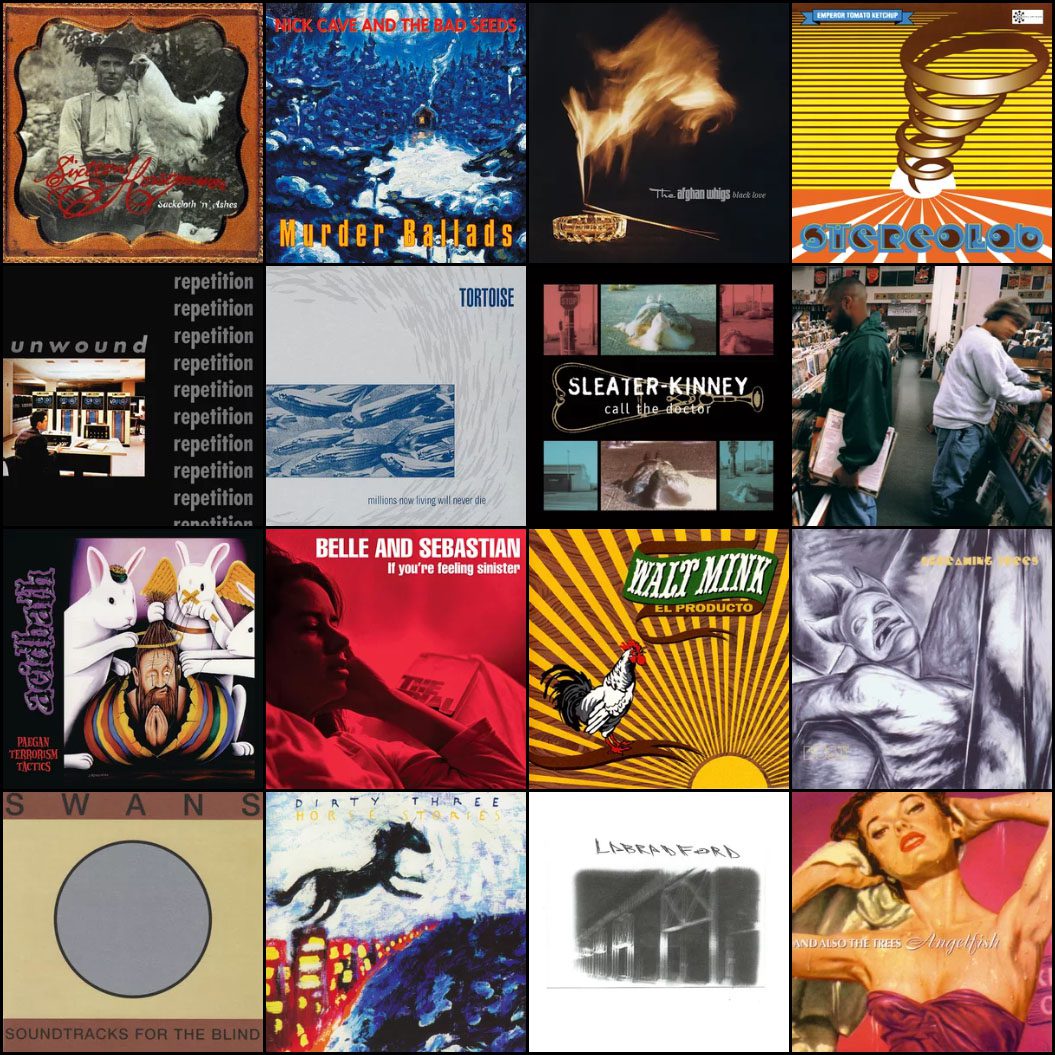
Fester’s Lucky 13: 1996

April 2, 2026
Fester’s Lucky 13: 1986