Several books mourn the deaths of rock stars, classic rock, the music industry and physical formats. But death isn’t always final in the music biz.

I read a lot of nonfiction music books, but not always right as they come out, as I often wait for a sale price because I really hate paying more than $10, let alone $18 on books. I’m talking about digital versions, and see no reason to pay more than what I used to pay for paperbacks — $6 to $8. This year the theme seems to be commemorating a distinct era of rock and pop music that generated the kind of mythical, iconic stars we arguably haven’t seen in the past couple decades, and romanticizing the music business, it’s technology and formats, and mourning their perceived loss of relevance.

Uncommon People: The Rise and Fall of Rock Stars by David Hepworth (2017)
While I was pretty enthusiastic about reading David Hepworth’s previous book, Never a Dull Moment: 1971 The Year That Rock Exploded (2016), I was less than excited to tackle his new one. The worship of icons, the cult of personality, always clashed against the reasons I grew up loving music, which present vast worlds of sound to explore and get lost in. I didn’t much care about the stories of the people who created those worlds, and the mundane details of their earthly existence, even when exaggerated beyond reality on behalf of the biggest stars. Just like how it’s far more rewarding to read The Hobbit than a biography on J.R.R. Tolkien. It’s not that I’m completely uninterested, as I’ve obviously read dozens of memoirs and biographies of musicians. It’s just that it’s the least essential aspect of their work. The first time hearing the songs of Little Richard, Elvis Presley and Buddy Holly, first of the pantheon of rock stars Hepworth covers, were far more rewarding to me than the personas, myths and legends that were created.
Hepworth’s stance is, “If we no longer have any breed who qualify for the description ‘rock star,’ how can it be that the idea of the rock star as a social type remains so strong?” He gives examples of famous people in other professions are described as rock stars as the highest compliment, from politicians and chefs to comedians, tennis players, even fund managers. For the purposes of his book, Kurt Cobain is the last ever rock star. In some respects, he’s right, and it kind of blows my mind, as he’s the one person in the book who I met, had a conversation with and shook hands with before he was a star. He had no indications of becoming a star, playing unpopular sludgy rock influenced mainly by the Melvins at that point. He had obvious talent as a singer and songwriter, but so did many others of his generation. Just one of thousands of musicians playing dives, struggling to make enough money for gas to the next gig, and dreaming of bigger things. Hepworth avoids the argument that many would make, just as the Rock & Roll Hall of Fame has never stuck to a classic definition of rock, there are still stars today, but mostly in the areas of hip hop, R&B, dance pop and singer-songwriters. But that’s someone else’s book to write.
Despite my reservations about the whole concept, I found Hepworth’s book enjoyable on the strength of his skill as a storyteller. He goes year by year between 1955 and 1995, telling a concise story about each star. The early entries are often about formative events that marked their transition from mere musician to icon, while the later ones often take place during the decline or death of the musicians. The usual suspects are covered — Jerry Lee Lewis, Dylan, Beatles, Brian Wilson, Stones, Who, Hendrix, Joplin, Morrison, Bowie, Elton, Marley, Springsteen, Queen, Michael Jackson, Prince, Madonna, U2, Axl Rose. Some of these he felt obliged to cover twice, such as Elvis’ death in 1977, when he was transformed from an embarrassing has-been to a deity. Similarly with John Lennon’s tragic murder, and Bowie’s death in 2016, where he wrote, “The widespread sense of bereavement many felt when David Bowie died in 2016 was puzzling in the sense that many of the people who missed him so badly had been quite content to miss much of the music he had made for the last twenty years of his life.” Another point for my argument that these often fictionalized rock stars have very little to do with the actual content of their music. I agree with Hepworth in that the most appealing aspect of Elton John is that he remains an avid and obsessive record collector. Which has nothing at all to do with his status as a rock star.
He also has a few surprises up his sleeve, like his argument for Brian Rankin as the first guitar hero. Many Yanks who aren’t super music nerds will have no idea who that is. He was the guitarist for the Shadows, and was indeed a huge influence on everybody in the early 60s. He also covers Black Sabbath, Lou Reed and Ian Dury, which I did not expect any more than Iggy Pop, Lemmy Kilmister or Ronnie James Dio (who were not included here, though Iggy is always mentioned in Bowie’s stories of course).
So why are there no longer rock stars? Hepworth quickly gets the question out of the way in the beginning of the book, “The age of the rock star ended with the passing of physical product, the rise of automated percussion, the domination of the committee approach to hit making, the widespread adoption of choreography, and above all the mystique-destroying rise of the Internet.” Also, the “rock era is over. We now live in a hip-hop world.” He also said the rock and roll proved to be “as finite as the era or ragtime or big bands.” On this point he’s definitely wrong. Consider if the rock era peaked in the 1970s. It’s nearly half a century later, and there are more rock records being recorded and distributed now more than ever. Not just as homegrown digital streams, but also physical media — records, tapes and CDs that can be ordered online, bought at brick and mortar stores, or at the merch booth when the bands come through town and play more often than not, well packed venues of various sizes. You can’t say the same happened with ragtime and big band jazz. You can say the same, of course, for later forms of jazz, folk, pop rock, R&B, soul and funk. Hip hop itself will soon be 50 years old, and I don’t see any expiration date. Will another subgenre of music become more dominant in the future? No doubt. But so what? Since when does a music have to dominate popular culture to be relevant? Not in the past 50 years for sure. There’s more music, more genres, more artists and more people. Things aren’t as simple as they were, and as far as music goes, that’s fine by me.
Cobain famously quoted Neil Young’s line “it’s better to burn out than to fade away.” It’s a stupid line, as Young himself would likely agree. It was the “story of Johnny Rotten,” but he probably meant Sid Vicious, figuring Rotten rhymed better, in the same song that he said “rock ‘n’ roll will never die.” Rotten happily married an older heiress and has lived in luxury ever since, his privilege allowing him to become yet another piece of shit right wing asshole. Young is happily fading away gradually, like the proud, arrogant, bristly, feisty star that he is. Cobain’s death wasn’t about his loss of passion for music or failure as a rock star. He was just one of many who married the wrong woman, took the wrong drugs, and did all the wrong things in trying to deal with his depression. Hepworth rightly pointed out that one of his early influences and friend, King Buzzo of the Melvins, never became a rock star, never got rich, but continues to release albums and tour, and is completely happy. “I win” he said. Yes you do, Buzzo. And everyone who continues to find their own Melvins among the thousands and thousands of great rock bands out there continue to win.
Rock stars were amusing for a while, but fuck ’em. We never needed them.
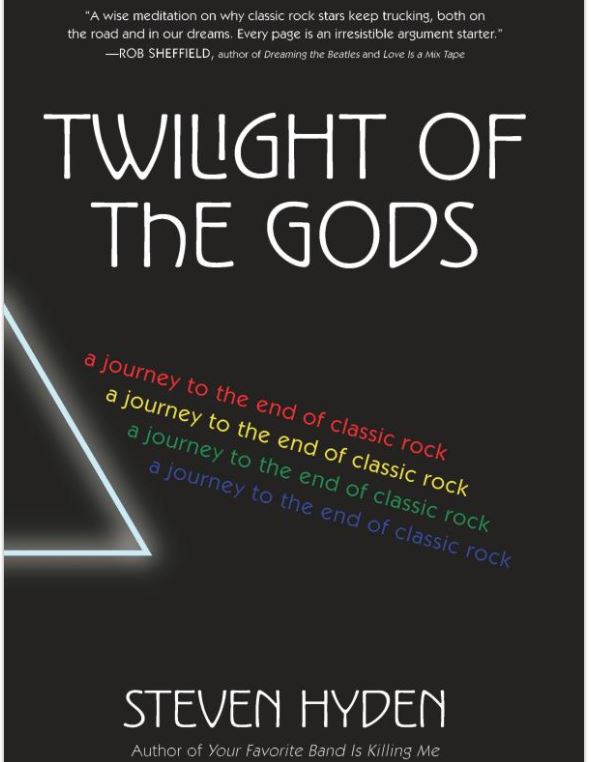
Twilight of the Gods: A Journey to the End of Classic Rock by Steven Hyden (2018)
Like David Hepworth’s book, I dragged my feet to read yet another obituary about the perceived glories of rock stars and classic rock. But his next book, This Isn’t Happening: Radiohead’s “Kid A” and the Beginning of the 21st Century (2020) showed Hyden is a good writer, and this should at least be a good read.
At least 25 years younger than Hepworth, Hyden offers the perspective from a younger generation. He discovered classic rock on the radio as a kid in the 1980s, just as it had become a popular radio format fueled by ageing and prosperous baby boomers. The theme of this book is the cultural impact of classic rock bands, as opposed to post-classic-rock bands like the White Stripes, the Killers, Arcade Fire, the National, and the War on Drugs, who don’t have the cultural impact of classic-rock bands, and never will. His book starts with the (fucking) Eagles, who, like any sane person, Hyden has many reservations about, and ends with Pearl Jam, who he clearly loves, as he just published Long Road: Pearl Jam and the Soundtrack of a Generation on Sep 27. I’ll probably read it in 2024 when it goes on sale for $1.99. Not to say it’ll be a bad book, just that most rock bios are available more cheaply eventually. Also I don’t love Pearl Jam.
Hyden meanders a lot, but there’s enough amusing lines to inspire a smirk now and then and keep me engaged as he goes from fudged album sales stats to Def Leppard, Styx’s (who he considered the “underclass” of classic rock that also includes Journey, REO Speedwagon, Kansas, Chicago, Boston, and Supertramp) Kilroy Was Here as “the closest rural America ever got to a Kraftwerk record,” the incomprehensibility of Greil Marcus’ book Mystery Train, and this amusing long-forgotten nugget:
“It’s one thing to admire the eccentricities of an outsider classic like Trout Mask Replica. It’s another to show your appreciation for the twisted genius of Captain Beefheart by giving him a hand job. Des Barres truly went the extra mile.”
The chapter about how Tom Petty picked up the slack when Bruce Springsteen had retreated to less bombastic music in the 90s and temporarily lost his rock star credentials was kind of fun. “In the hierarchy of eighties heartland rock, Bruce Springsteen was president, Tom Petty was vice president, John Mellencamp was speaker of the house, Bob Seger was president pro tempore, and Bryan Adams was (I guess?) secretary of leather jackets. If Bruce ever faltered, Tom was constitutionally required to step up.”
For some reason he ends up discussing the failed HBO TV show Vinyl, executive produced by Martin Scorsese and Mick Jagger. It was critically bludgeoned, and was fairly ridiculous, but that’s TV for ya. I enjoyed it, personally, and I think no worse than the overblown gangster theatrics of American Soul, about the rise of 70s dance show Soul Train. Not sure what all this has to do with classic rock, but it seemed to make sense at the time I was reading it.
One of the byproducts of the death of classic rock was what Hyden calls “metal shrunkgroups,” the first of which was the Hollywood Vampires, formed in 2012 by Alice Cooper, Johnny Depp, and Joe Perry, who “acknowledged rock’s decay and celebrated its ongoing decomposition. They were like a walking EKG measuring rock’s flatline.” Funny stuff, if completely irrelevant to my own reality.
Near the end, Hyden focuses on “dad rock,” totally square bands in the tradition of Steely Dan along the lines of Wilco. Again, this is neither here nor there in terms of the story of classic rock as far as I’m concerned, but as usual, I really couldn’t give a shit about the death or existence of classic rock.
Think of this book as a humorous think piece gone off the rails, and enjoy it for what it is, if you care to.
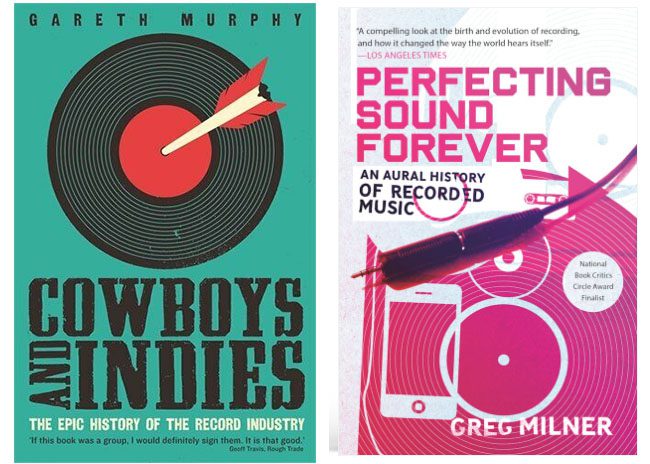
Cowboys and Indies: The Epic History of the Record Industry by Gareth Murphy (2014)
I must be a glutton for punishment, as I have no love for the record industry, and little nostalgia for outdated formats (though as I documented recently, I have bought some records mainly as wall art). Yet I’m compelled to absorb everything related to music, and these fit the bill, even if music often had to struggle to survive despite these industries.
Murphy starts his book with a pretty significant story, about the long forgotten first crash of the record business in the 1920s which extended into the 30s, which “began with the arrival of radio, culminated in a near-death experience in which the forty-year-old phonograph industry shrank to just 5 percent of its former size.” Just goes to show you that events that seem apocalyptic (the fall of physical media in our time) can become a long-forgotten blip in the radar in retrospect.
He dabbles in the battles in the marketplace between competing media formats, also long forgotten, that are interesting, but are more fleshed out in Greg Milner’s book. He touched on the practice of hiring opera singers to learn to sing in a way that replicates the sound of the recordings in demonstrations throughout the U.S., a neat trick to convince people that they couldn’t tell the difference between recordings and live performances. Thus began the long tradition of the music business being run by liars, con men, gangsters and psychopaths.
Another interesting early event was “In January 1922, the American government banned radio amateurs from broadcasting “entertainment,” an ambiguous term amended in September to “mechanically operated instruments”: in other words, teenagers broadcasting records.” There’s an interesting parallel here with the panicky campaigns “Home taping is killing music” in the 1980s, and filesharing, activities also dominated by teenagers with limited incomes.
The usual stories that I already knew were accounted for — the rise of Mamie Smith, the Okeh and Columbia labels, Bessie Smith, Jimmie Rodgers, the Carter Family, Charlie Patton, Louis Armstrong, Duke Ellington, Count Basie, Billie Holiday. Here’s a fun nugget from the jazz age:
“For being drunk, the jazz generation invented a new lexicon: blotto, fried, hoary eyed, splifficated, ossified, zozzled. Nasty bootleg booze was coffin varnish; to “pull a Danny Boon” meant to vomit, hangover sensations were referred to as the heebie jeebies or the screaming meemies. A vamp was a seducer; a lollygagger was a loose woman; a cake eater was a playboy; a face stretcher was an older woman trying to look young. Engagement rings were handcuffs or manacles.”
The popularity of juke boxes frightened musicians who feared their bread-and-butter, income from live performances, would go away. So “in 1942, a union representing session musicians, the American Federation of Musicians, led by James Petrillo, unleashed a second strike against record companies, which at the time were synonymous with radio corporations like RCA and CBS. By a unanimous vote at its annual convention, musicians agreed to shut down recording studios until record companies agreed to pay royalties into a union trust fund for out-of-work musicians.” Hindsight showed that was a bad idea, and we end up with a half a decade long black hole in the history of music, which was also of course partially due to shellac diverted to war manufacturing, and musicians shipped off to fight and die in World War II. Big bands were pared down to small, agile ensembles, resulting in the rise of bebop jazz, while crooners Nat King Cole and Sinatra ruled the charts.
After the war, record sales swelled from 275 million in 1946 to 400 million in 1947. In April 1948, Ted Wallerstein’s long-awaited secret project was prepared for launch—the 33-1/3 rpm 12-inch long player. What few people remember was that there was initially a big format war between that and RCA Victor’s retaliation in February 1949 with its 45 rpm 7-inch—allowing up to eight minutes of audio space. In hindsight it seemed obvious the purpose of singles vs. LPs, peacefully co-existing. But keep in mind, at the time not everyone, beyond classical lovers, saw the point of 3/4 an hour worth of music from a single artist. Jazz albums made use of the format pretty quickly, but it would take more than a decade for rock ‘n’ roll and pop to truly adopt and adapt to the album artform, and not long after, Dylan introducing the double album with Blonde On Blonde (1966).
In between interesting musical nuggets are long, drawn out dramas between sociopathic record executives — an endless parade shitbags like Yetnikoff and Mottola who’s greed and ruthlessness did more damage than good to music. Not all of them were, of course. My last note highlighted from the book is 4AD founder Ivo Watts-Russell retired to a hideaway in the New Mexico wilderness, taking dogs for runs from his local animal shelter. As good as place as any to end the history of the music biz.
Perfecting Sound Forever: An Aural History of Recorded Music by Greg Milner (2009)
Greg Milner really gets into the details, which would almost read like an academic history book if it weren’t for the occasional stories of sordid drama, and an ending that makes me lose all confidence in his analytical abilities. The book kicks off with the same vocal tricks used to market phonographs that Murphy mentioned in passing in his book. Thomas Edison was still around, and behind those efforts. Based on Edison’s work, “From now on, recordings would not sound like the world; the world would sound like recordings.”
His description of the 1915 Panama-Pacific Expo makes me want to dig more into it to see if there are many pictures:
“The Panama-Pacific Expo took over San Francisco for ten months in 1915, and then simply vanished. Every structure was razed, except for the Palace of Fine Arts and its weird staircases to nowhere. The demolition was the expo’s final symbolic act, the planners’ ultimate demonstration that the fair was barely corporeal, more like the hallucinatory product of a collective dream. (William Saroyan, who visited the fair as a child, remembered it as “a place that could not possibly be real.”)”
“Edison looked like he was enjoying himself for the first time in days. All the paeans to progress that surrounded him, all the Novagems and the lights that made them shine, and all Thomas Alva Edison wanted to do was listen to a record.”
Conductor Leopold Stokowski and the Philadelphia Orchestra did some of the earliest electronic recordings of symphonies starting in 1917. He later did recording experiments with Bell Laboratories in the 30s and did the Disney Fantasia soundtrack. “The music was recorded onto film with a setup that was basically an extreme version of Bell’s three-channel stereophonic method, which Stokowski dubbed ‘Fantasound…’ He would not understand that once you reached a certain saturation of loudness everything else had to be softer as a result. There were certain things he wasn’t willing to conceptualize.” When Stokowski was shown how the needles were pinned in the red, he’d just say, ‘It doesn’t matter, this is art.'”
One of the longest and bittersweet stories is the relationship between Alan Lomax and Lead Belly. Their recordings changed the world, but what Lomax told himself was a friendship was tainted by the unbalanced power dynamic in the racist times they lived, and Lead Belly was scammed, just as pretty much 100% of Black recording artists.
Another remarkable account was a breakthrough that went unnoticed during World War II. “Naval research focused on recording data rather than on sound, the researchers never bothered to hook up a telephone to the telegraphone. Had they done so, the combination of the amazing fidelity and then-available electrical amplification would have made magnetic recording the far superior method of making commercial recordings, and the history of recording would have accelerated by about two decades.” Not to mention it might have helped with the war. The technology was figured out with help from someone at the Armour Institute of Technology (now known as the Illinois Institute of Technology), and Bell engineer Clarence Hickman.
“Sinclair Lewis had said that when fascism arrived in America it would be wrapped in the flag and carrying a cross.”
Like Murphy, Milner also touches on the format war between 45 RPM 7″ records and 33 RPM 12″. The Battle of Speeds was a tussle just as significant as the battle between the cylinder and the flat disc. One where Murphy claims the 45s had more “presence.” It’s unclear if that’s measured in dynamic range, levels of distortion, compromise in bass, but it’s a term used by the new breed of audiophiles who emerged in the early 1950s. One of the early ambassadors of stereo sound was a former bandleader of the 1930s big band era Light Brigade, Enoch Light. In 1959, Light spent an unusual amount of money and time to record Persuasive Percussion, which throws extreme stereo separation into the listener’s faces.
Phil Spector and his British counterpart Joe Meek also pushed recording techniques forward, with Meek’s 1962 production of “Telstar” his most recognizable hit in the U.S. “He was fascinated by outer space and recorded a concept album called I Hear a New World. Like Spector, the world he heard had no basis in reality. He became famous for using the studio to build that sound from the ground up. In particular, he was a pioneer in the use of dynamic-range compression, traditionally utilized in recording to dampen unwanted peaks in the sound. Meek realized that by applying egregious amounts of compression, he could create effects that seemed like they were jumping out of the speakers.”
Honestly you really need to be an enthusiast/geek to be able to tolerate some of the level of detail here regarding the evolution of technology, recording techniques, recording studios like The Power Station, the popularity of gated reverb on drum sounds in the 1980s and its backlash, the loudness wars and the analog vs. digital debate.
The loudness wars of the 1990s have been well documented, the familiar “bricked out” waveform images to show the extreme clipping that went on, which reduced the dynamic range. It’s no wonder that I rarely go back to albums from the 90s, other than some indie rock and post-rock that avoided that whole nonsense. Surprisingly, the author calls out relatively obscure Boston post-punk band Mission Of Burma pioneering a particularly powerful sound with their recordings. The author also references The Feelies and Shellac as big influences on his own musical journey, and quotes Steve Albini often.
The vignettes on the pioneering productions of Lee “Scratch” Perry and the influential drum sounds of Bob Clearmountain, the advanced surround system of the Museum of Tolerance in Los Angeles and the groundbreaking work of Disney Imagineering are all interesting nuggets worth noting. I love the idea of sound design for a haunted house helping push sound reproduction technology forward.
“The room at Disney was being used to design sounds for a haunted-house attraction at Disney World. Tanja Linssen, Iosono’s director of product development, made the room fill with what sounded like disembodied figures hyperventilating. It was a truly spooky, unsettling sound. Then she directed me toward an X marked on the floor, and now the voices were right on top of me, and then inside my head as though I were wearing headphones… ‘Your brain goes ape-shit,’ Linssen said. “It’s trying to figure out what’s going on.'”
The biggest disappointments stack up near the end, starting with Milner’s clear bias and nostalgia for the sound of vinyl. Despite mountains of evidence showing there is nothing wrong with digital recordings when done well, some of which he touches on, instead he dicks around with the whackadoo crackpot theories of John Diamond that digital music is ruining our brains and even making us sick. He based his research on applied kinesiology, a load of b.s. made up by a chiropractor in the 1960s. All of which has been easily disproved by double blind listening tests.
Perversely, he ends the book with the suggestion that the peak of audio reproduction was Edison’s wax cylinder technology from 1889. For years I joked about people’s vinyl fetishism, with the next step being the revival of the wax cylinder. And here we have Peter Dilg, a collector and dealer of vintage phonograph equipment, who has a side gig of making acoustic recordings on wax cylinders, with an updated formula of a metallic soap-like resin replacing the old wax.
What started out as a seemingly well-researched book devolved into off the rails luddite rambling. Since the dust hasn’t yet settled on the growing pains of evolving music technology, a definitive history has yet to be written. With the proliferation of truthers and science/climate-change deniers, frankly we have more pressing problems.

Razzmatazz: A Novel by Christopher Moore (2022)
By far the most enjoyable fiction I’ve read this year so far, Razzmatazz is the follow-up to Noir (2018), a hilarious mystery satire set in 1940s San Francisco, like Bugs Bunny meets Men in Black. Bartender and amateur sleuth Sammy “Two Toes” Tiffin, his girlfriend Stilton (a.k.a. the Cheese) and their mates from Cookie’s Coffee return from the first book for new adventures. Everyone is broke and working on their own hustles: trying to open a driving school with a borrowed car; the Cheese and her friend using their wartime shipbuilding experience on a secret project that even they don’t understand, but have perked the interest of Men in Black; Eddie “Moo Shoes” Shu helping save his Uncle Ho’s opium den from the rival Squid Kid gangsters, who are determined to get back an ancient statue of the mysterious Rain Dragon that Ho stole four decades earlier.
The book features many flashbacks to that time in Uncle Ho’s past, his emigration from China to the U.S., struggling to find work in the events following the 1906 earthquake and fire, when the racist city government relocated the displaced population of Chinatown in a refugee camp in the Presidio, while attempting to move Chinatown to Hunters Point. This is all real history, and the government of China eventually intervened by rebuilding its consulate in the heart of old Chinatown. Meanwhile, the immigrants are doing the backbreaking work of rebuilding after the fire, brothels popping up in the areas that were all men. Ho rescues a prostitute who was being brutalized by johns, and sneaks her out of the city, all the while being guided by the dragon who talks to him.
Understandably, it’s a lot more sober at times than the more giddy predecessor, but still had it’s share of laughs. I’m absolutely dying for a third installment to my favorite two books, The Reaper series, but this is nearly as satisfying. Earlier in the year Moore replied to me in a Twitter post that he has done any work on a Reaper follow-up, and is working on an entirely new story. Whatever it is, I look forward to it.
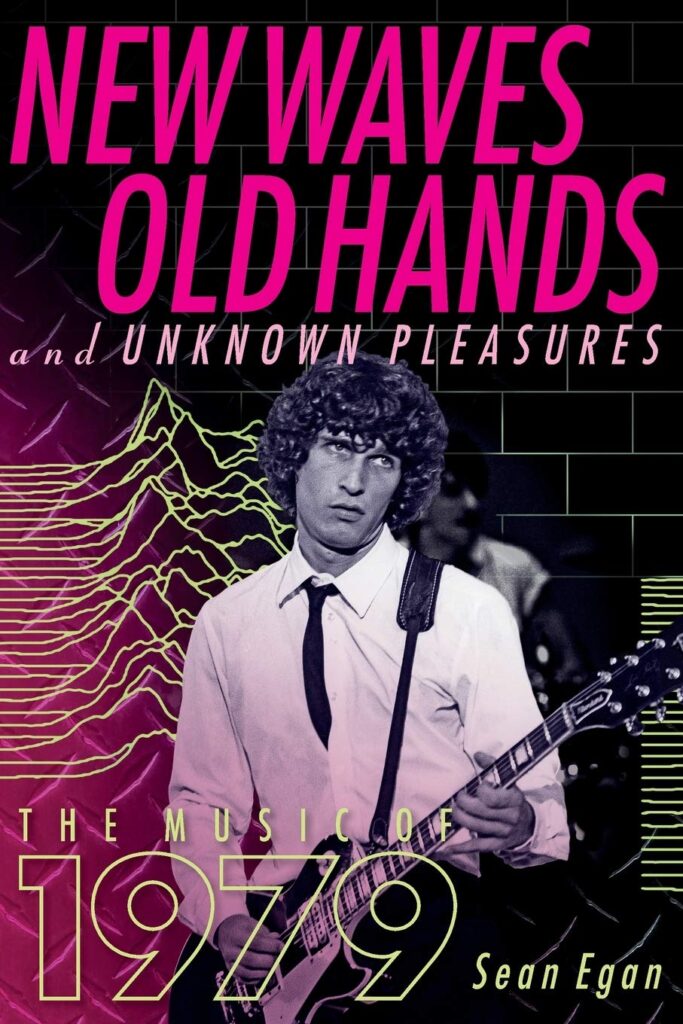
New Waves, Old Hands and Unknown Pleasures by Sean Egan (2019)
What happens when a strictly classic rock boomer (Sean Egan has written books about Hendrix, Beatles, Stones and Clash) writes a book about 1979, a year completely dominated by new wave and post-punk? You get a very strange book full of savage beatings and withering dismissals, fleeting moments of grudging respect, rare expressions of real enthusiasm, no joy and zero fucks. But even though Egan is wrong about 85% of the time, he’s still a good writer, and I’ll reading fucking anything about one of my favorite years in music.
Egan doesn’t go as far as to say Bob Dylan’s Slow Train Coming, Fleetwood Mac’s Tusk or Eagles’ The Long Run are the cream of the crop, but he certainly spent a lot of pages on Led Zeppelin’s weakest album. It’s hard to know which albums he truly loved, as he was pretty stingy with praise beyond London Calling, Dave Edmunds’ Repeat When Necessary and Nick Lowe’s Labour Of Lust. He doesn’t appear to hate the Skids, Graham Parker, ABBA, Ian Dury, Joy Division, Public Image Ltd., The Police, Blondie, Buzzcocks and The Jam with the same disdain he had for Talking Heads (“quirkiness little compensation for lack of a heart”), The Slits (“tinny, trebly, hesitant…slight”), XTC (“designedly thumping and unashamed of obvious artifice”), Wire (“the culmination of that depressing process of turning away from their own talents”), The Damned (“not a great album”), Magazine (“glum–a rather static affair”), Gary Numan (“relentlessly bleak and often repetitive”) and Gang Of Four. Basically many of the greatest albums of 1979. David Bowie’s Lodger was “irksomely difficult,” and Egan preferred another Visconti production, the Radiators’ Ghostown. That prompted me to revisit it, and it could indeed be better than that particular Bowie album. The Raincoats, The Ruts, Young Marble Giants, Marianne Faithfull, and Contortions got no mention at all, along with any reggae, or interesting outliers like Chrome, Heldon, or Doll By Doll.
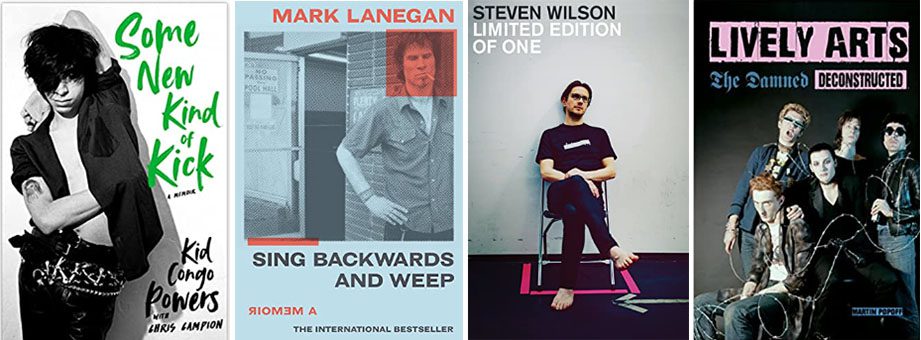
Some New Kind of Kick: A Memoir by Kid Congo Powers and Chris Campion (2022)
Like many memoirs by non-writers, even with the assistance of Chris Campion, Some New Kind of Kick keeps it simple to a fault. The meat of the book is in the first half, about growing up in L.A. which is fairly intimate and personal. He was an early participant in Rodney Bingenheimer’s English Disco and slowly overcame his shyness and became a part of the scene, especially when he discovered the Ramones and created the California chapter of their fan club. He and Campion ably recreated the first time thrills of his first visits to CBGBs near the end of it’s peak, and London in August 1977 during the Queen’s Silver Jubilee. Back in Los Angeles he was in the mix of the quickly growing punk scene, working at a record store, going to shows like the Screamers, the Germs, the Bags, visiting his first junkie punk rock boyfriend and seeing the final Sex Pistols show at Winterland, and then forming a band with Jeffrey Lee Pierce minutes after meeting him, his only experience on a borrowed guitar being a sixty second lesson from Lydia Lunch while in New York. This perspective from a wide-eyed teenager is totally fresh in contrast to the jaded, depraved oral histories of the likes of Legs McNeil and other older journalists. Regardless of how the rest of the book goes, it’s a must have for any fans of the history of punk.
Not long after co-founding The Gun Club, he was poached by The Cramps, and suddenly events fly by way too quickly. As a gay punk rocker, he had to have way more interesting adventures than what he shares here. At that point, everything is rattled off matter of fact without giving you the sense of what it was really like to be there. All the drugs and alcohol probably blunted his memories, but at least he didn’t make it all about the drugs. What a career though, with not one, but three iconic bands, including his stint in The Bad Seeds. Still, a missed opportunity to share more entertaining antics from Poison Ivy and Lux Interior, as his time with them couldn’t possibly have peaked with them taking Siouxsie Sioux to Disneyland.
To his credit, Kid Congo does give an honest account of his bouts of addiction and other self-destructive behavior as he bounced between recording and tours with the Bad Seeds in Germany and Brazil, and the Gun Club in Australia and back in the U.S., as well as his initial cracks at leading his own bands (Fur Bible, Congo Norvell and a 1989 solo EP, In The Heat of the Night). The book ends as it began, Kid shaken by the death of a loved one — his cousin Theresa who was murdered when he was young, and his longtime friend and bandmate Jeffrey Lee Pierce.
Fortunately, Kid Congo’s story ends happily, as he’s remained sober since 1997 and has released a half dozen records with his bouyant garage rock band, The Pink Monkeybirds.
Sing Backwards and Weep: A Memoir by Mark Lanegan (2020)
I really hate memoirs that are little more than addiction stories, but I also wanted to know what was rattling around Mark Lanegan’s head throughout his career with Screaming Trees and solo. I bit the bullet and plowed through one of the most harrowing accounts of depravity and addiction I’d ever read. Depressing. Turns out he had an unrequited crush on my old friend Kristen Pfaff, which I didn’t know, though many people had crushes on her. I thought his friendship with The Gun Club’s Jeffrey Lee Pierce would have been more interesting than it was. The problem is that any shared passion for music and genuine affection for each other was tainted by their horrendous drug addictions, which results in selfish, manipulative and sociopathic behavior. And so the story goes, over and over and over. His new friendship with a young Josh Homme who was touring with the Screaming Trees in the late 90s saw Lanegan dragging the hapless Homme into some extremely dangerous situations. It’s dark, but also kind of funny. Apparently all was forgiven, as Homme invited him to be part of his quickly ascendant Queens of the Stone Age. It’s sad that we lost Lanegan so relatively young, but having read his book, it’s shocking that he lived as long as he did.
Lively Arts: The Damned Deconstructed by Martin Popoff (2022)
Martin Popoff is best known for his heavy metal record guides that span from the 1970s through the 00s. If that wasn’t a massive enough undertaking itself, he’s published dozens of rock biographies and coffee table style books. His specialty has been hard rock and heavy metal, but one of his favorite bands is The Damned. Whether you are just now realizing there’s more to them than their debut album and Machine Gun Etiquette (1979), or you’re a lifer, his passion for the band is infectious, as he covers every album, song by song. He defends the much maligned Music For Pleasure (1977), released just nine months after Damned Damned Damned, and their later work. I used to play everything through The Black Album (1980) on my punk show, and only later grew to love Strawberries (1982) and Phantasmagoria (1985). I’m still easing into their more recent work, but it’s nice to have Popoff to guide me. I’ve been following his Friday Morning at the Funhouse YouTube guest appearance on Sea of Tranquility for over a year, his voice, written and spoken, is like an old friend. One who I sometimes want to argue with, such as in the preface when he states that he no longer follows new bands, since all his old favorites are still putting out more than enough music to follow. I can’t imagine. It would be like one day deciding I’m never trying any new foods, no new TV series other than reruns, and no new books from authors born after 1980. His stance with music isn’t rare, but he’s healthy, fit and a couple more years shy of 60, so if he wants to keep writing about music, he might need to adjust his policy, as everyone else will be dead.
Limited Edition of One by Steven Wilson (2022)
The memoir of “the most successful British artist you never heard of” is promoted with the hyperbolic pitch that it’s “unlike any other music book you will ever have read.” That’s simply not true at all. It’s just a bunch of humble brags cluttered by ramblings about shit he likes. Despite Steven Wilson not crossing over to mainstream popularity and exposure, it seems that a little bit of fan adoration has gone to his head. His attempts at fake modesty are laughable as he continually congratulates himself for his cleverness and ingenuity. I like a few Porcupine Tree albums, and some but not most of his solo work, but damn, this book started to make me despise the dude to the point where I had to stop reading about halfway through. There should be a warning sticker — “This book may ruin Porcupine Tree for you forever.”
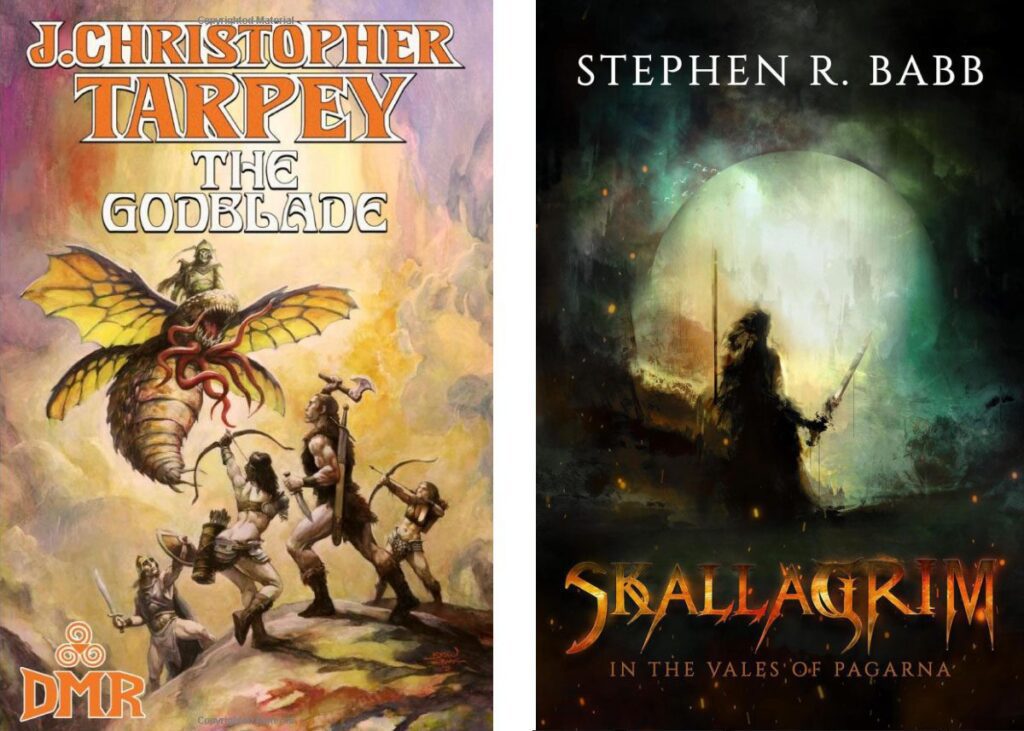
The Godblade by J. Christopher Tarpey (2020)
Skallagrim – In the Vales Of Pagarna (Book 1) by Stephen R. Babb (2022)
While I grew up on sci fi and fantasy, I was never big into epic sword & sorcery style fantasy — the last one I read was probably a Conan the Barbarian book when I was 13. I got these because I’m a fan of the bands of both of these authors. J. Christopher Tarpey’s highlight on his resume, along with his day job as a real life blacksmith in a small town outside of Austin, is the leader of epic metal band Eternal Champion. Recent songs “I Am the Hammer,” “Ravening Iron,” and “Banners of Arhai” are based on the book. Stephen R. Babb has been the principle songwriter for Glass Hammer for 20 years, which usually focused on symphonic prog, until recently, when the Skallagrim trilogy took in elements of epic power and doom metal. For two different bands, the similarities between the books are notable, both featuring epic quests, demons, wizards, and a ton of sword fighting. The main differences are that The Godblade has a bit more horror and explicit violence, such as the eyeless hornets of Othra, who shoot a squirming slug into victims which works it’s way up to the brain and turns them into an undead zombie rider that provides the eyesight. Here’s a bit taken from one of a dozen battles — “He cut the axe-wielder’s skullcap off cleanly. The brain was released into the air to hang outside the skull, tethered by nerves.”
In contrast, Babb’s hero Skallagrim has a distaste for violence and only uses it when forced to (which is most of the time), and is driven not by bloodlust and revenge, but by love. At least he thinks so, as he was enchanted so he can’t even remember the name of his dream girl with blue eyes. But he knows she’s important and piles up a body count in his quest to find her. This is quite different than The Godblade’s hero Rænon, where romance couldn’t be further from his mind, though he does enjoy a threesome with his two busty, hired-hand mercenary archers Tafala and Kiv. No sordid details are shared, but boobs of various characters are described with enthusiasm throughout the book, in keeping with the tradition of ye olde classic epic fantasies going back to Robert E. Howard. While they won’t be winning any Nebulas, the writing is solid and should be satisfying for both fans of the genre and the bands. Fair warning, despite being 392 pages, In the Vales Of Pagarna does not achieve a resolution to the story arc, as it’s book one of three, so be prepared for the commitment!
More
- Bunnyman: A Memoir by Will Sergeant (2022)
Corporate Rock Sucks: The Rise and Fall of SST Records by Jim Ruland (2022) - Mutations: The Many Strange Faces of Hardcore Punk by Sam McPheeters (2020)
- The Vinyl Detective Mysteries – Written in Dead Wax: A Vinyl Detective Mystery by Andrew Cartmel (2016)
- The Stranger Times by C.K. McDonnell (2021)
- Bad Monkeys: A Novel by Matt Ruff (2009)
- New York Rock: From the Rise of The Velvet Underground to the Fall of CBGB by Steven Blush (2016)
- Nöthin’ But a Good Time: The Uncensored History of the ’80s Hard Rock Explosion by Tom Beaujour, Richard Bienstock (2021)
- A History of Heavy Metal by Andrew O’Neill (2017)
- Limelight: Rush in the ’80s by Martin Popoff (2020)
- Siren Song: My Life in Music by Seymour Stein and Gareth Murphy (2018)
May 31, 2026
Fester’s Lucky 13: 1996
April 2, 2026
Fester’s Lucky 13: 1986