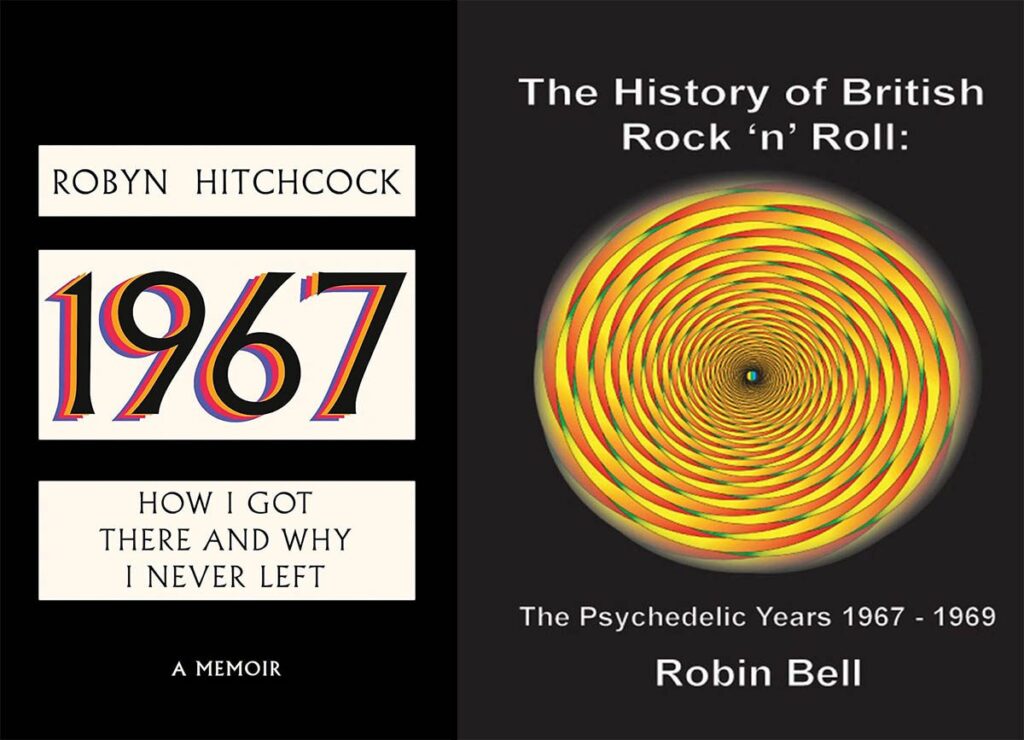
Robyn Hitchcock’s 1967: How I Got There and Why I Never Left presents a memoir spanning just one year, and Robin Bell fills the historical gaps with The History of British Rock ‘n’ Roll: The Psychedelic Years 1967-1969.
Like Michael Chabon’s quote says, it is pretty inspired to restrict an autobiography to a single year. Robyn Hitchcock does cheat a bit and starts it in 1966, but it makes sense that 15 is a pivotal year when you’re discovering music, especially when it’s such an incredibly eventful year.
I have, however, read a ton of bios that talk about the dreariness and drudgery of growing up in English’s school systems, both public and private, and the details don’t really get any more interesting the 30th time around. It did make me laugh that one reason that Hitchcock spent so much time in the music department was that the teacher had great sandwiches. When the school is underfeeding a growing teenager, there’s worse things to do than to learn an instrument in order to get good sandwiches!
Also, while his parents did pay to put him in this private school, like most kids, he didn’t have much spare money for a lot of records, so his beginning collection was extremely sparse, spending at least a quarter of the book talking about Bob Dylan, with a smattering of Hendrix, Pink Floyd and just a few others, and whatever other records his classmates played on the communal player.
While Hitchcock was clearly a Syd Barrett acolyte from the earliest Soft Boys recordings, he was also into Captain Beefheart. It would have been nice to have him talk about some of the other music from that year that he heard later.
The book is too short, and I was slightly disappointed, which lead me to seek out a proper history of UK bands in 1967. I wasn’t sure what I would find, as aside from Rob Young’s Electric Eden: Unearthing Britain’s Visionary Music (2011) and Joe Boyd’s White Bicycles: Making Music in the 1960’s (2008) both of which focus on folk rock, nothing comes to mind from a high profile writer that covers the psychedelic rock scene. But here we have a trilogy (so far) covering British music from 1956 through 1969 by Robin Bell, who previously published books about living in the Australian outback and the Swedish forests. I wasn’t sure what to expect, but it’s well researched and pretty disciplined, resisting for the most part distracting digressions and rabbit holes. By necessity, as how else can you cover three years of British rock history in 491 pages.
For the most part, Bell covers the essential A & B list bands: The Beatles, The Rolling Stones, The Who, Yardbirds, The Kinks, Small Faces, The Pretty Things, The Animals, The Bluesbreakers, Cream, Pink Floyd, Traffic, The Move, The Creation, The Zombies, Procol Harum, Spooky Tooth, The Nice, Donovan, The Hollies, Soft Machine, Fleetwood Mac, The Incredible String Band, Jeff Beck Group, Jethro Tull, King Crimson, Family, Humble Pie, Led Zeppelin.
I say for the most part, because he does inexplicably skip over The Who for the entirety of 1967-68 aside from them blowing The Rolling Stones away in Jagger’s Rock ‘n’ Roll Circus. Jagger was so embarrassed he let it linger unreleased for 30 years. He does eventually get around to talking about The Who’s records for the release of Tommy. Given how much they’ve already been covered, I feel too many pages were dedicated to The Beatles and Stones, particularly the non-music related legal troubles they had. I have to say Detective Sergeant Nobby Pilcher was a right bastard who was a frequent villain in these stories, showing how savagely the “establishment” fought back against the new rock ‘n’ roll/hippie youth culture.
Thankfully, Bell saves space for brief stories about all kinds of artists, from one hit wonders to no-hit underground heroes, including the likes of Kaleidoscope, The Left Banke, The Smoke, The Action, John’s Children, Graham Bond Organisation, Bee Gees, The Artwoods, Tomorrow, The Syn, Dantalian’s Chariot, Skip Bifferty, Marmalade, The Idle Race, Blossom Toes, Rupert’s People, Tintern Abbey, Elmer Gantry’s Velvet Opera, Aynsley Dunbar Retaliation, Picadilly Line, Taste and many more.
Toward the end, for 1969, he gave lengthy accounts of big music festivals, with detailed descriptions of the performances. It’s pretty clear the author attended many of these, and has some nostalgia, but aside from Woodstock, which was immortalized with the live recordings and film, and the tragic event at the Rolling Stones’ Altamont concert, I don’t think they merit so much space in the book that could have given more attention to the bands. For example, I was at 92% before he finally got around to mentioning Free and David Bowie. Bowie had his first big hit with “Space Oddity” in July just before the Apollo 11 moon landing mission took place, but was otherwise relatively unknown. But Free’s first two albums, released when all the members were just 15-18, were just as impressive as Led Zeppelin’s in their own way. And yet once again they’re getting cheated out of attention with just a few paragraphs, less than what Serge Gainsbourg got, who was French, just as they were overlooked in the R&R HOF for Bad Company. Ugh.
I chuckled at how Bell concluded the book by giving a one-page account of the 70s, from glam, heavy metal, punk to new wave, and his final paragraph is this:
Gradually however the raw and harsh sounds of Punk Rock began to be replaced by what has been known as New Wave Rock, epitomised by bands such as Elvis Costello and The Attractions and The Police – but even here there were sub-cultures developing. Less commercial influences began to show up, including electronic music, Ska music and American funk music with bands such as The Smiths, Joy Division, The Cure, Siouxsie and The Banshees and Echo and The Bunnymen coming to the fore towards the end of the decade.
Bell was clear that he felt the 60s was the peak of rock music, which is often the viewpoint of his generation. I personally take most of the 70s, as well as 1980, 81 and even 86 over the 60s. It’s too bad he didn’t take time out from the outback to check out the great Australian music scene and write about that too.
But overall in the end I was left pretty satisfied, despite the fact that each year, 1967, 1968 and 1969 clearly merit entire books dedicated to them at some point. I’d love to see more from these two authors, David Hepworth (Never A Dull Moment: 1971 – The Year That Rock Exploded) and Andrew Grant Jackson (1965: The Most Revolutionary Year in Music, 1973: Rock at the Crossroads).
May 31, 2026
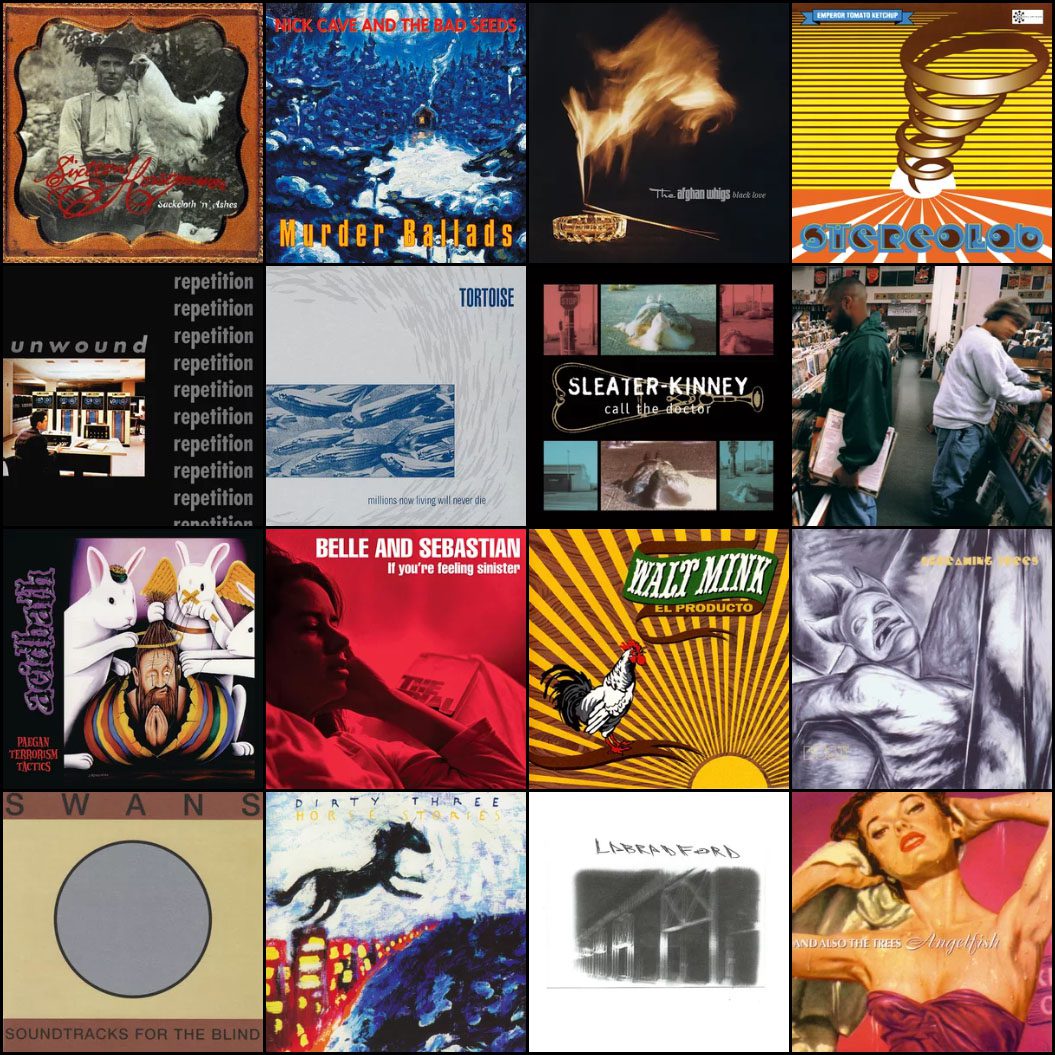
Fester’s Lucky 13: 1996
April 2, 2026
Fester’s Lucky 13: 1986