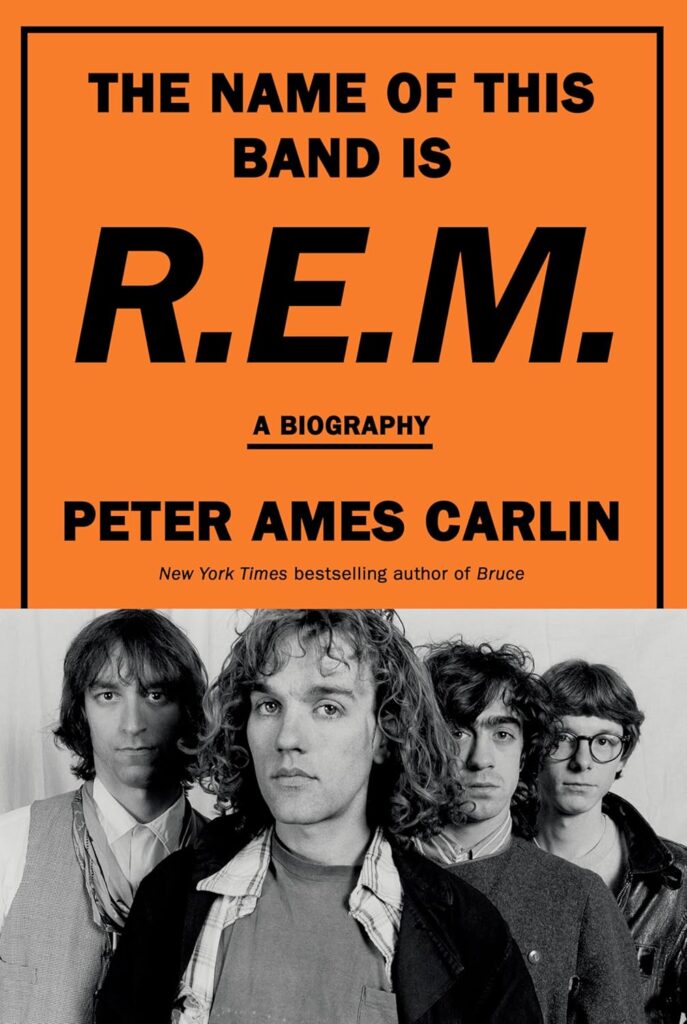
The Name of This Band Is R.E.M.: A Biography by Peter Ames Carlin (Nov 4, 2024)
After reading the Cheap Trick book (more on that later), I looked at the list of books in my Kindle I had to choose from:
Paint My Name in Black and Gold: The Rise of the Sisters of Mercy by Mark Andrews
Twee: The Gentle Revolution in Music, Books, Television, Fashion, and Film by Marc Spitz
Time Has Come Today: Rock and Roll Diaries 1967 – 2007 by Harold Bronson
All These Things That I’ve Done: My Insane, Improbable Rock Life by Matt Pinfield
Eh, I wasn’t too excited about any of them. I keep a wishlist and usually buy them when they go on sale, which doesn’t always correspond with what I’m in the mood for. My oldest friend who shared a lot of experiences with me in R.E.M. fandom growing up recommended the Ames Carlin biography, so I thought, why not, and plonked down the full price $15 for it.
R.E.M. weren’t like most bands. From the very beginning they set out to sound different from any other band, to refuse to do normal videos with lip synching. Michael Stipe was still in art school when they formed, and faculty thought he could have a promising career as a painter/visual artist. But Bill Berry urged the members to drop out of school and commit fully to the band. When they did, Stipe’s artistic vision drove the band, not just as a brilliantly unique lyricist, vocalist and performer, but everything from visuals, business dealings and even their lifestyle.
To some (especially to Miles Copeland and Jay Boberg of I.R.S. Records) it would seem like they were willfully trying to avoid success, but their hard work touring and releasing a steady stream of albums showed that wasn’t the case. They wanted to achieve success on their own terms, which Peter Ames Carlin’s biography demonstrated in every detail. At their commercial peak, there were no stories of drugs and depravity like there are for 99.9% of rock bands that reach such heights. Only Peter Buck spotted walking around in public in his pajamas with a can of beer. Stipe, who in the early days was too shy to participate in interviews, grew into the pop star persona like it was meant to be, not only swanning around with celebrities, but having meaningful friendships with many of them, to the point where the loss of close friend River Phoenix sent him in a tailspin.
Unless Ames Carlin was unwilling to dig for dirt, there was little dirty laundry or scandal, aside from when longtime manager Jackson Holt was accused of sexual harassment of staff. Rather than close ranks around him, they carefully investigated the situation over a couple months, then fired his grabby ass and wiped him from their history. Possibly the first band to demonstrate feminist ethics in practice, and hopefully not the last. A few years before fully publicly coming out as queer, Stipe quipped to one intrusive reporter that he’d fuck anything that moves. “So stay . . . very . . . still.” So sure, there was sex, but it wasn’t what was interesting about the band. Particularly because they did not leave behind scorched earth of cheated lovers and abused groupies. There were no indications that the band did much with drugs, at least nothing hard or crazy. I guess that just leaves rock ‘n’ roll, and that’s just fine indeed.
R.E.M. set out to be one of the best and their essentially accomplished that with their first five albums and an EP. The commercial success they enjoyed after that was a well deserved reward for their hard work and innovative albums leading up to their commercial peak. It’s almost an idyllic fairytale story in a way, one that many bands wish they could have had. My only complaint with the author is that he approached the music more as a fanboy than with real critical analysis. The only album he had anything remotely negative to say about was the very last one, Collapse Into Now. One can be both, as Ian MacDonald was with Revolution in the Head: The Beatles’ Records and the Sixties (1994), where he became increasingly critical of the songs, including Sgt. Peppers. But to be fair not many people have the analytical genius as MacDonald.
Aside from that, it’s an extremely well researched, well written book that I’d recommend to any R.E.M. fan, hardcore or casual. It also inspired me to re-listen to the entire catalog along the way, resulting in this!
Ranking the Albums
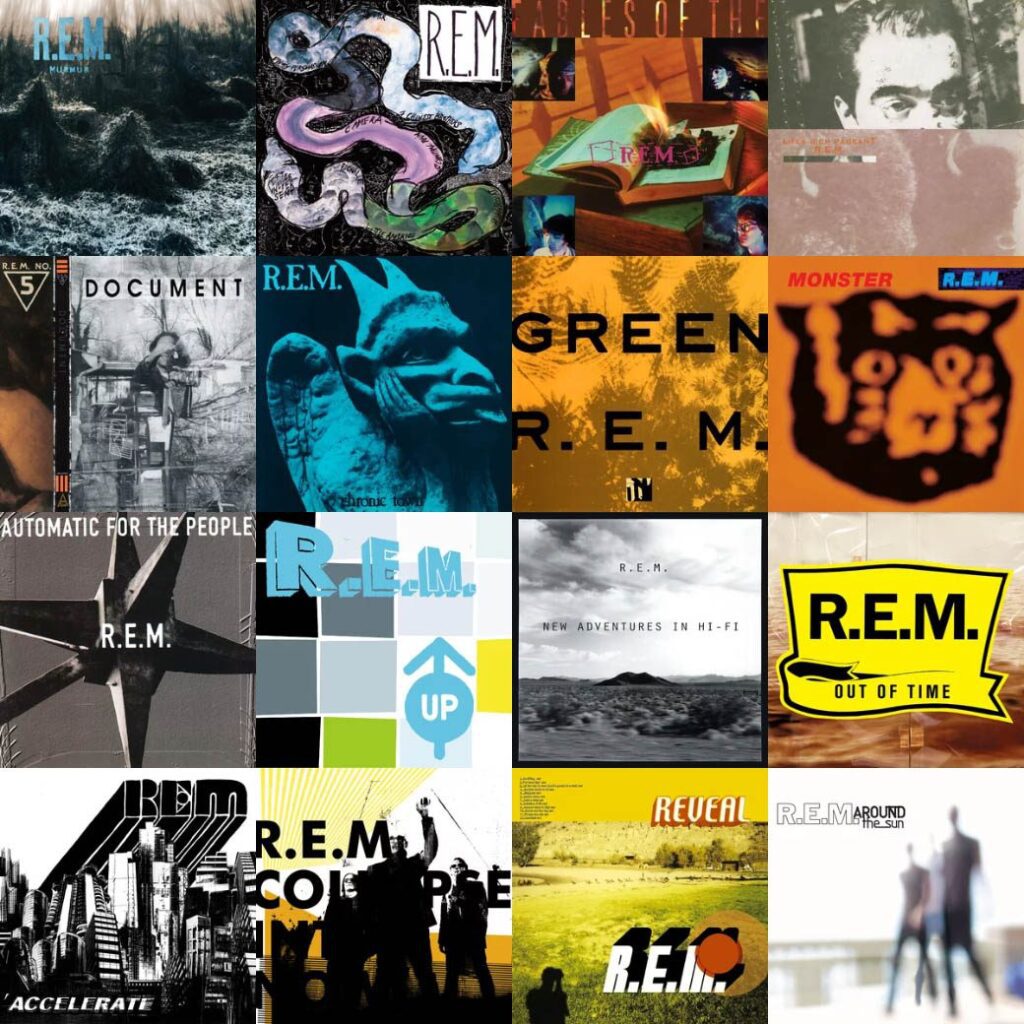
I’m an unapologetic Murmurer, someone who according to Peter Ames Carlin believes R.E.M. never matched their debut album. It’s not that the band didn’t get better in many ways. Their musicianship, Michael Stipe’s singing and lyrics all improved in various ways. But the better the got, the more polished and professional they became, and the more conventional they sounded, particularly at their commercial peak from Green through Automatic for the People.
1. Murmur (I.R.S., 1983)
Like a lot of bands, I heard R.E.M.’s music, starting with the “Radio Free Europe/Sitting Still” single and the Chronic Town EP in 1981-82 before I knew who played these songs on KUNI. KUNI (University of Northern Iowa) was unique for a college station in that they had some professional DJs like Bob Dorr, and had several transmitters, including one near my hometown in Dubuque. I’d discovered the station on my clock radio sometime in early 1981, just spinning the dial, and heard this strange new music that I’d never heard. For much of the first year, it was like listening to a foreign language with no idea what was going on. They tended to play long half hour sets then would rattle off the names of the artists at the end, and it was hard to connect who was who. So it wasn’t until well after Murmur had been released that I could even identify R.E.M., and I didn’t start buying their records until 1985. Murmur remains my favorite, as the murky, mysterious songs, impossible to decipher the lyrics, nevertheless transported me to new and complex emotional territory. It’s never been overplayed on radio or MTV, and when I saw them in 1987, they only played one song in their 25 song set from their debut, “Sitting Still,” which happens to be my #1 favorite song of theirs to this day, so I was fluffed and chuffed. They’re the only band among my favorites who’s albums were weaker than the previous one through their first seven (Automatic for the People broke that pattern, being way better than Out of Time). And yet I always had time for them, up through their final album, Collapse Into Now (2011).
Jangle Pop, Indie Pop, Post-Punk, Folk Rock | RYM #5 | Acclaimed #1
2. Reckoning (I.R.S., 1984)
There’s been many a band that peaked with their first album (Television, Sex Pistols, Gang Of Four) and never recovered. Then there’s R.E.M., the best band to ever decline with each subsequent album, while getting more popular, and still remaining pretty great artistically. They couldn’t possibly repeat the mystique of Murmur (1983), so they just evolved. It’s impossible to think of Reckoning being disappointing with songs as great as opener “Harborcoat,” “So. Central Rain,” “Pretty Persuasion,” “(Don’t Go Back To) Rockville” and “Little America.” My least favorite track, “Camera,” gains poignancy when reading about how it’s a tribute to a photographer friend who tragically died in a car crash. The poetic metaphors, the social anxiety, it’s deep. That’s the worst one? Okay, maybe this should be number one? It’s close, but the overall magical vibe of the debut still wins out.
Jangle Pop, Indie Pop, Post-Punk, Paisley Underground | RYM #22 | Acclaimed #11
3. Fables of the Reconstruction (I.R.S., 1985)
I’d been primed to be an R.E.M. fan over the course of five years. I bought this album the week it came out and I was not disappointed. It was the first R.E.M. album I owned, so it’ll always have a special place. I can see why the normals wouldn’t get it, as it was the band at their most obliquely mysterious. “Feeling Gravity’s Pull” sets the tone with an eerie minor key guitar riff, like the 13th Floor Elevators mixed with The Fairport Convention, a British folk rock group that shared with R.E.M. the producer Joe Boyd. The brilliant “Driver 8” reminded me of my truck drivin’ grandfather. My favorite track has been and always will be “Life and How to Live It,” a perfect example of Michael Stipe’s mumbled vocals making it impossible to parse what he’s singing other than the song title and other random fragments. And yet, the emotion comes through clear as a bell, with Peter Buck’s brilliantly mournful riff. “Can’t Get There From Here” is another genius track that sounds like nothing the band did before or since. Even the band didn’t quite appreciate how great the album was at first, still shuddering from their grim stay in London, commuting hours a day in bad weather and traffic to and from the studio. In the box set reissue, Peter Buck called it a personal favorite — “It’s a doomy, psycho record, dense and atmospheric. It creates its own strange little world, illogical but compelling.”
Jangle Pop, Indie Rock, Folk Rock, Post-Punk | RYM #64 | Acclaimed #18
4. Lifes Rich Pageant (I.R.S., 1986)
Pretty much the only American indie release that charted in the UK that year, it’s hard to argue that R.E.M. weren’t deserving of it. Their switch from Mitch Easter and Don Dixon production team to Don Gehman was an interesting choice. They clearly must have been seeking out that snap ‘n’ cracklin’ sound found on his most recent production, John Cougar Mellencamp’s Scarecrow (1985). I.R.S. must have been thrilled. As mentioned in the book, the band’s refusal to make more accessible videos caused the label much angst, but they did not interfere with the band’s artistic process. In my mind, R.E.M. was just as big and important in the U.S. as The Smiths were in the UK. In reality, they wouldn’t achieve that status until the 90s. After the eerie atmospherics of Fables of the Reconstruction (1985), many understandably appreciate the crisp, rockier production and Michael Stipe enunciating properly for the first time. I got a bit sick of it at the time, aside from all-time favorites “I Believe,” which coincided with my political activism and even optimism in high school, the crunching intro “Begin the Begin,” “These Days” and the ridiculously lovely “Fall on Me.” But nowadays I’m always happy to hear pretty much any track, as it holds up as a more substantial, satisfying classic than anything released after it.
Jangle Pop, Alternative Rock, Folk Rock | RYM #24 | Acclaimed #9
5. Document (I.R.S., 1987)
The exact same day I started college, Document was released. Despite being their worst album at the time, it was still great. “It’s The End of the World” just seemed epochal. When I heard it, I didn’t feel like anything was over. Rather, it felt like the air, the whole world vibrated with more energy and potential than ever providing the soundtrack for yet another stage of my life. “The One I Love” is Stipe being a cold-ass bitch, and it’s hilarious that the normals took it for a sincere love song. It sounds like nothing else in their catalog and I never tire of it. “Exhuming McCarthy” is my favorite track. It adds some crack and bite to the more utopian political tunes on the last album, and “Finest Worksong” carries on the tradition of a muscular opener, Peter Buck kicking off with a tasty garage psych riff. “Disturbance at the Heron House” is another crisp, melodic tune with a standout jangly riff, while “Welcome to the Occupation” revisits the minor key mystery of Fables. The missteps is the cover of Wire’s “Strange.” Great song by a great band, and it’s different enough, but not as good. While they also included a cover on their previous album, “Superman,” that too honestly felt like filler. They get experimental with an improvised sax solo on “Fireplace” that doesn’t quite ruin the flow, but they aren’t helped by the borderline annoying “Lightnin’ Hopkins” and closers “King of Birds” and “Oddfellows Local 151,” which start to drag. Nevertheless they’re not bad, and can still be rewarding in the right mood.
Alternative Rock, Jangle Pop, Post-Punk | RYM #43 | Acclaimed #6
6. Chronic Town EP (I.R.S., 1982)
This is formative R.E.M., yet also incredibly fully formed in terms of their brilliantly original sound that they had achieved on their first single, “Radio Free Europe/Sitting Still” (1981). “Sitting Still” happens to also be my #1 all-time favorite R.E.M. song, even more so than the wonderfully unique A-side. Why am I talking about these songs when they’re not even on this five song EP? Well, I heard all these songs on college radio before I even knew who R.E.M. was. I’d hear these songs on my clock radio as I struggled to stay awake reading, but nodding off to sleep before I could parse who the band was. R.E.M. literally soundtracked my dreams before I even consciously knew who they were. Shortly after I bought the Fables record, I dubbed a tape from a friend’s older brother who was in college, who started the tape with the single, then the EP, then Murmur and Reckoning. Mind blown. So for me, Chronic Town is seven songs, even though the two songs from the single were both re-recorded for Murmur. Not to mention the fact that “Wolves, Lower,” “Gardening at Night” and “Carnival of Sorts (Boxcars)” are stunningly original tracks that still rate in my top 20 favorite R.E.M. songs.
Jangle Pop, Post-Punk, Paisley Underground, Dance-Punk, Indie Pop | RYM #2
7. Green (WB, 1988)
Their major label debut features two tracks that seem suspiciously compromised, “Get Up” and “Stand.” I can tolerate the former, but not the latter. I always thought the lead track “Pop Song 89” would have been a good first single. “Orange Crush” is one of their hardest rockers so far, and it works, with references to toxic agent orange used in warfare giving it some weight. They also get bucolic, folky and pretty on several tracks, which also works, giving a preview of the band’s soon to be world domination. “You Are the Everything” and “Hairshirt” were favorites from the start, but the best track for me was the closer “Untitled,” which soars. It’s both uplifting and melancholy that earns it a place in my top ten favorite R.E.M. tunes.
Alternative Rock, Jangle Pop, Power Pop, Psychedelic Folk, Psychedelia | RYM #165 | Acclaimed #12
8. Monster (WB, 1994)
I’ve often mentioned how remarkable it was that R.E.M. remained a great band despite the fact that almost every album they released was a slight step down from the previous one. That pattern was disrupted by Automatic For the People (1992), but Monster really disappointed me at the time. I wasn’t the only one, as the used CD bins were overflowing with copies. And yet there’s many who defend it and I’ve gradually come around to appreciating it more all these years later. Initially it sounded to me like they encountered their first round of writer’s block, and Pete Buck saying, FUCK IT and just turning up the tremolo over everything, like a little girl unleashed with a new glitter gun. That’s part of the story indeed – the unexpected death of Michael’s good friend River Phoenix on Halloween 1993 stunned him for months, and he was unable to write. Then another death, Kurt Cobain, when the band was just starting recording sessions the next April, knocked something loose and they wrote the darkly moving tribute “Let Me In.” While there was darkness in other songs, the approach was playful, mixing post-grunge elements with glam, Stipe getting in character and camping things up, publicly self-identifying as queer for the first time. This departure in sound and attitude was jarring for many, but in hindsight, it was exactly who the band were at that moment, and it honestly felt much more honest than “Shiny Happy People,” “Everybody Hurts” and “Man on the Moon,” songs that I rarely can stand to listen to. For the first time since Green, there’s no such song here — even “Crush With Eyeliner” rocks. “Tongue” seemed the least obvious choice as a single, but it too has a charming groove with Stipe’s falsetto. “Strange Currencies” is just a classic, and “What’s the Frequency, Kenneth?,” “Bang and Blame” and “I Don’t Sleep, I Dream” hold up well next to some of their best.
Alt Rock, Psych, Grunge, Power Pop, Glam | RYM #544 | Acclaimed #44
9. Automatic For the People (WB, 1992)
AFTP interrupted their devolution trend, with in a way is their most cohesive album, a study of autumnal melancholy. While many consider it their masterpiece, I still rate it, well, here. I still can’t stand hearing “Everybody Hurts” and “Man on the Moon.” Correct, I don’t like “Everybody Hurts,” but no, I don’t also hate puppies and kittens. As much as I’m glad many people find comfort in it, it’s too obviously on-the-nose to appeal to me. The latter, like “Losing My Religion,” isn’t completely shit, until radio pounds it relentlessly into your brain dozens of times a day. You’d think I’d love the dirgey “Drive” but I don’t. My favorite tracks are “Nightswimming,” which definitely evokes a particular moment in life, “Try Not to Breathe” and “Sweetness Follows.” The rest are good, but the fussy chamber arrangements don’t automatically elevate the music above their earlier work. I would contend that the critics who say it does, don’t really like R.E.M. Good on them, though, for getting rich off of an album that does not overtly sell their souls to Satan by bending to label demands and music trends. From what I can tell it was sheer coincidence that their shift to a middle-aged phase where they want to explore cute, folky little instruments like Buck’s mandolin and Berry’s melodica, and chamber orchestral arrangements coincided with a mainstream thirst for folky dad rock.
Alt Rock, Pop Rock, Jangle Pop, Folk Rock, Acoustic Rock, Chamber Pop | RYM #9 | Acclaimed #1
10. Up (WB, 1998)
Possibly R.E.M.’s biggest challenge to date was the loss of drummer Bill Berry, who decided to retire to farm life. Not just a drummer, he played an important role in helping compose their music, and kept the band anchored with strong structures. In some ways, the result it pretty predictable, with the band floating aloft into experimental dabblings with electronic music, ambient and art pop. However, even without Berry, they’re still damn good at being R.E.M., and have a number of standout songs, including “Lotus,” the Beach Boys homage “At My Most Beautiful,” “Daysleeper” and my favorite, “Walk Unafraid.” Even with a freaking drum machine, they still sound like R.E.M., though their label boss’s son Joey Waronker (Walt Mink, Beck, Elliott Smith) does lend his sticks on a few tracks. I’ve read assertions that this is their best album, which is completely insane even in an upside down alternate universe, but nor is it disappointing.
Alt Rock, Art Pop, Ambient Pop, Psych, Lounge | RYM #670 | Acclaimed #32
10. New Adventures In Hi-Fi (WB, 1996)
I’m not normally one for ties, but I’ve gone back and forth several times, revisiting these albums during and after reading the book. Again, this is a unique album in their catalog as it sounds like no other, much of it recorded on the fly during soundchecks on the Monster tour. The result is a loosey goosey, unadorned production that is refreshing after the heavily arranged chamber pop albums, and Monster’s interesting but dense production. At 1:06:25, you’d think it suffers from peak CD-era bloat. While it is sprawling, it’s hard to pick which songs I would want to do without, because though it’s not all killer, there’s no filler. No single tune knocks it out of the park as an all-time classic, and hence there were no hits, contributing to their relative commercial decline. But “Electrolite” and “E-Bow the Letter” (which bears similarities to the stream-of-consciousness flow of “Country Feedback”) are excellent songs, as are the triumphantly rocking “Departure,” and brooding “Undertow.” “Leave” has an insistent siren sound that could be irritating, but it works, giving it an apocalyptic gravity. Lead track “How the West Was Won and Where it Got Us” was a favorite of some of the band members, and “The Wake-Up Bomb” lives up to it’s title. I completely blew off listening to this album at the time, until I circled back after Up came out, which is why those albums are tied so closely together in my mind, even though they’re extremely different. I can’t help but feel I missed out from not having these songs in my life for those two years.
Alt Rock, Americana | RYM #157 | Acclaimed #20
12. Out Of Time (WB, 1991)
If there’s ever a song I wish I could Eternal Sunshine of the Spotless Mind (yes, it’s a verb now, cuz that movie is iconic), it’s “Shiny mutherfukin’ Happy People.” Oh my god, fuck that song hard, kill it, and bury it deep in the Earth’s core. Seriously guys, why do that? It sounds like a colossal joke, baiting the mainstream with the stupidest, most annoying song they could come up with (cuz apparently “Stand” wasn’t nearly stupid enough). I was still a fan enough to not dismiss the whole album, but I taped it from my college radio station’s CD rather than bought it. “Radio Song” kicks off with a really appealing riff and Stipe vocal melody, but as much as I like KRS-One in the context of Boogie Down Productions, his presence does the song no favors. “Low” sounds to me like their attempt at the spare style that The Breeders masterfully pulled off on Pod (1990), the title referencing Bowie’s Eno-assisted landmark album from 1977. Unfortunately it’s not completely successful. The instrumental “Endgame” is ornate, but ultimately boring filler, and I don’t find the wordless “whoas” on “Belong” charming. As well arranged as “Losing My Religion” is, I just can’t with that song anymore. Bury it! By far the best song is “Half a World Away,” which has ten times the emotional impact of anything else on the album, with the exception of Stipe’s visceral, seething angst on “Country Feedback,” delivered with mesmerizing flow. “Me in Honey” ends with an appealingly melodic, uplifting note, but feels like a lesser version of Green’s “Untitled.” Until the next century, this was by far their worst album. Of course it’s what broke them through to superstardom.
Jangle Pop, Alt Rock, Pop Rock, Country, Folk Rock | RYM #213 | Acclaimed #11
13. Accelerate (WB, 2008)
Without Berry, R.E.M. described themselves as a three-legged dog. As promising as Up was, this is apparent on all four of their final albums in the 2000s. After the disappointment of two albums in a row, this was meant to show that they can still rock. And while R.E.M. were never hard rockers, it does a capable job, with the bracing blast of “Living Well is the Best Revenge” and “Man-Sized Wreath” kicking up considerable dust. But something is missing, and when the dust settles, these songs just don’t stick to the ribs. The one possible exception is “Supernatural Superserious.” Whenever I hear the intro riff, I light up and think oh yeah, this song! I like it, but again, it simply does not haunt me after it’s done playing like four dozen of the band’s best songs do. What that means precisely is that R.E.M. has descended from their god-like status into the role of simply a very good rock band, which compares well with their peers, in 2008 including Portishead, Elbow, White Denim and The Cure’s 4:13 Dream. I rated all those albums a bit higher, but R.E.M. still comes out ahead of well over 500 albums on the list. So sure, we can call it a comeback from the somewhat (but not utterly) egregious Around the Sun.
14. Collapse Into Now (WB, 2011)
Their final album is not hugely different than the previous one. Slightly less self-consciously “rockin'” it’s not trying as hard to prove anything. The band knew this would be their last before they started it, and honestly it’s surprising they even went through with it, given there were no plans to tour. While it technically was to fulfill their contract to WB, who it seems were good sports in probably losing an ass-ton of money from the renewed $80 mil contract in ’96, given the fact that sales dropped from 10 million for Monster to 8, 6, 3, 2 million for Around the Sun and down to 700,000 for Accelerate and finally, only 200,000 for this final album. It’s funny how everyone assumed R.E.M. would continue to somehow get increasingly bigger, when, at least in hindsight, that wasn’t remotely possible. Nevertheless, they came up with one last final batch of solid songs, if nothing outstanding enough to be an essential inclusion on a best of collection. At the moment, “It Happened Today” is my top choice, though “Oh My Heart” and “Every Day is Yours to Win” are also pretty good.
Alt Rock, Pop Rock, Power Pop | RYM #829 | Acclaimed #36
15. Reveal (WB, 2001)
While I was an enthusiastic supporter of Up, from the reviews I read and the couple tracks I heard from this album, I thought the band were spent. Fair enough, relatively they were, though they and superfans might not cop to it. It’s their crack at a sunny summer album, and while the band were not ecstatic over the results, it has it’s charms. “Imitation of Life” stands out as sounding the most like full-strength R.E.M., but this late in the game, it also feels like an imitation. But it sounds quite nice, and I have no problem keeping it on an R.E.M. playlist, as well as “I’ve Been High” (there’s also “Summer Turns to High” – were they smoking something?), “She Just Wants to Be,” and “All the Way to Reno (You’re Gonna Be a Star)” with it’s twangy Ennio Morricone guitar. The rest range from decent to inoffensively bland, but nothing that invokes rage like the songs I shall no longer name.
Pop Rock, Alt Rock, Sunshine Pop, Art Rock | RYM #812 | Acclaimed #86
16. Around the Sun (WB, 2004)
Here we are at the bottom of the barrel, the nadir of their catalog. The album with reviews so bad and ratings so low (2.58 on RYM) I was afraid to even listen to it for over two decades, until just a few weeks ago when I was reading the book. And guess what, I enjoyed it! It sounds like R.E.M., and I fucking love that band! Granted, it sounds like a very proficient R.E.M. tribute band, but honestly, I would gladly plonk $20 to see such a band live in a cozy little venue. It’s not like I’ll ever see them again (the first and only time was in 1987, which was great, but I was averse to the huge stadiums they played after). So, coming in with the lowest of expectations, it’s not all that bad. Two million fans who bought it must have agreed. The best track is probably the leadoff, “Leaving New York,” and even that is somewhat sluggish. “The Outsiders” is not as catchy as “Radio Song,” but Q-Tip’s performance is better than KRS-One’s. “Final Straw” is the only other track that survived the culling on my playlist over the past few weeks, but truthfully, every month I hear new albums that could pass for R.E.M. in this period. The languid pace and subtly lush, adult contemporary production is kind of in vogue these days, so I wouldn’t be surprised at all for some fanatic to claim this as their best album. More power to ’em. I’ll revisit this again before I die I’m sure, no doubt because I’m biased, with the band playing such an important role in my life for so long.
Pop Rock, Alt Rock | RYM #1,670
Playlist
This Band Has No Past: How Cheap Trick Became Cheap Trick by Brian J. Kramp (Sep 6, 2022)
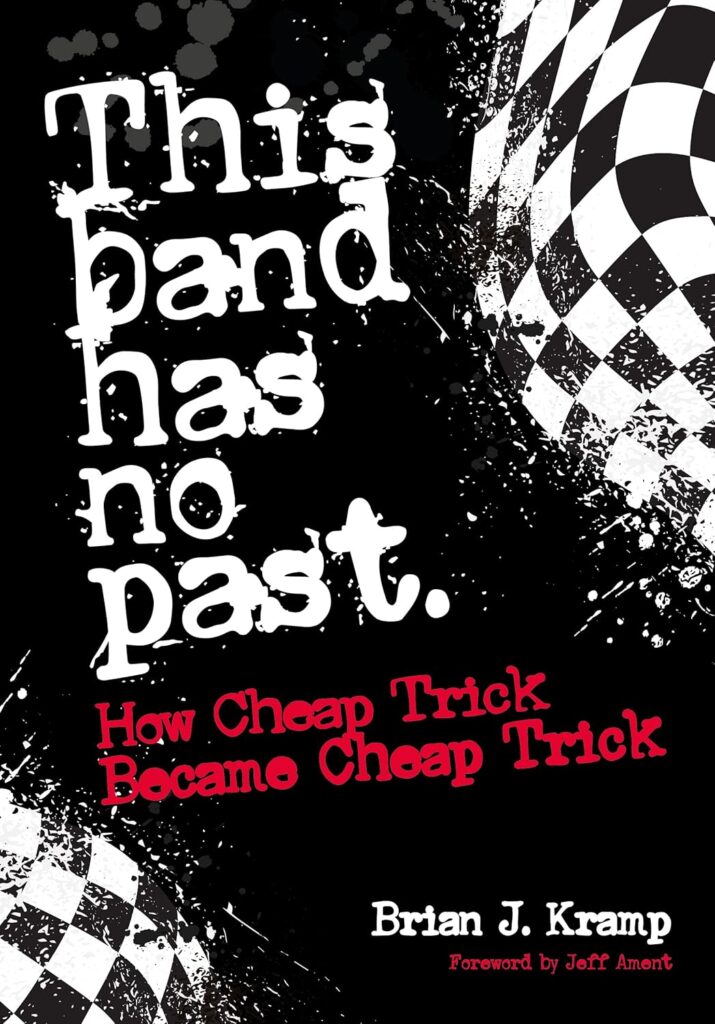
Cheap Trick was nearly as important to my childhood in 1977-79 as R.E.M. were to my teen years. Unlike the R.E.M. book, however, it’s a bit of a slog to anyone but the most insane, devoted fans, who are A-OK with reading about every. Single. Fucking gig the band played. Even before Cheap Trick existed, Kramp exhaustively researched the activities of all the early bands each member were a part of starting in the mid-sixties. He had to have scoured the archives of all the local papers between Rockford, Madison and Chicago, and all the nearby Chicago suburbs and towns in between. It’s truly an impressive achievement that I applaud.
There’s plenty of interesting moments when Cheap Trick intersected with all kinds of big names, like when Rick Nielsen sold one of his guitars to Jeff Beck, and Rick and Tom Petersson made a pilgrimage to London to see some of their favorite bands, including Love Sculpture (with Dave Edmonds), Jethro Tull, Gun, Skid Row (with Gary Moore). King Crimson, Yes and The Move. There was also a Scottish band called Dream Police opening for Led Zeppelin. While there, Rick bought a giant mellotron from Orange Music shop (soon known for their amps) and had it shipped home. Kim Fowley wanted to manage Rick’s pre-Cheap Trick band Fuse, and Frank Zappa wanted to sign them to his label. They had high profile gigs with Terry Reid (who recently turned down a gig to be Led Zeppelin’s singer) at Chicago’s Kinetic Playground, and The Who at a festival in Milwaukee, as well as The Faces, Jethro Tull, Chicago, Ten Years After, The Flying Burrito Brothers, Mountain, James Gang, Bob Seeger, Mahavishnu Orchestra, MC5, and The Stooges. I gotta say, there was a lot of rock action happening outside the big city in the late sixties and early seventies.
There’s a couple conflicting stores about how they came up with their name, one involved a Grand Funk gig, and another, most plausible, was a Slade gig where original singer Randy “Xeno” Hogan commented on the band’s audience participation tactics, “These guys are doing every cheap trick in the book.”
Early sets were all covers, including ‘Dealer Dealer’ (Manfred Mann) ‘Rock And Roll Queen’ (Mott The Hoople) ‘Down On The Bay’ (The Move) ‘Rich Kid Blues’ (Terry Reid) ‘Cold Turkey’ (John Lennon) ‘It’s All Over Now’ (The Rolling Stones), ‘Wam Bam Thank You Ma’am’ (The Small Faces) ‘Second Generation Woman’ (Family) ‘Let It Rock’ (Chuck Berry) ‘My Wife’ (The Who) ‘Vacation / Walkin’ On Sunset’ (John Mayall) ‘Love Me Do’ (Badfinger) ‘Waiting For The Man’ (The Velvet Underground) ‘Suffragette City’ (David Bowie), ‘Revolution’ and ‘Get Back’ (The Beatles), ‘Stupid Girl,’ ‘Let It Bleed,’ and ‘Honky Tonk Women’ (The Rolling Stones), ‘You’re Lookin’ Fine’ (The Kinks), ‘Boris The Spider’ and ‘Shakin’ All Over’ (The Who), ‘The Stealer’ and ‘All Right Now’ (Free), ‘Jeepster’ (T. Rex), ‘I Hear You Knockin’’ (via Dave Edmunds), ‘Tin Soldier’ (Small Faces), ‘Love-itis’ (Mandala), ‘Midnight Rider’ (The Allman Brothers),’ ‘Rock And Roll’ (Led Zeppelin), ‘Lookin’ Back’ (Bob Seger), ‘River’ (Terry Reid), ‘Will It Go Round In Circles’ (Billy Preston), ‘Messin’ With The Kid’ (via Rory Gallagher), ‘I Know’ (Gary Wright & Wonderwheel), ‘Coz I Luv You’ and ‘Mama Weer All Crazee Now’ (Slade), and ‘Hang On To Yourself’ (David Bowie). The award for Most Covered Band goes to Badfinger: ‘No Matter What,’ ‘Love Me Do,’ ‘Suitcase,’ ‘Rock Of All Ages,’ ‘I Can’t Take It,’ and they at least rehearsed ‘Without You.’ So somewhere in there are all the pieces that became Cheap Trick’s sound.
As a songwriter, Nielsen built upon a unique foundation of influences, mostly British. From the explosive rock of The Who, a band he appreciated for the ‘unpredictability’; to the party stomp of Slade and The Sensational Alex Harvey Band, who Rick described as ‘a mash of cool stuff’ and ‘haunting and heavy and fun, all at the same time’; to the schizo blues of Family and Patto, who Rick praised for their ‘irreverence’; to the quirkiness of Sparks (expats) and Roy Wood of The Move. Rick loved how Roy ‘couldn’t be constrained; he had to be different … always take things one step too far.’ It was a volatile stew, boiled down and refined.
At a gig with Bo Diddley, Rick asked him what kind of strings he used, and he said, ‘I don’t know, they’ve been on there for twenty years.’ When Bun E. approached Diddley to ask for some guidance, all Bo had to offer was, ‘Don’t play none of that tom-tom shit.’ The band also filled in as Chuck Berry’s backing band, and when Bun E. threw in a fill, Berry gave him a savage verbal beatdown, then said, “There’s twelve thousand people out there. Smile!” “And I go, ‘”Yes, sir, Mr. Berry!” replied Bun. And he goes, “Now laugh!” “And I go, ‘”Yes, sir!” Berry lightened up once they found their groove. Tom told the Austin Daily Texan in 1977, “Chuck Berry let Rick do more solos than he did. He gave Rick the spotlight, and Chuck Berry was all smiles.” Two hours onstage with Chuck made a huge impact on the band. They learned to simplify and trim the fat.
Another important step toward Cheap Trick becoming who they are was to find the right producer. They courted Jack Douglas, who was a protege of Bob Ezrin, and his first solo job was Alice Cooper’s Muscle of Love (1973) followed by engineering (and really, doing the production work Todd Rundgren wasn’t bothering to do) New York Dolls (1973) and Aerosmith’s Get Your Wings (1974) and Toys in the Attic (1975). The got his attention, and while they sorted out getting a record deal, he worked with Artful Dodger, Starz, Moxy, Patti Smith and lastly, Derringer, before it was time to work on Cheap Trick’s debut. For the next three albums they’d work with Tom Werman, and as great as they are, the debut remains my favorite sounding Cheap Trick album.
The book concludes after the band achieves mainstream success with Live at Budokon. At that point, they can count Eddie Van Halen, Daryl Hall, The Runaways and Sparks as fans. A long career stretched ahead of them still, but I like how the book stayed focused on the band’s early days. Good thing too, with it’s detail, it would be 2000 pages otherwise.
May 31, 2026
Fester’s Lucky 13: 1996
April 2, 2026
Fester’s Lucky 13: 1986