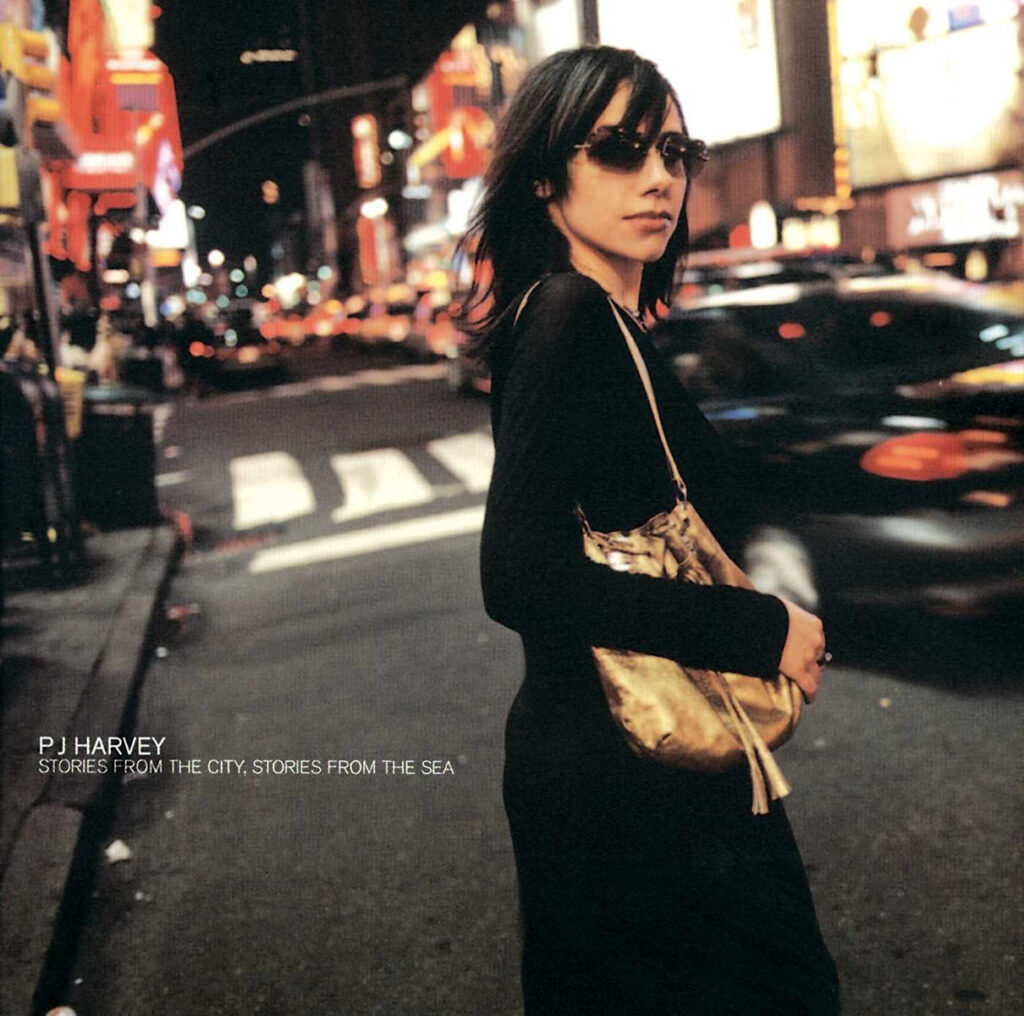
I knew Polly Jean Harvey would be something special when, in one of her first interviews in 1992, she cited Captain Beefheart and Bob Dylan as her inspirations. And later she incorporated members from the bands of Beefheart, Tom Waits and Nick Cave. No other artist surpassed PJ Harvey’s consistency in timeless songwriting and passionate performances in the 90s. The question last year wasn’t whether she would maintain the quality, but if the public would recognize her next album as the landmark it would inevitably become.
While her previous albums were harrowing documents of unrest, depression, ecstasy and pain, Stories From The City, Stories From The Sea shows Polly, now 30, is more comfortable in her skin. To say it’s her “happy record” would be a disservice to the complexity of her lyrics. She has obviously been through a deep relationship or two, and has apparently learned to pause enough to enjoy life, love and sex. “Baby, baby/Ain’t it true/I’m immortal/When I’m with you,” she sings in the opener, “Big Exit.” Guitars slash, and drums pound courtesy of Rob Ellis, reuniting with the band for the first time since 1993’s Rid Of Me. But it wouldn’t be Polly without at least a hint of angst. But this time her restlessness isn’t crippling, it’s energizing. Empowered by the confidence earned with experience, she sings, “But I wanna pistol/In my hand/I wanna go to/A different land” and “So I take my/Good fortune/And I fantasize/Of our leaving/Like some modern-day/Gypsy landslide.”
Leaving the safety of her rural home in England, she crossed the sea to spend half a year in New York City. Thus begin the stories. The music has returned to the rawer rock ‘n’ roll of her first two albums, but with much calmer tempos, varying from driving rhythms traveling past blurred lights, and the rolling and swaying of a boat ride. Polly reigns in her more eccentric vocalizations, controlling her voice perfectly in their appropriate context. At times she sounds more like Chrissie Hynde and Patti Smith than ever before. Indeed, the minor key sway of “Good Fortune” seems to be a tribute to Smith’s “Dancing Barefoot,” while “Horses In My Dreams” is a more lyrical homage. “A Place Called Home” suggests yearning for security “I walk/I wade/Through full lands/And lonely/I stumble.” But when the locomotive keyboards take off, we know she’ll never settle. Stupendous. “One Line” and “Beautiful Feeling” slow things down and reminds one of Kurt Cobain at his contemplative best. Radiohead’s Thom Yorke contributes expressionistic wails to both songs, and even gets a little saucy in the dark sensualism of “The Mess We’re In” — “Night and day/I dream of/Making-love/To you now baby.” “The Whore Hustle And The Hustlers Whore” brings the album to a dizzying peak. It presents a flurry of vice, and from the center of the maelstrom, Polly doesn’t preach, merely observes “Too many people out of love/The city’s ripped right to the core.” “You Said Something” distills a romantic moment “On a rooftop in Brooklyn” where her lover said something she’s never forgotten. We don’t know what was said, but it doesn’t matter, as the melody packs an emotional wallop that no one can forget.
“Kamikaze” hunkers down and rocks more furiously than anything the band has done in seven years — “Space here we come” indeed. “This Is Love” gets more playful — this time Polly is tired of philosophizin’, she just wants to get down and screw — “I can’t believe life’s so complex/When I just wanna sit here and watch you undress . . . You’re my dirty little secret, wanna keep you so.” The album ends with perfection with the lovely Zen/Taoist sentiments of “We Float,” “But now we float/Take life as it comes.” What better way to end the best album at the beginning of a new century.
May 31, 2026
Fester’s Lucky 13: 1996
May 30, 2026
All Them Witches – House of Mirrors (BMG)
May 29, 2026
Elder – Through Zero (Stickman)