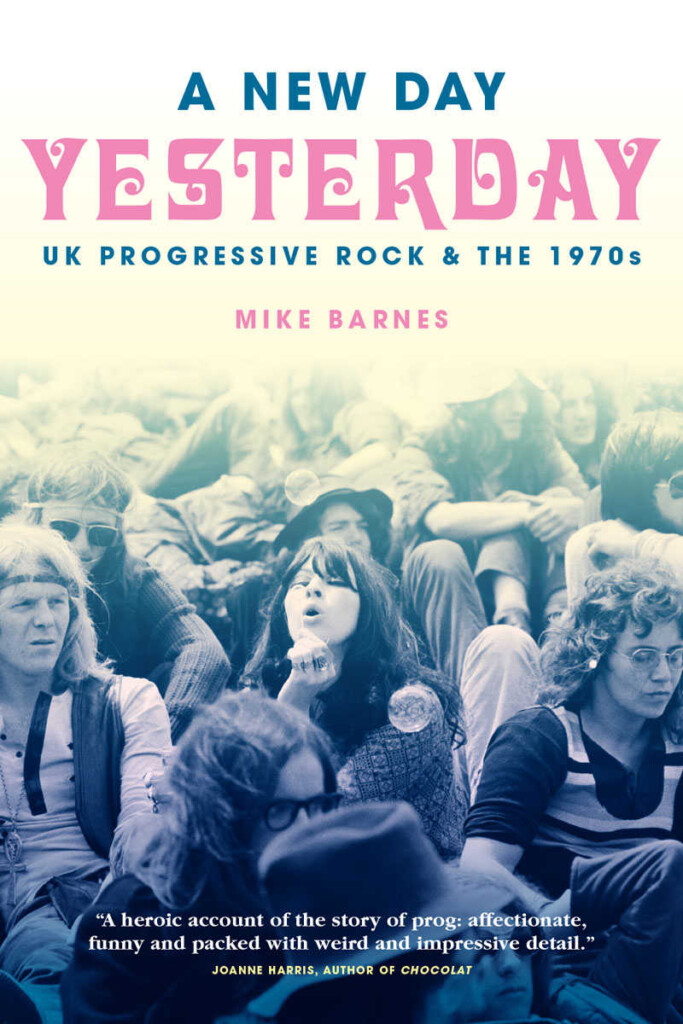
A few months before this book’s March 5 release date, as I put it in my cart to pre-order, I thought, wait, didn’t I just read a prog book? Maybe not “just,” but a few years ago, yes, David Weigel’s The Show That Never Ends: The Rise and Fall of Prog Rock (2017), a very well written history by a bloke with a background in political journalism. Still, it left a lot uncovered, and I knew Mike Barnes would come at it from a different angle, as an accomplished music journalist who contributed to The Wire Primers: A Guide to Modern Music (2009) and Captain Beefheart: The Biography (2001).
Sure enough, it was easy to spot Barnes’ bias toward the more adventurous, experimental and wild side of prog, such as the massive experimental big band/avant jazz prog experiment Centipede, King Crimson’s Red (1974), Van der Graaf Generator, Robert Wyatt, Gong, 801 with Phil Manzanera and Brian Eno, and This Heat. But he doesn’t neglect the popular favorites, and is largely diplomatic, balancing his criticisms of Pink Floyd and Emerson Lake & Palmer with plenty of positive things. At least for the early stages of their careers.
There was a certain coolness about The Dark Side Of The Moon and a typical slow 4/4 grandeur that Mason had been keen to avoid as a potential cliché, but from Atom Heart Mother onwards it was a feature of almost every track that he and Waters played on. Certainly by the end of side two, this kind of uni-pace begins to feel like a trudge.
His m.o. isn’t sacred cow-tipping, but he did use words of other critics for the more biting criticism of Dark Side as “some kind of miserablist stereo demonstration record” for a “lowest common denominator audience.” By the time we get to The Wall, he doesn’t pull any punches, thankfully.
What The Wall particularly shows is that the writer who had set the controls for the heart of the sun in 1968 now had come up with the monolithic, ugly and practically useless structure of a huge wall, which was left to stand like an outlier, a kind of monument to the end of the Seventies, emblematic of the emotional blankness and dysfunction that had gripped Pink Floyd.
Aside from the downfall of ELP via Works and Love Beach, those kind of criticisms are actually pretty rare, as Barnes enthusiastically romps through the 70s, ignoring linear timelines squeezing in artists who are at best, prog-adjacent such as Roxy Music and Brian Eno, Faust, Henry Cow, Kevin Ayers and Hawkwind. It wasn’t until 70% into the book that he delves into prog precursors Procol Harum, Traffic and Family.
It took me over a month to get through this 600+ page book, not because it’s dry (though, you know, a nonfiction book on prog won’t appeal to everyone), but because I was constantly curating a playlist to accompany my reading. It had me doing deep dives, revisiting the catalogs of Jethro Tull, Soft Machine, Mike Oldfield, Hatfield And The North, National Health, Camel, Greenslade, Gentle Giant, Gryphon, Strawbs, Curved Air, Steve Hillage, Quiet Sun and Steve Hackett. It also provided fresh insights into favorites I was also very familiar with such as Crimson, Van Der Graaf, Yes and Gong. There were a few unnecessary chapters, as if Barnes was trying to pad it out to reach a thousand pages, called “Divertimento Nos. 1-6,” including drugs, fashion, “funny foreigners,” sex, politics and festivals. For the most part they were awkward and did very little to add to the book in his attempt to flesh out the cultural context.
Also, it figures that a writer for The Wire and Beefheart biographer would frame This Heat as the ultimate culmination of prog’s achievements by the end of the decade. They were a great band that conducted some very interesting experiments, a convenient crossroads where prog, avant rock, tape experiments, industrial music and post-punk intersect, but their importance was a bit overstated in the context of prog history. It’s also not surprising that, post-1970s, he has no time for the likes of Marillion or Porcupine Tree, but rather sees the spirit of prog more in Wire, Magazine, Kate Bush, Sonic Youth, and a bunch of post-rock bands. Clearly someone else will have to write the book covering contemporary prog, along with all the other prog outside of the UK. Bring ’em on!
Fast ‘n’ Bulbous Favorite UK Prog of the 1970s
- Black Sabbath – Sabbath Bloody Sabbath (WB, 1973)
- Yes – Close To The Edge (Atlantic, 1972)
- Rainbow – Rising (Polydor, 1976)
- King Crimson – Red (Atlantic, 1974)
- Wishbone Ash – Argus (MCA, 1972)
- Pink Floyd – Wish You Were Here (Capitol, 1975)
- Yes – Fragile (Atlantic, 1971)
- Mahavishnu Orchestra – The Inner Mounting Flame (Columbia, 1971)
- T2 – It’ll All Work Out In Boomland (Decca, 1970)
- The Sensational Alex Harvey Band – The Impossible Dream (Mercury, 1974)
- Robert Wyatt – Rock Bottom (Thirsty Ear, 1974)
- Pink Floyd – Dark Side Of The Moon (Harvest, 1973)
- Genesis – Selling England By The Pound (Atlantic, 1973)
- Mahavishnu Orchestra – Birds Of Fire (Columbia, 1973)
- Led Zeppelin – Presence (Swan Song, 1976)
- Yes – The Yes Album (Atlantic, 1971)
- Genesis – Foxtrot (Atlantic, 1972)
- Judas Priest – Sad Wings Of Destiny (Columbia, 1976) | Bandcamp
- Van Der Graaf Generator – Godbluff (Charisma, 1975)
- Camel – Mirage (Deram, 1974)
- Genesis – A Trick Of The Tail (Atlantic, 1976)
- Traffic – John Barleycorn Must Die (Island, 1970)
- Soft Machine – Third (CBS, 1970)
- Genesis – The Lamb Lies Down On Broadway (Atlantic, 1974)
- Genesis – Nursery Cryme (Atlantic, 1971)
- Camel – Moonmadness (Decca, 1976)
- Genesis – Wind & Wuthering (Charisma, 1976)
- Budgie – Never Turn Your Back On A Friend (MCA, 1973)
- Uriah Heep – Look At Yourself (Mercury/Sanctuary, 1971)
- Mahavishnu Orchestra – The Lost Trident Sessions (Legacy, 1973)
- Van Der Graaf Generator – Still Life (Charisma, 1976)
- Jon Anderson – Olias of Sunhillow (Atlantic, 1976)
- Uriah Heep – Demons And Wizards (Mercury, 1972)
- Peter Hammill – The Silent Corner and the Empty Stage (Charisma, 1974)
- Van Der Graaf Generator – Pawn Hearts (Charisma, 1971)
- Budgie – In For The Kill! (MCA, 1974)
- Yes – Going For The One (Atlantic, 1977)
- Peter Gabriel – Peter Gabriel (Mercury, 1977) | Bandcamp
- Peter Hammill – Nadir’s Big Chance (Blue Plate, 1975)
- Budgie – Budgie (MCA/Roadracer, 1971)
- Supertramp – Crime of the Century (A&M, 1974)
- Jade Warrior – Floating World (Island, 1974)
- Yes – Relayer (Atlantic, 1974)
- Caravan – In The Land Of Grey & Pink (Deram, 1971)
- Mahavishnu Orchestra – Visions of the Emerald Beyond (Columbia, 1975)
- Jethro Tull – Thick As A Brick (Chrysalis, 1972)
- Van Der Graaf Generator – The Quiet Zone/The Pleasure Dome (Charisma/Blue Plate, 1977)
- Hatfield And The North – Hatfield And The North (Esoteric/Virgin, 1974)
- Genesis – Trespass (Atlantic, 1970)
- King Crimson – Larks’ Tongues In Aspic (Atlantic, 1973)
- Yes – Tales From Topographic Oceans (Atlantic, 1973)
- Strawbs – Hero And Heroine (A&M, 1974)
- Family – A Song For Me (Reprise, 1970)
- Camel – The Snow Goose (Deram, 1975)
- Hatfield And The North – The Rotters’ Club (Esoteric/Virgin, 1975)
- Gentle Giant – The Power And The Glory (PolyGram , 1974)
- Van Der Graaf Generator – World Record (Charisma, 1976)
- Mahavishnu Orchestra – Between Nothingness And Eternity (Columbia, 1973)
- Gong – The Flying Teapot (Radio Gnome Invisible Pt. 1) (Virgin/Charly, 1973)
- Gong – You (Radio Gnome Invisible Pt. 3) (Virgin/Charly, 1974)
- Van Der Graaf Generator – H To He, Who Am The Only One (Charisma, 1970)
- Jethro Tull – Aqualung (Chrysalis, 1971)
- Strawbs – Ghosts (A&M, 1975)
- Budgie – Squawk (MCA/Roadrunner, 1972)
- Pink Floyd – Animals (Capitol, 1977)
- Yes – Time And A Word (Atlantic, 1970)
- Uriah Heep – Very ‘Eavy, Very ‘Umble (Mercury, 1970)
- King Crimson – Starless And Bible Black (Atlantic, 1974)
- Manfred Mann’s Earth Band – Nightingales & Bombers (Bronze, 1975) | Bandcamp
- Procol Harum – Grand Hotel (A&M, 1973)
- Gentle Giant – In A Glass House (PolyGram , 1973)
- Khan – Space Shanty (Polygram, 1972)
- Steve Hillage – Green (Virgin, 1978)
- Brand X – Unorthodox Behaviour (Charisma, 1976)
- Gentle Giant – Octopus (PolyGram , 1972)
- Caravan – If I Could Do It All Over Again I’d Do It Over You (Deram, 1970)
- Stomu Yamashta, Steve Winwood, Michael Shrieve – Go (Universal, 1976)
- Gentle Giant – Acquiring The Taste (PolyGram , 1971)
- Gong – Camembert Electrique (Virgin/Charly, 1971)
- Mike Oldfield – Ommadawn (Virgin, 1975)
- Strawbs – Grave New World (A&M, 1972)
- 801 – 801 Live (Island, 1976)
- Bachdenkel – Lemmings (Initial/Ork, 1970)
- Curved Air – Phantasmagoria (WB, 1972)
- Gong – Angel’s Egg (Radio Gnome Invisible Pt. 2) (Virgin/Charly, 1973)
- Wishbone Ash – There’s The Rub (MCA, 1974)
- Manfred Mann’s Earth Band – Solar Fire (Bronze, 1974) | Bandcamp
- Jade Warrior – Last Autumn’s Dream (Vertigo, 1972)
- Gentle Giant – Free Hand (Chrysalis, 1975)
- Chris Squire – Fish Out of Water (Altantic, 1975)
- Soft Machine – Bundles (See For Miles , 1975)
- Steamhammer – Speech (Brain, 1972)
- Family – Fearless (Reprise, 1971)
- Strawbs – Bursting At The Seams (A&M, 1973)
- Steve Hillage – Fish Rising (Virgin, 1975)
- Jade Warrior – Way of the Sun (Island, 1978)
- Manfred Mann’s Earth Band – The Roaring Silence (Bronze, 1976) | Bandcamp
- Brand X – Moroccan Roll (Charisma, 1977)
- Caravan – For Girls Who Grow Plump In The Night (Deram, 1973)
- Manfred Mann’s Earth Band – Watch (Bronze, 1978) | Bandcamp
April 2, 2026
Fester’s Lucky 13: 1986
February 27, 2026
Fester’s Lucky 13: 1976
January 30, 2026
Fester’s Lucky 13: 1966