The summer of reading rundown with over twenty books, including obscure SF, popular favorites and the latest Hugo winner.
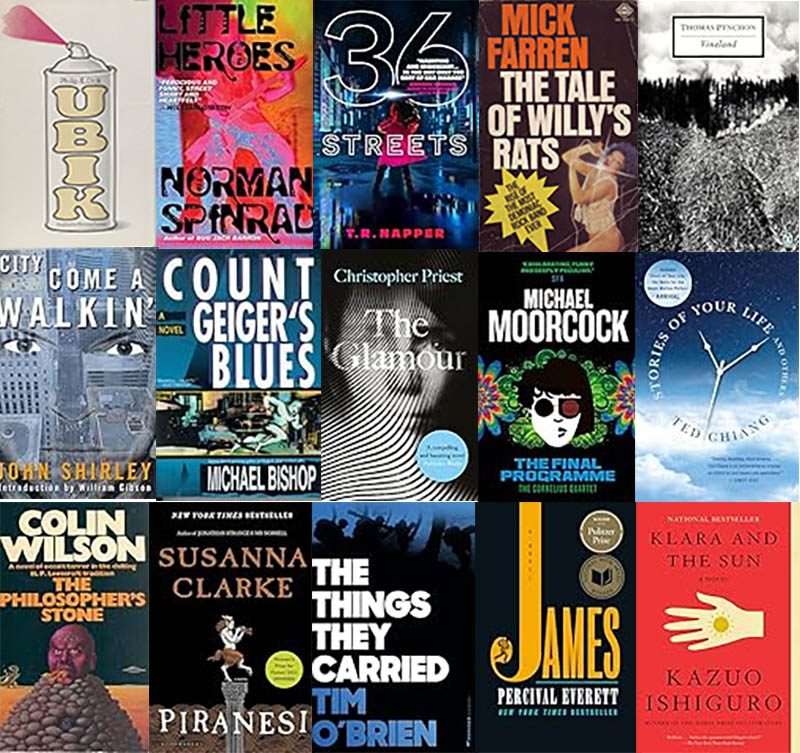
My unplugged vacation in May inspired me to extend my reading binge throughout the summer. While I’m always reading something, and I love my Kindle, I blame the allure of Kindle Daily Deals in hindering my progress in discovering books I love. For years I wasted way too much time reading random garbage. I started following a bunch of BookTubers, and now my TBR list has over 600 books, a mix of new books, classics and obscure SF and counterculture lit. Less time in front of the computer has done a lot of good for my sleep health, and my overall mental health.
Philip K. Dick – Ubik (1969)
I was thinking of who my top ten favorite authors are and Philip K. Dick is a strong candidate, but I’ve only read five of his novels and some short stories so far. This mind-bender didn’t disappoint, a hugely original and influential exploration of consciousness suspended between life and death. Finally getting around to this 56 years after it’s publication, I can see it’s mark on movies like Inception (2010), and Neal Stephenson’s Fall; or, Dodge in Hell (2019). The satirical ads for different products, all called Ubik, at the beginning of each chapter are brilliant. Anything else would be a spoiler so I’ll just leave it at that, and place this book snugly within my top 30 all-time list, just under To Androids Dream of Electric Sheep? (1968) and A Scanner Darkly (1977).
Norman Spinrad – Little Heroes (1987)
The economy is a disaster, the soul of rock ‘n’ roll has been sucked dry by corporate behemoths, and cheap wire-net shunts have replaced drugs for the latest fix, except that wireheads suffer negative affects worse than LSD and crack. We learn that this soulless landscape is approximately the late 2010s, given the age of character Gloriana O’Toole, The Crazy Old Lady of Rock ‘n’ Roll who haunted the 60s psychedelic scene and remained, if not a star, a survivor in the changing landscape. Four other main characters — Puerto Rican street thug Paco, shallow Rutgers grad Karen who feels the only way to fulfill her dream to live in Manhattan is to pick up some rich asshole at one of the exclusive NY clubs, and Bobby and Sally, two talented tech nerds hired to assist Gloriana in creating the next big AI superstar to revive a failing music label — are all distinctly unlikable in the beginning of the book. Bobby is particularly excretable, an uptight nerd with a shockingly vicious streak of misogyny. He would have become an incel for sure IRL. How will all these garbage people go through the necessary character arcs? To my dismay, it would take 727 pages.
What I thought would be a compact, quick, dirty ‘n’ rockin’ read, became an elongated, profoundly filthy odyssey with some aspects of cyberpunk, but plenty of socioeconomic and political commentary too. Some new wizard wire has entered the black market that seems to have more inspiring effects on the users without the negative side effects of the old gear. As most of the characters jack in with increasing frequency, it seems to spark an evolution in creativity, personal growth, and possibly even anarchist revolution in the hands of the Reality Liberation Front.
Norman Spinrad is one of the true mavericks of the New Wave of speculative fiction, hanging ten on loads of controversy sparked by books like Bug Jack Barron (1969) and The Iron Dream (1972). While a more ballsy editor could have easily tightened this book up, I was not disappointed, as it successfully paid homage to both revolutionary 60s spirit and cybernetic wares. RIYL William Gibson’s Idoru, Thomas Pynchon’s Vineland, and Michael Moorcock’s Jerry Cornelius.
T.R. Napper – 36 Streets (2022)
This Aussie bloke is a doctor of Cyberpunk! I looked up his dissertation after watching a YouTube interview with him, and put his books on my TBR list. Before turning to writing, T. R. Napper was a diplomat and aid worker, delivering humanitarian programs in Southeast Asia for a decade. He lived in the Old Quarter in Hanoi for several years, the setting for his first novel 36 Streets. Back in Australia, he works as a DM, running dungeons and dragons campaigns for young people with autism for a local charity.
T.R. Napper’s first novel was also part of his Ph.D. thesis, “The Dark Century: 1946-2046: Noir, Cyberpunk, and Asian Modernity.” If you thought from its academic origins it would be dry, you’d be wrong. In fact, it may be one of the darkest, bloodiest dissertations ever. Such was Napper’s commitment, he took up Kumdo (Korean sword fighting) in order to more accurately portray fight scenes, and ended up with a black belt, along with one for Taekwondo. Our hero/anti-hero is Lin “The Silent One” Wu, rescued from an orphanage with her twin sister and raised in Australia by a kindly white woman, before being forced to leave the country back to Vietnam, where there is an ongoing war with China. While her sister seemed well adjusted, married to a Chinese diplomat and loved in her community, Lin was the opposite — violent, addicted to drugs, taken in and mentored by the leader of a street gang and trained thoroughly in multiple martial arts. She’s offered an assignment that’s more complex than the usual thug gigs, to pose at a private investigator for a wealthy client to solve a murder and find a missing person, a designer for a game called Fat Victory, a war game simulation based on the century old conflict with the U.S., from the perspective of U.S. soldiers who suffer all kinds of traumatic horrors. If players don’t pre-set a time limit, they tend to get stuck in the game, ending up in acute cases of PTSD or worse. For that reason the game was illegal, but flourished on the black market.
Napper adds a fresh spin on cyberpunk with this future Vietnam setting, addressing issues of colonialism, and the culture and philosophy of war, violence and revenge along with the more common tropes of corrupt corporations, corrupt governments, synthetic drugs, cybernetic body modifications and memory manipulation. I feel like I’ve paid my dues with war films and fiction, and generally avoid those at this point of my life. But Napper’s electrifying and unique approach to cyberpunk drew me in, and while I’m still not a big fan of frequent fight scenes, he pulls it off masterfully, while also injecting plenty of weighty philosophical themes to ponder, such as whether the price of erasing large chunks of memory is too much — can one’s soul and humanity remain intact if you’ve wiped away all the bad stuff? He lived in Hanoi for several years which helped with the vivid, convincing sense of place. I have his short story collection Neon Leviathan (2020), Ghost of the Neon God and The Escher Man (both published just last year) on my TBR list because, despite my mixed feelings for violence, I’m hooked. I’m also hopeful that as Napper evolves as a writer he’ll try out some more hopeful post-cyberpunk, or at least dial back the violence at some point.
The Dark Century: 1946-2046: Noir, Cyberpunk, and Asian Modernity
Abstract: From US-occupied Japan in 1946, to the end of two systems between China and Hong Kong in 2046, noir as an artistic and philosophical discourse has provided powerful insights into the impact of modernity across Southeast and East Asia. The Dark Century 1946 – 2046 is a dissertation in two parts—an essay and a work of fiction—that analyses under-explored noir, neo-noir, and cyberpunk narratives in film and literature. The research approach is multidisciplinary, incorporating creative practice, textual analysis, critical theory, and cultural studies. I argue that noir, neo-noir, and cyberpunk share a philosophical lineage, and provide a counter-hegemonic discourse on modernity.
While noir has found distinct local expressions in film and fiction, what links the global experience of seemingly disparate nations, East and West, is a context of rapid development, cultural loss, the alienating forces of economic capital, and the corrupt rule of a Leviathan state. Through examination of seminal works of transnational noir, I identify four archetypes within the noir discourse – Android, Gunslinger, Samurai, and the Private Eye – and argue they provide compelling and consistent insights into the impact of modernity across radically different cultures. Working from this basis, I propose a new definition of the narrative form. I also delineate the local noir traditions for four countries underrepresented in noir scholarship: Japan, Hong Kong, Australia and Vietnam. The creative artefact, Thirty-Six Streets, is a science-fiction noir thriller that aims to realize some of the noir themes relevant to transnational noir in general, and Vietnam in particular. The novel is focalised through Lin ‘The Silent One’ Vu, a gangster and sometime private investigator. Born in Vietnam, raised in Australia, everywhere an outsider; she lives in Chinese-occupied Hanoi, in the steaming, paranoid alleyways of the Old Quarter – known as the Thirty-Six Streets. Lin is drawn into the grand conspiracies of the neon gods: of regimes and mega-corporations, as they unleash dangerous new technologies in a quest for absolute power.
Full PDF of thesis, along with one of his novel 36 Streets.
Mick Farren – The Tale of Willy’s Rats (1975)
Like Last Exit to Brooklyn or Naked Lunch, this book would have been banned if anybody knew about it. No need, after a short lived publishing run on Mayflower, it disappeared until the now defunct site Funtopia offered a PDF of the book in 2002, with Mick Farren writing a new introduction where he expressed his mixed feelings, that it might be “too personal for pulp and two lurid for literature.” It’s reasons for controversy has evolved over time. Then it would have been for the sex, drugs and flirtation with Satanism. Now it’s the breathtakingly vile misogyny, particularly on the part of the co-bandleader and guitarist Jerry, a sadistic woman-hating sociopath who makes Brian Jones look like a saint. Told in first-person narrative from the perspective of singer Lou Francis, he recoils from Jerry’s cruel treatment of others, but is hardly innocent himself. With Lou coming up in early R&B and blues bands, one might assume from the timeline that the primary model is The Rolling Stones. Rather, it’s a mix of Farren’s own personal experiences with the band the Deviants, formed as the Social Deviants in 1966, with a bit of wish-fulfillment of success more akin to The Stones, The Doors and Pink Floyd, with elements of Mott the Hoople (e.g. the Rat’s exact template of Stones with a Dylan influence), Alice Cooper, MC5, and of course Farren’s close cronies the Pink Fairies and Hawkwind.
Farren wrote for and edited underground paper IT (International Times), contributed soft-porn to publications like Club International, co-wrote the novels Watch Out Kids (1972) with Edward Barker, and the SF post-apocalyptic rock & roll western The Texts of Festival (1973) with the hero named after Iggy Pop. While making notes for his SF trilogy DNA Cowboys, he banged out the quintessential rock novel that renders 99% of real band biographies redundant. It’s all there, the breathless discovery of Elvis and the blues as schoolboys, learning guitar, getting deflowered, dropping out of school, street busking, booze, girls, forming multiple bands with horrible names (Uncle Dooley’s Blues Band, Uncle), sleazier drugs, sleazier sex, ego trips, head trips, acid trips, in fighting, exploitation by management and labels, but with Farren’s no-nonsense, taut writing that doesn’t get lost in the weeds like so many do. And of course the final band name, Willy’s Rats was pulled from Naked Lunch! A pilgrimage to see Pink Floyd at the UFO club at Tottenham Court Road was a tasty treat of real music history, while a trip to what was essentially the Manson Family ranch out in the desert while on an American tour was harrowing. Bits of the band’s performance in New York from the end of the story are scattered throughout the book, complete with song lyrics, with Lou fretting about threats from a psychopath to shoot them. Basically the template for the subsequent 50 years of rock bios and Behind the Music cliches, the ending diverges from predictability with quite a surprise that’s never happened in real life. Grab that PDF, plug it into an e-reader and find out if you dare.
Thomas Pynchon – Vineland (1990)
This is a re-read, but it’s been so long it all felt pretty fresh, given that I’ve since read all of Pynchon’s later novels except for Against the Day (2009). Aside from the wildly split opinions on Gravity’s Rainbow (1973), consensus is Vineland is his weakest book. And granted, it has the chaotic narratives that jump between a confusing array of characters, but many of the more enticingly strange threads, such as the math professor-turned leader of PR3 (People’s Republic of Rock ‘n’ roll) student rebellion being murdered, yet reappearing as a ghost-zombie Thanatoid, not to mention a UFO abduction and Godzilla attack, are left to dry up on the vine, so to speak. Pynchon purposefully made this book much shorter than his previous effort, leaving many things ambiguous. The story of hippie burnout Zoyd Wheeler’s daughter Prairie, searching for her revolutionary-turned-traitor mother Frenesi Gates, kind of fades out in the chaos to instead paint a surreal portrait of the clash of 60s counterculture with 80s right wing authoritarianism. Does it boil down to Frenesi falling for neofascist government villain Brock Vond due to an unconscious desire for order? Did the left really sell out to the right simply because they got off on being told what to do? It’s something that Pynchon lays out to grapple with, but offers no pat answers. If one is willing to not get hung up on details, and, uh, resolutions, it’s still an immensely enjoyable and meaningful book. Paul Thomas Anderson’s upcoming movie One Battle After Another (Sep 26) must be a very loose adaptation, otherwise star Leonardo DiCaprio would only get the first 15 minutes of screen time as his character Zoyd fades into the background of the story. It’s a good time to be a Pynchon fan with the movie, and his upcoming book Shadow Ticket (Oct 7).
John Shirley – City Come A-Walkin’ (1980)
I got to experience the emergence of cyberpunk with William Gibson’s stories in 1981-82 via my subscription to Omni magazine, but two important pre-cursors that Gibson was indebted to were Bruce Sterling and John Shirley. I was first exposed to them via Sterling’s Mirrorshades (1988) anthology, and then some stories in a magazine called Mondo 2000. Like Gibson, early novels like The Artificial Kid (1980) and City Come A-Walkin’ crackle with creative energy, are action packed, and in Shirley’s case, pretty vividly violent. Having served time in punk bands, he also convincingly conveyed the grubby atmosphere of a punk club in our hero Stu Cole’s Club Anesthesia in San Francisco. When resident punk (or angst rocker) Catz Wailin isn’t performing, the default house mix is disco in this queer-friendly sanctuary. Unfortunately this cultural oasis is disrupted by organized crime and hyperviolent vigilantes. The city has had enough, and manifests itself in human-ish form, with all the knowledge and power that circulates through wiring at its disposal. Music is described as dense and heavy along the lines of Killing Joke’s apocalyptic post-punk and Ministry. Parts of the book had been revised for a 2014 edition, and some descriptions and references to CD-ROMs and the Pet Shop Boys couldn’t have been in the original 1980 edition. One could easily imagine a movie treatment of this, like a merging of Blade Runner with The Terminator.
Michael Bishop – Count Geiger’s Blues (1992)
Fine arts critic Xavier Thaxton is a cultural snob in the southern metropolis of Salonika, who has no time for the lowbrow art of pop culture (including junk food, TV, rock music and comics), until he skinnydips in a pool with radioactive waste and suddenly develops severe allergies to high art. The only way to counteract his reactions is to consume low culture, eventually gaining some appreciation for the band Smite Them Hip and Thigh via his retropunk nephew The Mick. Unfortunately the widened scope of his cultural appreciation made his allergies worse, until he purchased a costume of a new comic book hero Count Geiger introduced by local indie comic publisher Uncommon Comics, eventually realizing he has similar powers as the character. The book strikes an entertaining balance between philosophical discussions on Nietzsche and superheroes, Dante’s Inferno style satire of cyberpunk, fine dining, strip clubs and even ball sports, shady businessmen and nuclear waste disposal, romance, comedy and tragedy. Known as a SF writer, Bishop’s work here encompasses empathetic, humanist character portraits along the lines of Nick Hornby and some of the wit of Kurt Vonnegut.
Christopher Priest – The Glamour (1984)
Associated with the British New Wave of Sci Fi movement of the late 60, Christopher Priest began branching out beyond SF in the 80s, with The Glamour arguably a kind of unheralded masterpiece. It starts out seemingly straightforward, the main character, cameraman Richard Grey is injured badly by a car bomb and suffers amnesia. When things get weird, the book potentially takes a turn into PKD/Ballard style postmodernism with unreliable narration, or perhaps surrealism and magical realism like Murakami. I’m not telling which it is, and really, the reveal in the end can be interpreted a number of ways. I have a strong sense that this was a big influence on Christopher Nolan’s film Memento (2000), which was confirmed by Nolan then adapting Priest’s book The Prestige (1995).
Michael Moorcock – The Final Programme (1965)
Written in 1965, Michael Moorcock had trouble getting his first installment in the Cornelius Quartet published for a few years, due to it’s groundbreaking take on hallucinogenic drug culture, queer sexuality and gender fluidity, stuff that 60 years later still inspires gasps and pearl clutching. Throw in some anti-hero behavior on the part of Jerry Cornelius (physicist, Jesuit, wannabe rockstar) such as incest and murder-for-hire, as well as self-indulgently overlong guitar jamming, and we’ve got a perfectly contentious avatar of 60s underground counterculture. As editor of New Worlds magazine, Moorcock encouraged other writers to take the Cornelius character and run with it, resulting in him popping up in a bunch of other short stories and books like Zelig. The writing structure draws from the avant-garde like William S. Burroughs with seemingly disjointed dialogue suggesting that everyone is on drugs. And yet there’s plenty of brisk James Bond style action sequences that keeps things moving. The book touches on all kinds of metaphysical concepts, extinction-event overpopulation, immortality and AI implications of supercomputers as precursors to cyberpunk, each time just a quick hallucinogenic flash rather than a tedious info dump. Six decades later, your baggage may vary — it might seem dated along the lines of a depraved mix of Austin Powers, The Avengers and Dr. Who, but just know that this pre-dated all those things. Definitely as groundbreaking and influential as the work of J.G. Ballard.
Ted Chiang – Stories of Your Life and Others (Arrival) (2002)
I hadn’t read short story collections in ages because I favor more immersive novels. However I tried an experiment of reading Chiang’s stories one or two at a time in between books as palate cleansers. It worked well, but his stories are so good I ended up finishing the second half of the collection in one day. The styles and settings are incredibly diverse, from hard science and math thought experiments to morality fables set in the 17th century. My favorite by far was “Understand,” a riveting account of how an experimental drug meant to repair brain damage goes beyond expectations with a drowning victim and within weeks has superhuman intellect. Then he learns he has a nemesis with a conflicting agenda. This should be a movie. “The Lifecycle of Software Objects” takes a very unique approach to the AI trope where “intellect” cannot accelerate learning from basic life experience and emotional growth. Written in 2010, I’m curious what he thinks now. I guess I’ll have to read his next collection!
Colin Wilson – The Philosopher’s Stone (1969)
When Colin Wilson wrote in his nonfiction book The Strength to Dream (1961) that H.P. Lovecraft was a “very bad writer” whose work is best considered a case study more than literature, publisher August Derelith challenged him to try to write a better Lovecraftian book. Wilson did, with The Mind Parasites (1967) which Derelith published. With working class and no university background, Wilson proved to be a precocious organic intellectual, publishing his bestselling work of existentialist philosophy, The Outsider (1956) at 24. Wilson probably identified with Lovecraft’s own status as an outsider, and clearly enjoyed his first experiment, because he went on to write the even more ambitious The Philosopher’s Stone, and the “The Return of the Lloigor,” story. Nearly all of Wilson’s academic references were attributed to real-world research, given his lifelong interest in consciousness, mysticism and the paranormal. He also used it as an opportunity to express his controversial opinions, like the one where Shakespeare kind of sucks:
“Later, I read Tolstoy’s essay on Shakespeare, in which he says all that I have just said, and a great deal more. I found it surprising that his clear analyses should not have completely destroyed Shakespeare’s reputation. And then, on reflection, I saw that it was not surprising. Most people live on a level of emotional triviality which means that when they read Shakespeare, they experience the pleasure of hearing their own feelings echoed. And since the language is impressive, and requires a certain intellectual effort to follow, they can have no doubt that this is really Great Literature. This combination – of fine language with totally trivial content – has kept Shakespeare’s stock high for three hundred years, and will continue to do so until the movement of evolution consigns him to the dustbin of quaint but meaningless antiquities.”
The book is set up as a memoir of the narrator, Dr. Howard Lester, starting with his childhood. Slowly things start to move when he collaborates with Sir Henry Littleway to research ways to expand consciousness, mental powers, life longevity and possibly immortality. Through an experimental brain operation, they gain the ability of “time vision” to see back in time via objects and artifacts. This leads them to learn about the interdimensional Old Ones. Will their research awake these sleeping gods and provoke disasters similar to extinction events, or will it lead to the next step in human evolution?
As much as I admire Lovecraft’s body of work, I have to admit that this book held my interest better than most of those original stories. So, challenge accepted and succeeded.
Susanna Clarke – Piranesi (2020)
Susanna Clarke’s Jonathan Strange & Mr Norrell (2004) was an all-time favorite, so the wait for her next book seemed endless. Sixteen years later, I bought Piranesi the day it came out. However I didn’t get past the first couple chapters, because it felt like some kind of spiritual parable like Herman Hesse’s Siddhartha. Definitely not what I was expecting. It was set in a mysterious but desolate house by the sea full of statues and a few sets of human bones. The stark setting felt claustrophobic, and I was not interested in that at the time, still early days in the pandemic.
Nearly half a decade later I finally got around to finishing it, and am glad I did. I should have trusted Clarke knew what she was doing. While it can’t/won’t compete with her debut novel, the excitement certainly escalated as it went on, reaching a satisfying climax and conclusion. Here’s hoping it won’t be sixteen years until her next book.
Tim O’Brien – The Things They Carried (1990)
One of the few good things about being a grown-ass adult is not having to read things you don’t want to read. I never thought I would read another book on the Holocaust, WWII or Vietnam ever again. And yet I did have this on my to-read list for 35 years, and with a gentle push from a friend I finally did it. Memorial Day weekend seems as good time as any to end my break with reading horrible things about war.
I realized that parts of it I actually remember, from when I saw O’Brien speak and read from the just-published book when I was at Macalester in 1990, where he also graduated back in 1968. I knew his writing is great, and while there are certainly harrowing, grisly stories, you can tell that O’Brien is also an accomplished poet, with his economical style that somehow made even the most terrible things are described beautifully.
My favorite story was the one where a solder manages to smuggle his high school sweetheart into Vietnam, and she quickly learns how to operate and shoot guns, and within weeks is going on missions with the Green Beret special forces, until she goes feral and simply disappears into the jungle. While his actual experiences transformed into fiction, the stories still honor his friends and frenemies who died during his tour
Percival Everett – James (2024)
I’m often reluctant to hop on bandwagons of trending popular books, but I loved Everett’s Erasure (2001), so I was confident that his retelling of Mark Twain’s The Adventures of Huckleberry Finn (1885) would be well worth my time. I knew it would be heavy, but for Everett, I was willing to delve briefly into the darkness at the peak of my summer reading. I loved the reimagination of James as a formidably literate intellect, the type of organic intellectual described by Antonio Gramsci who is self-taught, whose internal monologues explore deeply complex philosophical issues. The seemingly simple task of acquiring a mere pencil comes at great cost, but it’s benefits of James potentially documenting his story could be colossal. This makes the indignities he and other slaves and former slaves even more profoundly outrageous and dehumanizing, and Huck’s confusion once James reveals his true self all the more absurd. The twist in their relationship was also pitch perfect. Really a great book, and deserving of all the awards it will likely receive.
Kazuo Ishiguro – Klara and the Sun (2021)
I have a violent aversion to most popular literary fiction that top bestseller lists and win awards. Thus when I heard The Remains of the Day (1989) described as a self help book disguised as a novel, I wanted to run away screaming. The fact that Ishiguro’s last three books have all delved in SF (Never Let Me Go, 2005 and Klara) and fantasy (The Buried Giant, 2012), piqued my interest, so I gave this one a go. Told from the perspective of an AF (artificial friend) doll named Klara, the prose is exceedingly simple, true to the limits of Klara’s AI programming. And yet, every AF is designed to be unique, and thus Klara stands out for her observational skills and empathy. Despite that, she lingers in the store for months and months, as people are diverted by a newer generation of models that have enhanced features, but less empathy. Being solar powered, she develops her own superstitions/mythology about the power of the sun based on her observations, and once she’s purchased for a girl, she applies her self-taught belief system to try to solve a problem. Like many kids, her human friend Josie is “lifted,” e.g. genetically modified with boosted intelligence. The process, however, made her intermittently ill, and Klara believes it’s her mission to figure out how to help her. Like most popular literary fiction, there was a melancholic cloud of dread throughout the book that things were going to go very wrong. Interactions with other humans, both adults and children, touch on themes such as class privilege, social cliques, loneliness, even fascism. And of course, that evergreen nugget, what it means to be human. This slow moving story was mercifully a quick read, yet like Haruki Murakami, I suspect it’ll plant seeds of threads to contemplate for quite a while. A film adaptation by Taika Waititi will come out later this year called Tears and Rain, and I’m confident if anyone can reshape the story to be watchable as a movie, it’s Waititi.
Robert Jackson Bennett – The Tainted Cup (Shadow of the Leviathan Book 1, 2024)
Most Recent Read, awarded the Hugo Award this month.
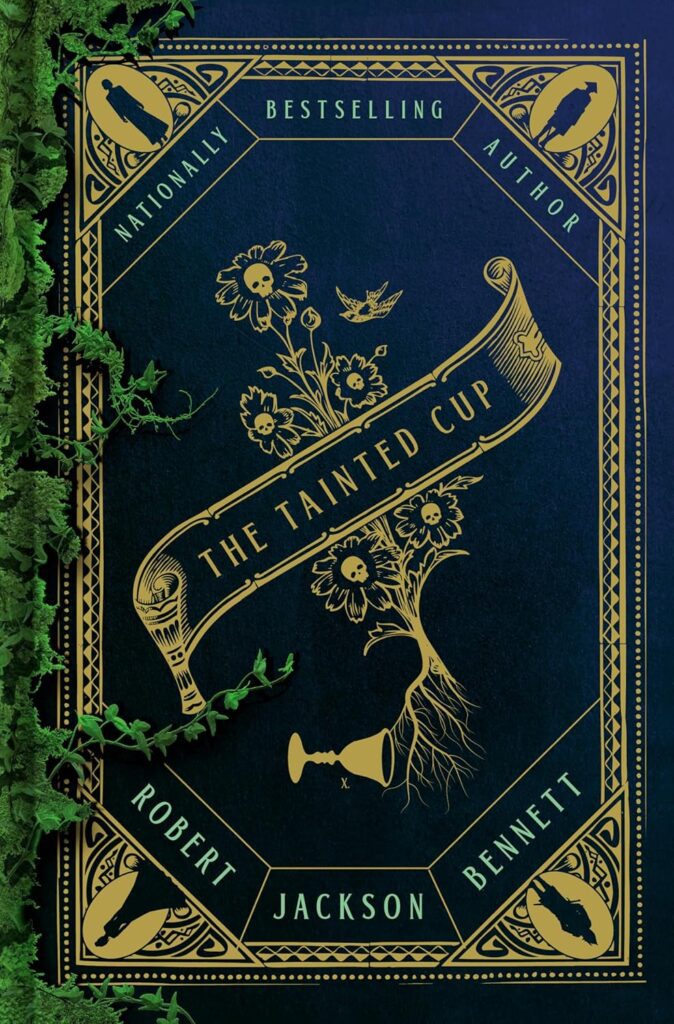
This year’s Hugo award winner had me interested with it’s premise of legendary investigator Ana Dolabra and her young apprentice Dinios Kol solving a murder mystery in a fantasy world. A high ranking official is found dead in one of the mansions of the Empire’s richest and most powerful family. His body spontaneously sprouted dappelgrass in a most gruesome manner, and there are no immediate suspects. The game is afoot. Daretana is a kind of backwater province on a continent that is surrounded by giant walls to protect them from Leviathan, which are apparently giant monster whales that have a habit of crushing entire cities. I think they’re like whales, but information about them is scarce for some reason. It’s a claustrophobic world where everyone’s levels of dread rise to an anxious peak every wet season. This could be my own bias because I am very particular about fantasy, but the world building is unsatisfying and unappealing. Aside from that, the writing, character building, and mysteries are all pretty top notch, and many will be delighted. Ana in particular has a gleefully prickly, edgy, witty personality, though I think more of her backstory was revealed in an afterthought infodump at the end than was strictly necessary. Since it’s told from Din’s rigid, by-the-book perspective, there’s not much mystery to him other than to see his confidence grow with experience and more practice in rule-breaking. There’s likely more to learn about Ana’s mysterious past, but I’m on the fence whether I want to return to this grim world to find out in A Drop of Corruption, Book 2, which came out in April.
Jonathan Gould – Burning Down the House: Talking Heads and the New York Scene That Transformed Rock (2025)
Nonfiction Music book of the Summer
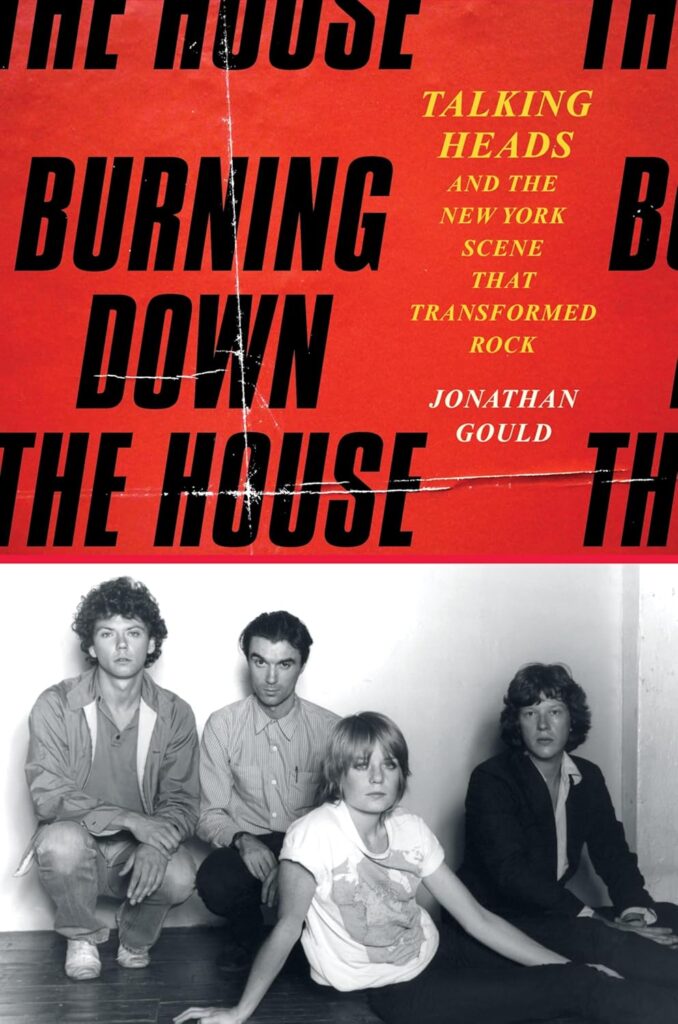
It feels like only yesterday that I read Chris Frantz’ Remain in Love: Talking Heads, Tom Tom Club, Tina (2020), and wasn’t sure I was ready for more Talking Heads reading. There certainly isn’t a lack of coverage, with David Bowman’s This Must Be the Place: The Adventures of Talking Heads in the Twentieth Century (2001), Ian Gittins’ Talking Heads: Once in a Lifetime: The Stories Behind Every Song (2004), Jonathan Lethem’s Talking Heads’ Fear of Music (33 1/3 Book 86, 2012), Alan Bennett’s The Complete Talking Heads (2024), and David Starkey’s Talking Heads (On Track, 2025), among others. I may not know everything about the Talking Heads, but I know as much as I need to. However, Jonathan Gould has the greatest bonafides of any of the above writers, except for literary fiction star Lethem, having written Can’t Buy Me Love: The Beatles, Britain, and America (2007) and Otis Redding: An Unfinished Life (2017), and despite note being granted interviews with any of the members, it was a safe assumption that this would be the definitive book.
It was good timing, sandwiched between the 40th Anniversary reissue of Jonathan Demme’s acclaimed concert film Stop Making Sense (1984) and Rhino’s deluxe bookback box set of More Songs About Buildings and Food (1978). Gould delivers, filling in the cultural backdrop of the Heads’ journey from RISD to the gritty Manhattan lofts of the mid-70s. However, I would note that “the New York Scene That Transformed Rock” part of the book’s title is somewhat of a misnomer, because he’s fairly dismissive of the importance of Patti Smith, the Ramones, Television, Blondie, Richard Hell & the Voidoids, Johnny Thunders & the Heartbreakers, The Feelies, saying they were the only band to “have a musical career.” After Frantz’s fawning portrayal of his wife Tina in his book, this book reminded me of the feeling I got that he was a bit afraid of her. Indeed, the monster in this story for the most part isn’t Byrne’s hogging the credits and spotlight, or Eno’s prima-donna behavior. It’s Tina Weymouth’s constant, endless bullying of Byrne in the press, talking about him as if he was her mentally deficient child, and one who’s (not officially diagnosed) Asperger’s spectrum behavior represented some kind of moral failure. Only the band knows for sure, but Weymouth could be the reason there was not a ninth studio album. Byrne presented songs to the group, but they wanted to return to the jamming approach they did in the beginning of the decade. His songs ended up on Rei Momo (1989), and Byrne never looked back. I could talk about why they were the greatest American band in 1979-1982 (Television were better in 77-78, R.E.M. in 1983-88), but the book covers it quite well.
Currently Reading
Mick Farren – The Quest of the DNA Cowboys (DNA Cowboys #1, 1976)
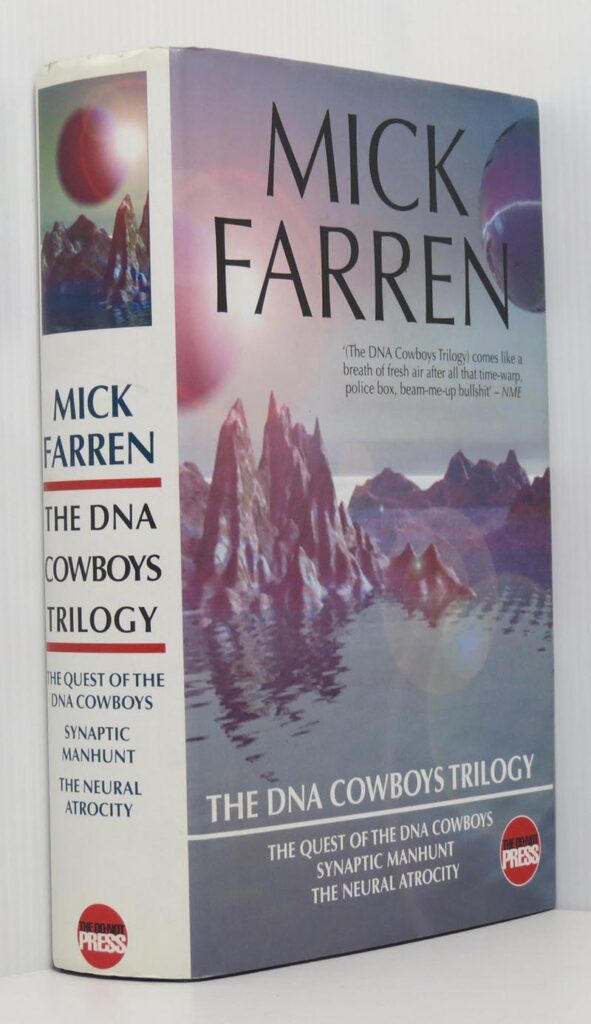
I had some original paperbacks of some Mick Farren books that I donated to charity before moving, and now they’re selling for hundreds of dollars. Ugh! This hardcover bind-up of the DNA Cowboys Trilogy was a nice find though. Farren is fairly underground, splitting time between being a rock musician (Deviants, solo), producer, non fiction, horror (Renquist Quartet vampire series) and SF. He’s a good writer, and his SF has plenty of the psychedelic, demented rock & roll energy heard in his music.
Shiro Masamune – The Ghost in the Shell (1991-03)

This may take a while, as I picked up the hardcover omnibus, which is 832 pages. It’s a beautiful book, and if more manga series get this treatment, I would be more likely to catch up on other titles. I had to give up of having a regular pull list at a comic store in 2015 when I moved away from any nearby store, and was honestly tired of dealing with the accumlated piles of issues. I tried a bit of Tsutomu Nihei’s BLAME! on my Kindle Fire, but it remains a frustrating experience, as it’s awkward to zoom in to make panels readable.
TBR
- Di Filippo, Paul – The Steampunk Trilogy (1995)
- Pratchett, Terry – Mort (Discworld #4/Death #1, 1987)
- Shiner, Lewis – Frontera (1984)
- Scalzi, John – Starter Villain (2023)
- King, Stephen -11/22/63 (2011)
- Murakami, Haruki – Kafka on the Shore (2005)
- Danielewski, Mark Z. – House of Leaves (2000)
- Moore, Christopher – Fool (2009)
- Sloan, Robin – Mr. Penumbra’s Twenty-Four-Hour Book Store (2009)
- Pargin, Jason – Zoey Is Too Drunk for This Dystopia (Zoey Ashe #3, 2023)
- Farmer, D.C. – Troll Lotta Love (Hipposync Archives #5, 2017)
- Vonnegut, Kurt – Mother Night (1961)
- Dick, Philip K. – The Three Stigmata of Palmer Eldritch (1964)
- Egan, Greg – Permutation City (Subjective Cosmology Cycle #2, 1992)
Manga & Graphic Novel TBR
- Charles Burns – Black Hole (1995-05)
- Gou Tanabe – H.P. Lovecraft’s At the Mountains of Madness (2024)
- Eddie Campbell – Alec: The Years Have Pants (1984-01)
- JC Deveney & PMGL – Haruki Murakami Manga Stories 1: Super-Frog Saves Tokyo, Where I’m Likely to Find It, Birthday Girl, The Seventh Man (2023)
- JC Deveney & PMGL – Haruki Murakami Manga Stories 2: The Second Bakery Attack; Samsa in Love; Thailand (2024)
- JC Deveney & PMGL – Haruki Murakami Manga Stories 3: Scheherezade; Sleep (2025)
- Kentaro Miura – Berserk (1989-ongoing)
- Hiroki Endo – Eden: It’s an Endless World! (1997-08, 18 vol)
- Tatsuya Endo – Spy x Family (2019-ongoing)
- Makoto Yukimura – Planetes (1999-04, 4 vol)
- Tsutomu Nihei – BLAME! (1997-03, 10 vol)
- Naoki Urasawa – Pluto (2003-09, 8 vol)
- Haruko Ichikawa – Land of the Lustrous (2012-24, 13 vol)
- Naoki Urasawa – 20th Century Boys (1999-06, 22 vol)
Anticipated

Thomas Pynchon – Shadow Ticket (Oct 7, 2025)
It’s always a major event when Pynchon releases a new book, particularly because he’s quite old, and every new release is to be treasured. Those put off by his early postmodernist books should try Inherent Vice (2009) and Bleeding Edge (2013), which are fun and relatively easy reads.
- Lethem, Jonathan – A Different Kind of Tension (Short Stories, 23-Sep)
- Kitasai, Yume – Saltcrop (30-Sep)
- Liu, Ken – All That We See or Seem (14-Oct)
- Arnott, Jake – Blood Rival (15-Oct)
- Hill, Joe – King Sorrow (21-Oct)
- Kristoff, Jay – Empire of the Dawn (Empire of the Vampire #3, 4-Nov)
- Islington, James – The Strength of the Few (Hierachy Trilogy #2, 11-Nov)
- Carey, M.R. – Outlaw Planet (18-Nov)
- North, Claire – Slow Gods (18-Nov)
- Ruocchio, Christopher – Shadows Upon Time (Sun Eater #7, 18-Nov)
- Newman, Kim – Model Actress Whatever (12-May)
2025 So Far
- Philip K. Dick – Ubik (1969)
- Norman Spinrad – Little Heroes (1987)
- T.R. Napper – 36 Streets (2022)
- Mick Farren – The Tale of Willy’s Rats (1975)
- Thomas Pynchon – Vineland (1990)
- John Shirley – City Come A-Walkin’ (1980)
- Michael Bishop – Count Geiger’s Blues (1992)
- Christopher Priest – The Glamour (1984)
- William Gibson – Idoru (Bridge #2, 1996)
- Christopher Moore – Anima Rising (2025)
- Haruki Murakami – The City and Its Uncertain Walls (2024)
- Ted Chiang – Stories of Your Life and Others (Arrival – Short Stories, 2002)
- Philip K. Dick – The Collected Stories 4: The Minority Report (2023)
- Neal Stephenson – Quicksilver (Baroque Cycle #1, 2003)
- Michael Moorcock – The Final Programme (1965)
- Neal Stephenson – Polostan (Bomb Light #1, 2024)
- Jonathan Gould – Burning Down the House: Talking Heads and the New York Scene That Transformed Rock (2025)
- Colin Wilson – The Philosopher’s Stone (1969)
- Susanna Clarke – Piranesi (2020)
- William Gibson – Burning Chrome (Short Stories, 1986)
- Tim O’Brien – The Things They Carried (Short Stories, 1990)
- Percival Everett – James (2024)
- Mick Farren – The Quest of the DNA Cowboys (DNA Cowboys #1, 1976)
- Bruce Sterling – Mirrorshades: The Cyberpunk Anthology (1986)
- Kazuo Ishiguro – Klara and the Sun (2021)
- Andrew Cartmel – The Run-Out Groove (Vinyl Detective #2, 2017)
- Ben Aaronovitch – Rivers of London (Rivers of London #1, 2021)
- Robert Jackson Bennett – The Tainted Cup (Shadow of the Leviathan Book 1, 2024)
Collecting
I used to have several hundred books, and it kills me that I had to get rid of most of them in order to make the cross country move from Chicago to Rancho Bulboso. With the new house there was a couple big book shelves that have taunted me with semi-empty shelves taken up by some of my nonfiction music books, and random crap. Around my birthday I started adding to my hardcover collection of all-time favorite books.
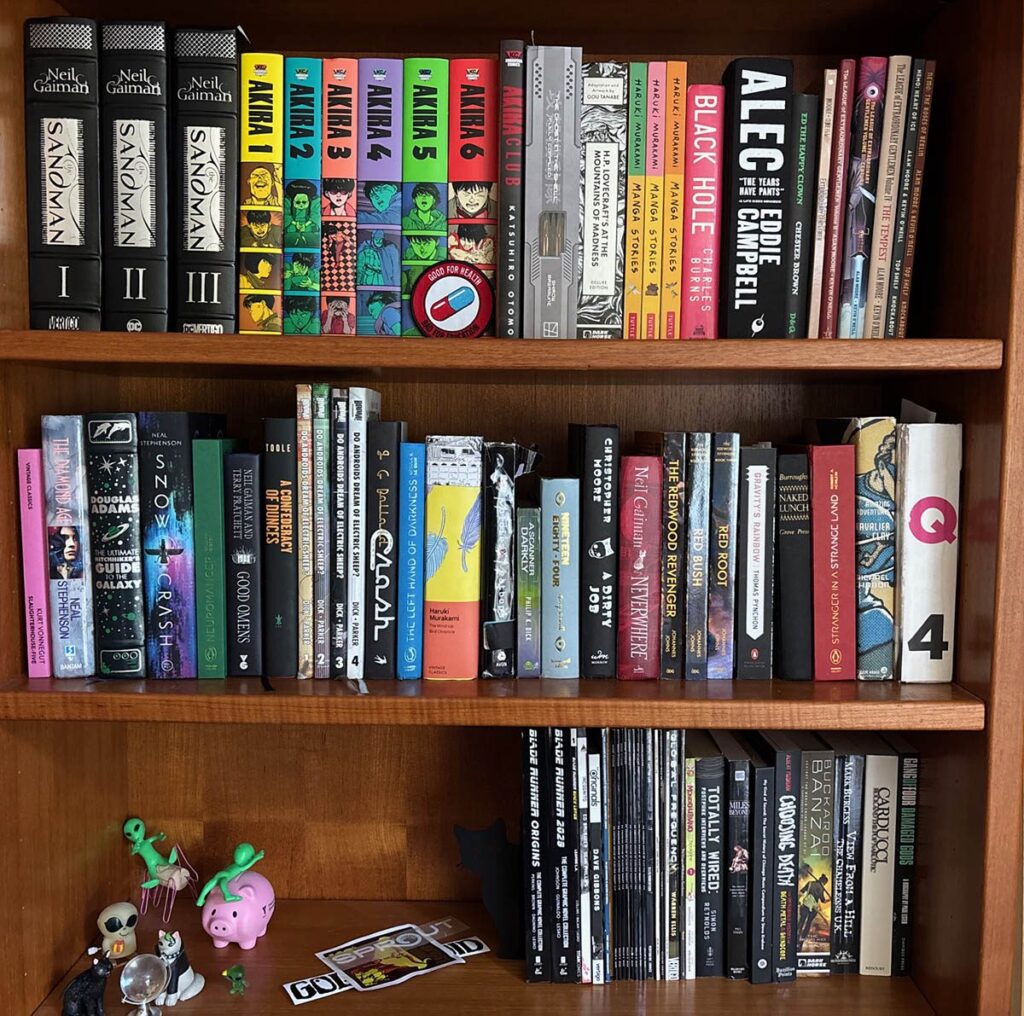
If I had the money and space, I would collect those classic DAW SF books with the yellow spines. The story behind the publisher is great, and worthy of a big coffeetable history book with lavish illustrations, if not a movie. Here’s an example of the trippy cover art in some of the PKD books.

BookTubers
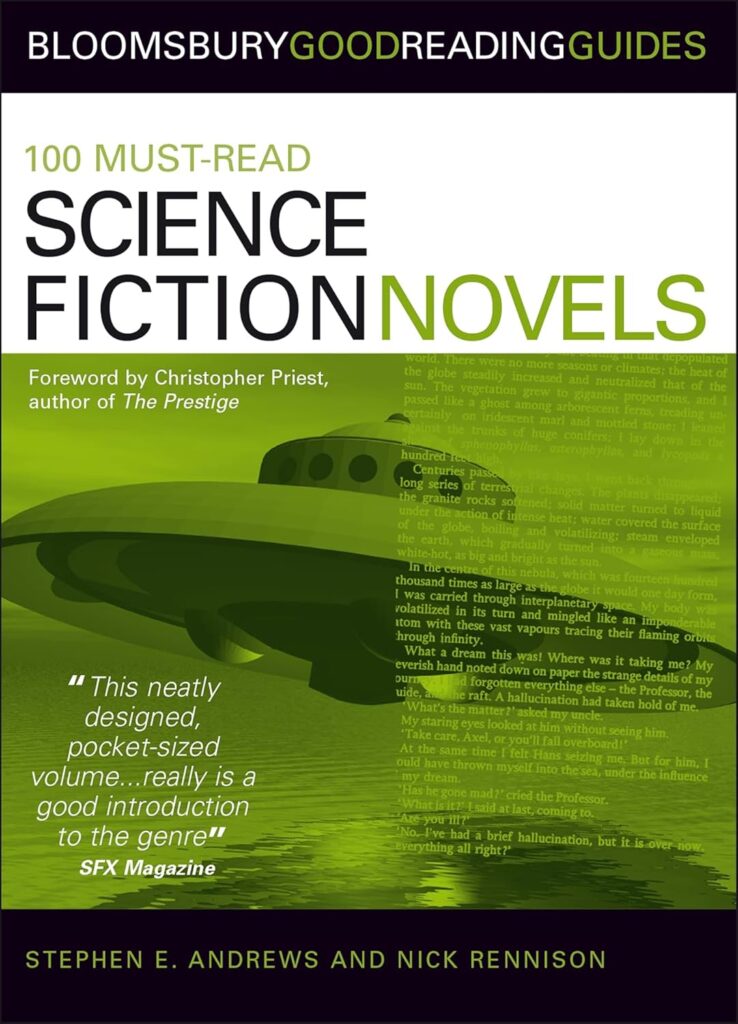
Despite the fact that the act of daily reading for pleasure has been in decline since the 1940s, one bright spot is the proliferation of BookTubers, many of them Gen Z, who are spreading enthusiasm for reading, and parallel with the vinyl community, collecting books. With the charm of youthful enthusiasm comes annoying habits of acting like they invented reading, and 25 year-olds selling classes on how to read Ulysses. So it’s probably no surprise that my favorite BookTuber is a few years older than me, Stephen Andrews, who’s been in the bookselling business for over 40 years and has written several guides, including this one which I picked up. His recommendations are responsible for seven of my favorite summer reads.
Outlaw Bookseller
Stephen Andrews jokes that he goes into angry old man rants, but he actually shares a lot of joy and enthusiasm for books that would otherwise have been forgotten and looked over by younger readers. I read several hundred SF books as a kid, and often regret not keeping up the pace as an adult, because there’s so many greats I never read. Andrews digs deeper than the most obvious canon better than anyone I’ve seen, and also has a deep knowledge of music fiction and crossovers with SF, being a musician and fan.
Rammel Broadcasting
Older than Gen Z, this bloke rediscovered his joy for reading about five years ago and went all in. He has one of the most pleasant styles of delivery of all the BookTubers, and has a pretty high rate of intersecting with my own quirky tastes in literary fiction outside of SF (PKD, Murakami).
Bookpiled
The next most knowledgable tuber after Outlaw Bookseller, he collects a massive amount of classic SF, and has got me interested in underrated writers like Barry N. Malzberg.
Mike’s Book Reviews
Like many tubers, Mike’s a huge Stephen King fan, and has definitely perked my interesting in circling back to some of King’s more acclaimed books that I missed. He reads a lot of massive fantasy series that I have no interest in, but he’s one of the most entertaining to watch as I putter about in the kitchen.
Media Death Cult
Very silly, fantastically produced channel that’s entertaining even if I’m not on board with all the books covered.
Words in Time
Young Aussie has turned me on to some good stuff.
Bart’s Book Space
Migrating from Poland to the U.S. as a teenager, his enthusiasm for both new releases and classic fiction and SF is infectious.
- Red Fury Books
- Sunnyvale Reject
- Quinn’s Ideas
- BRIAN LEE DURFEE Reviews
- Zen Lieu Reads the World
- TheShadesofOrange
- SciFi Scavenger
- Talking Story
- Daniel Greene
- Secret Sauce of Storycraft
- Ian Gubeli
- PulpMortem
- Library of a Viking
- Geeks That Parent
- Danni Dabbles
- EmmieReads
- Write Conscious
May 31, 2026
Fester’s Lucky 13: 1996
April 2, 2026
Fester’s Lucky 13: 1986