Books I read on vacation in Costa Rica.
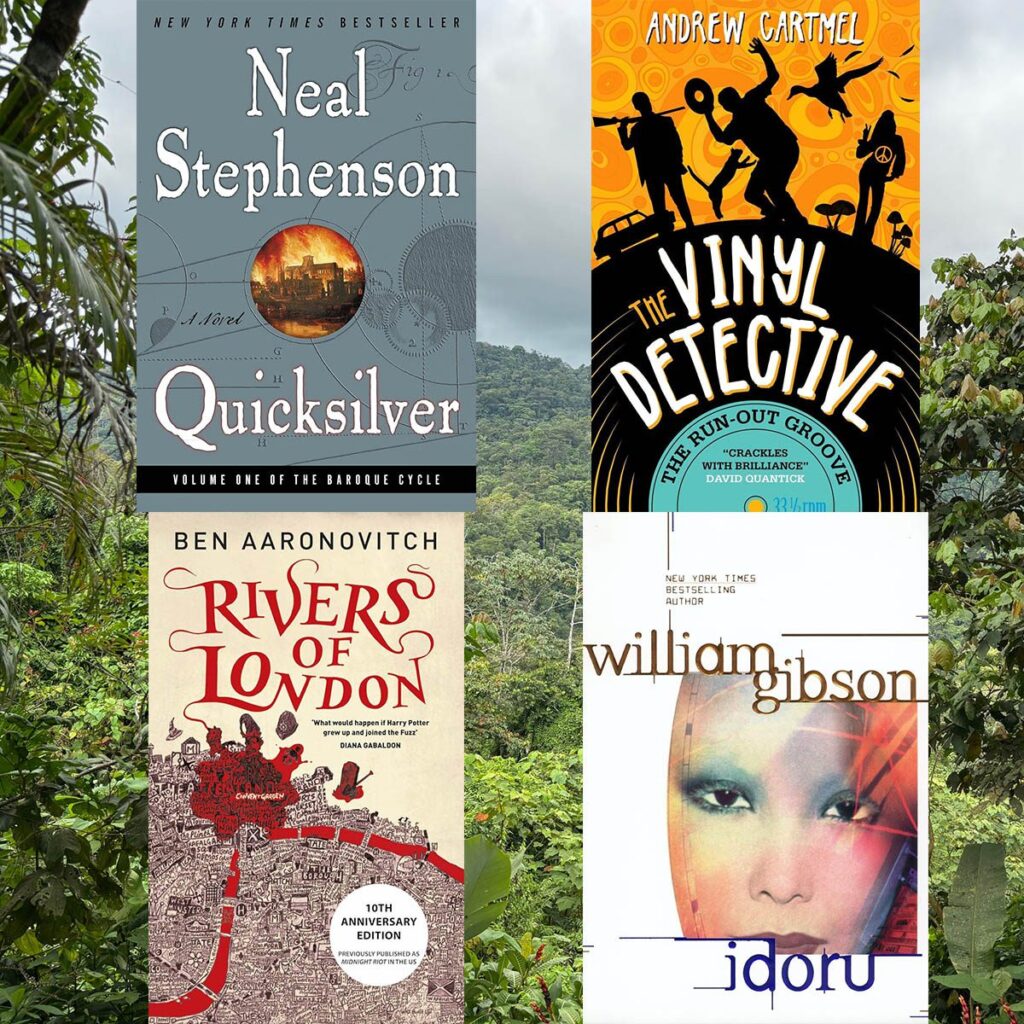
This is no guide to the best beach reads of 2025, but rather just what I read for a week while on otherwise total media blackout — no phones, social media, TV, and the music was mostly piped in at the resort, a mix of bossa nova and lounge style covers along the lines of Nouvelle Vague. I did listen to some Dire Straits when getting ready in the mornings, since people have been talking about the 40th anniversary reissue of Brothers in Arms (1985).
We were at Lands in love Hotel & Resort in Costa Rica. The 280 acre property is in the cloud forest, 75 miles from the San Jose airport. It hosts all kinds of activities including ziplining, whitewater rafting, early morning and night nature hikes (all of which we did), canyoning, eco biking, tubing, wall climbing, and bungy jumping. But most importantly, the animal tour, as primarily, it’s all to fund their Animal Love sanctuary (600+ dogs, cats, horses, goats, sheep, ducks, geese, chickens, rabbits, etc.).
Founded in 2005 at the site of a former hotel by a group of 16 friends from Israel as a kind of kibbutz, it truly is a utopian community that’s attracted volunteers to stay year round, some of whom have retired here.
When we weren’t on adventures, we had leisurely meals provided by the brilliant head chef Naama Ariel, who made everything (over 100 vegan dishes, smoothies and desserts) from scratch. I really need to learn to make good homemade hummus an chickpea omelettes. I wish she’d publish a cookbook. I did a lot of reading at and in the pool (yay waterproof Kindles!) and when it was raining, in the covered patio.
Neal Stephenson – Quicksilver (Volume One of the Baroque Cycle) (2003)
My favorite author of 90s post-cyberpunk, along with William Gibson, took a deep dive into historical fiction with Cryptonomicon (1999) with brilliant success. Rather than change direction, Stephenson doubled down, jumping from the origins of modern computers in WWII to the origins of modern science in the late 17th century with Isaac Newton and his colleagues Robert Hooke and Gottfried Leibniz in the Royal Society. The story is anchored in three main fictional characters (whose descendants were the core of Cryptonomicon) — school roommate and friend/assistant of Newton and Puritan Daniel Waterhouse, vagabond (King of the vagabonds), former soldier and adventurer Jack Shaftoe who goes by “Half-Cocked Jack” that to my horror I slowly realized because he literally has a partially severed penis. Shaftoe rescues Eliza from a Turkish brothel, and she arguably has the most history-making impact. Hailing from the fictional island country of Qwghlm (due to ice storms in June, it’s presumably between Scotland and Norway), she becomes a spy, invents the word “sabotage,” and gets into helping rich people with their investment portfolios, in turn shaping modern economics.
The book actually starts later in the 1800s, when Waterhouse is living in Boston and is summoned back to England. The first half of the book keeps going back to his harrowing voyage where pirates are attempting to kidnap him, but they outwit them thanks to his math skills, no joke. Then that storyline simply disappears. There is a bad habit that blossoms here and has plagued some, but thankfully not all of Stephenson’s books ever since — long, rambling digressions into the far too specific technical details of how shit works. His publisher recognized he’s a bit of a genius, and apparently didn’t have the stones to edit his writing. Thus, we get 20+ page digressions on Puritan philosophy, syphilis (the French Pox if you’re English, the English Pox if you’re French, har har), currency and the art of haggling, vivisection (UGH), slavery, palace intrigue, politics, wars, and the Plague just to name a few. Not to mention that there is no compelling plot, so no real resolution to anything at the end of this book. Just the promise of 2,000 more pages of the same. Yes, this is why it took me 22 years to finally get to this. But you are rewarded with a judicious sprinkling of some brilliant writing and witty, dry, gross, often even juvenile humor. You really have to love Stephenson to tolerate the quirks, unless you are one of those gluttons for punishment who seek out the most unwieldy and difficult books for fun. If you are that kind of sick bastard, you just might appreciate his genius, and simply sit back and soak it all in.
The prospect of trudging through two more volumes does give me pause, but they’re sitting there in my Kindle taunting me, so maybe on my next vacation. I will most likely skim through the many digressions to maintain my sanity.
Andrew Cartmel – The Run-Out Groove (The Vinyl Detective #2) (2017)
When I read the first volume of this series, there weren’t any other books written in the series. I only recently realized that there’s now eight, which is good news, because this is my kind of cozy mystery — the hero is a nerd record collector who loves cats. Not that there’s a shortage of cozy mysteries with cats, but most of them are too poorly written to tolerate. But Cartmel is a solid writer who can spin up a good plot, interesting characters, and just the right amount of music nerd asides. Perfect vacation reading, especially when recovering from the nearly thousand page long Quicksilver. I noticed that Cartmel thanked Ben Aaronovitch, who he collaborated with on a comic, and I realized I bought one of his books on sale a while back.
Ben Aaronovitch – Rivers of London (2011)
I went through a phase where I read a lot of urban fantasy, but that subgenre kind of dried up in terms of quality writing. I was skeptical about this series, but was pleased to find that Aaronovitch has the chops necessary to balance inventive mysteries that cross over from real-life crime procedurals into the world of ghosts and magic. He had a bit of practice writing for Dr. Who for a bit. The hero is young Constable Peter Grant. After two years in Probationary status, his career prospects to be a detective didn’t look promising, until he meets a ghost at a murder scene, and is taken under the wing of Detective Chief Inspector Thomas Nightingale, who also happens to be a wizard. As both his constable and apprentice, Grant becomes acquainted with the gods and goddesses of the rivers, begins learning to cast spells, and unravels the complex mystery behind a string of supernatural murders. There is some comic relief and light romantic flirtation, but also a very high body count. An interesting fusion of Harry Potter style fantasy with crime procedural thrillers and a strong influence of Neal Gaiman’s American Gods. A very promising series, I’ll definitely try the next one.
William Gibson – Idoru (Bridge #2) (1996)
While Gibson’s cybepunk Sprawl trilogy in the 80s was a massive influence on the genre and my own perception of technology, I remember finding his Bridge trilogy in the 90s even more enjoyable, as Gibson develops a very pared down writing style that leaves out unnecessary words to convey the frantic action that often occurs in these books just as well as any best selling technothrillers. I re-read Virtual Light last year 31 years after it was first published in 1993, and it was a completely different, but just as rewarding experience, given how astutely prescient Gibson’s near-future scifi was and continues to be. We move from 21st century Bay Area to Japan in this book, with mostly a new set of characters. Rez is an ageing rock star who suddenly announced at some shadowy Tokyo night club that he’s going to marry Rei Toe, Japan’s biggest media celebrity, who also happens to be a creation in virtual reality.
Chia McKenzie is a 14 year-old member of the Lo/Rez fanclub, despite the fact that they are her mother’s age, and the first album was released before she was born. The club sends her on a mission to Japan to get to the bottom of this marrying a virtual idol and somehow rescue him from this nonsense. Colin Laney is a new breed of researcher who has a seeming mystical ability to see patterns in data surrounding people that can be predictive, and gets hired by the Lo/Rez management team, including a tough Aussie felon who’s head of security. Both characters stumble upon intrigue involving illegal nanotechnology (microscopic 3D printers that can build entire cities) and Russian gangsters amongst anime-loving Otaku, virtual Walled City inspired by Kowloon Walled City, and a Love Hotel. Then there’s the discover that Rei Toe is much more human than anyone realized. Just the fact that Gibson predicted virtual idols like Hatsune Miku two decades before the fact is just one of many testaments to his genius. I just hope his optimistic take on AI also come true.
At a relatively brief 308 pages, I devoured this second reading in one day, and I look forward to revisiting the third installment, All Tomorrow’s Parties, as the excruciatingly long wait for the sequel to Agency (Jackpot #2, 2020) continues.
May 31, 2026
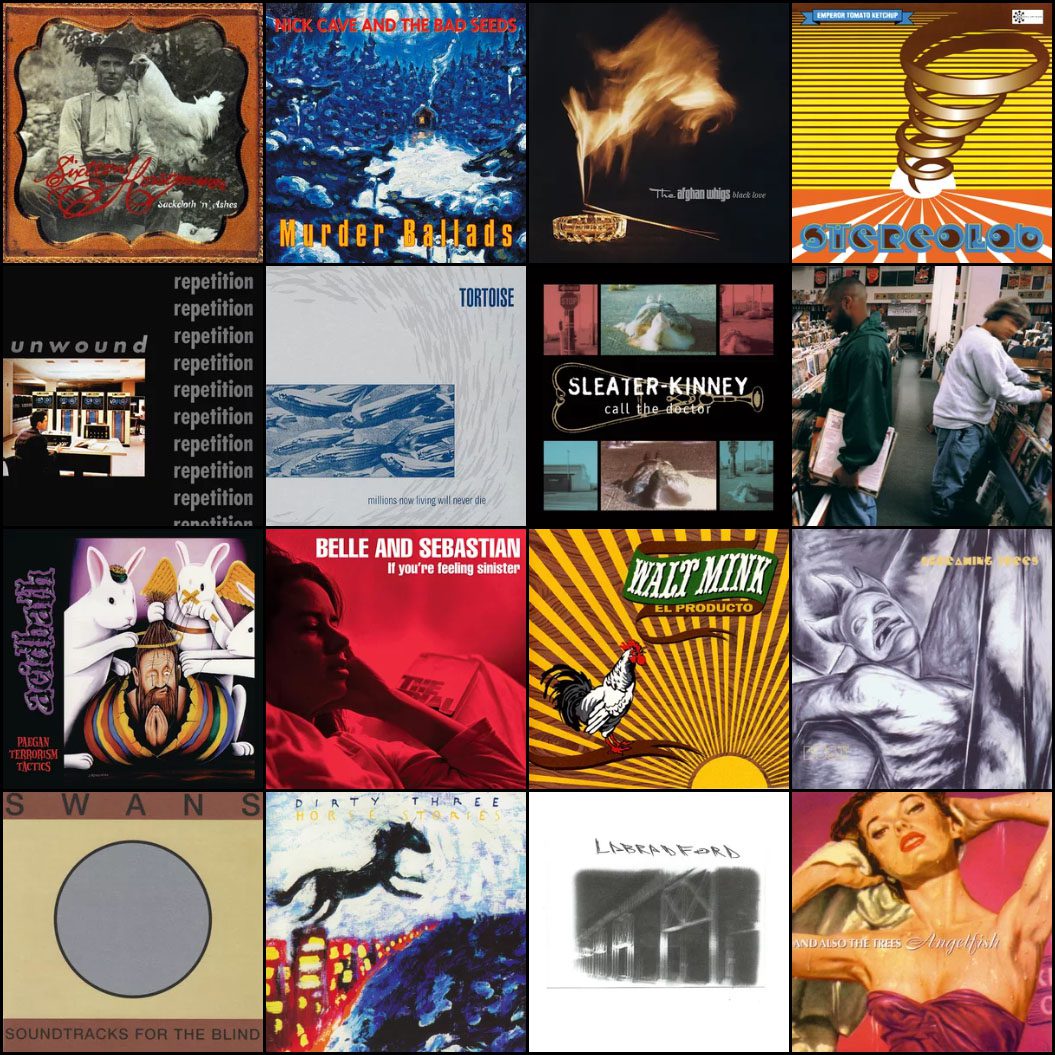
Fester’s Lucky 13: 1996

April 2, 2026
Fester’s Lucky 13: 1986