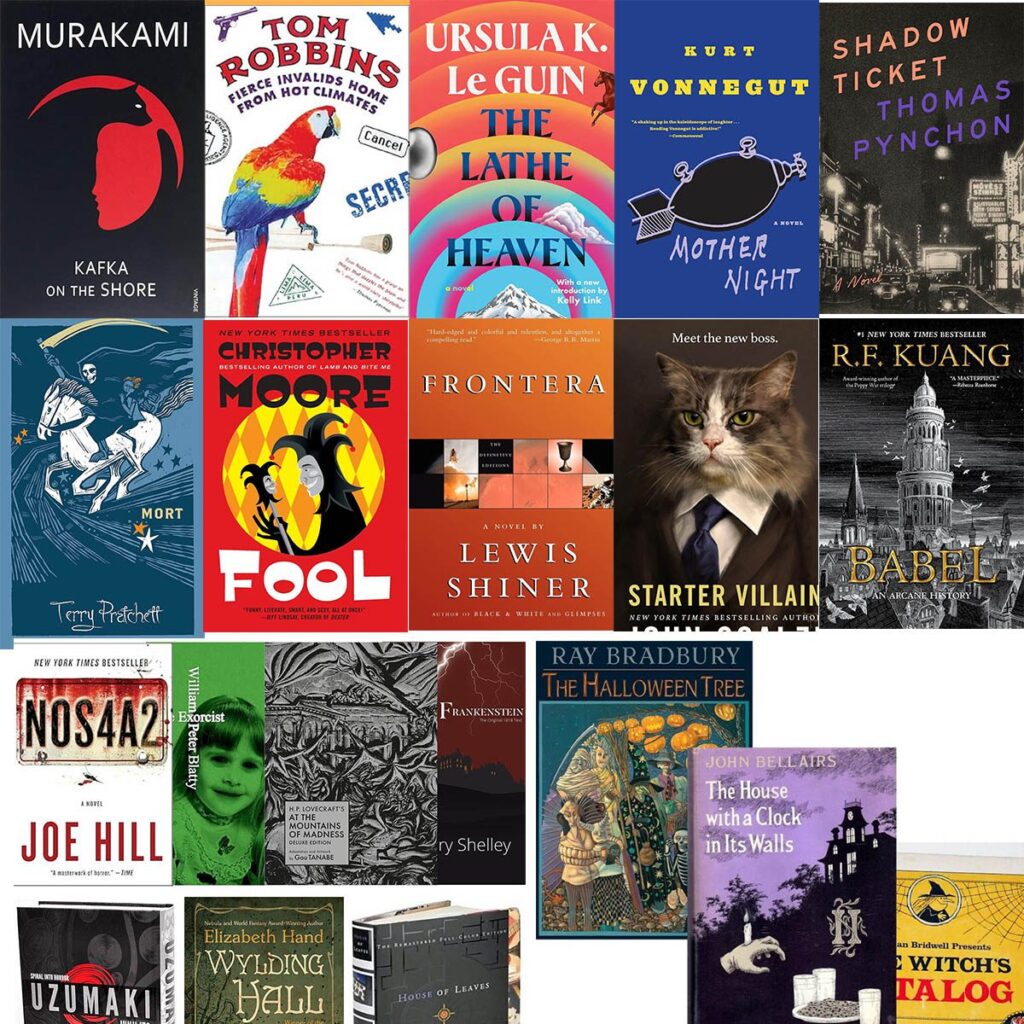
In addition to spooky season, I read some other books, old and new.
Tom Robbins – Fierce Invalids Home from Hot Climates (2000)
“People of the wurl, relax.”
After reading the disappointing Villa Incognito (2005), I got a bit worried when this book’s hero Switters, a 36 year-old CIA agent and known loose cannon, obsesses over both his sixteen year-old step-sister and the notions of innocence. For several chapters. I wouldn’t have complained if some of that was trimmed from the lengthy novel. But once he’s visited a shaman in Peru’s Amazon rainforest named alternatively End of Time and Today is Tomorrow, things get rolling. His mission to release his grandmother’s beloved parrot Sailor Boy into the wild is foiled when on a drug-induced spirit journey, Switters unwittingly is fed the parrot. The price for the arcane knowledge is a curse that he is not to let his feet touch the ground again on penalty of death. His doubts are dissolved when British ethnographer, R. Potney Smithe, drops dead in front of him from a similar curse.
Switters makes do with a wheelchair and sometimes stilts, and ends up with a renegade order of nuns in a convent tucked away in the Syrian Desert. The nuns are the keeper of a prophecy, the Third Secret of Fatima, and during his lengthy stay with them, has extensive discussions about spirituality, the dogma of organized religion, the balance of good and evil, and the power of imagination and humor and how he incorporates it into his own paths informed by Zen, Taoism, Tantra, as well as pacifism and anarchy. The running gag of his obsession with James Joyce’s Finnegans Wake highlights the importance of language and the idea that the universe is a place of inherent paradox and cyclical mystery. It’s Switters’ bible of sorts, a manual to finding meaning in the irrational, embracing contradictions and chaos.
Robbins frequently crosses the line of good taste and restraint, partly because at that point, he’s 65 and has zero Fs left to give. This feels like a kind of magnum opus, a culmination of his previous work. If Switters seems an unlikely character in how extremely capable he is with his talents, and a bit smug in his intellect. His Bugs Bunny manner and some particularly obvious flaws make his ego forgivable as he does go through a character arc, slowly becoming at least somewhat worthy of the love of Sister Domino Thiry, who is much more age appropriate at 46.
Amidst the irreverent philosophizing and slapstick humor are some serious themes, as well as some prescient moments that are downright spooky in a book published on September 5, 2000:
“American foreign policy invites opposition. It invites terrorism.” Switters said, “Terrorism is the only imaginable logical response to America’s foreign policy, just as street crime is the only imaginable logical response to America’s drug policy.”
But mainly he leaves us with the wisdom to embrace contradictions with a mix of Zen detachment and irreverent wit, defeating melancholy by refusing to take things, and oneself, too seriously.
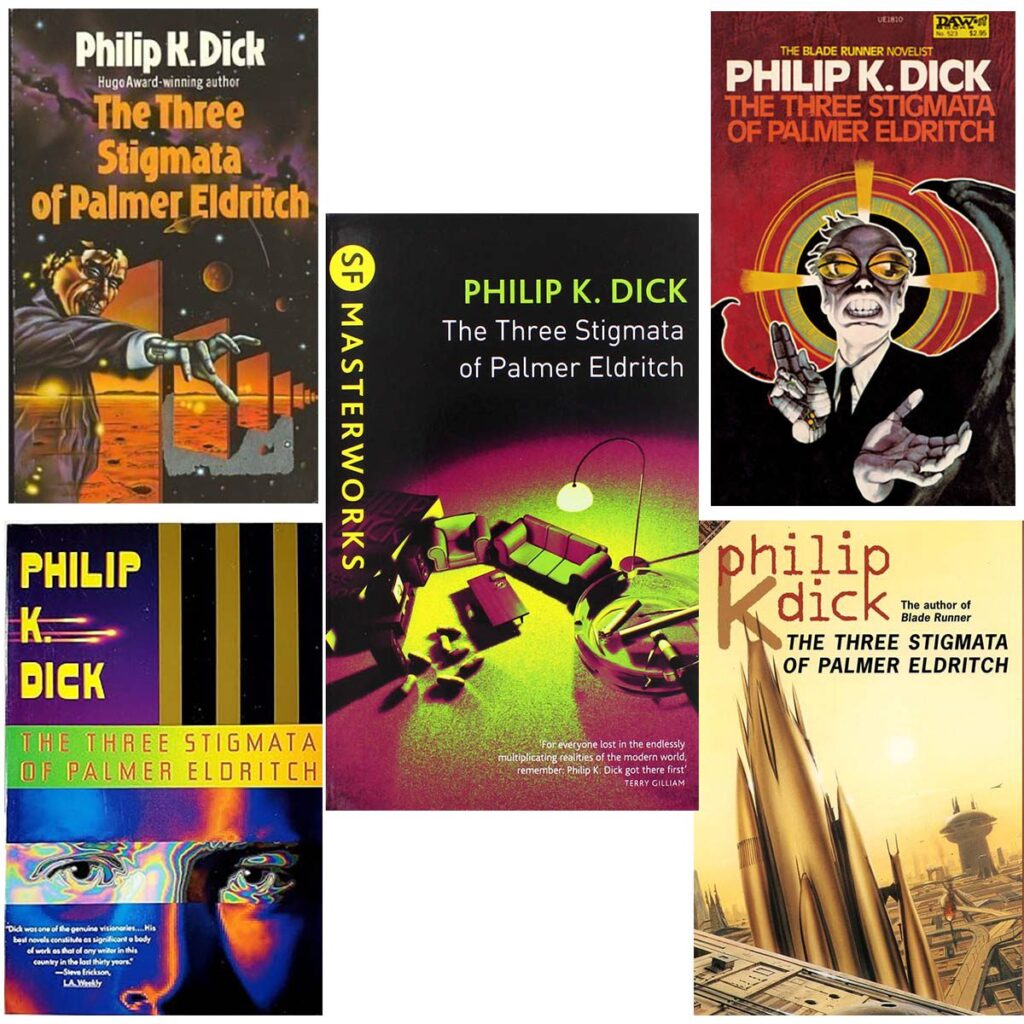
Philip K. Dick – The Three Stigmata of Palmer Eldritch (1964)
“I did not find God in the Prox system. But I found something better. God promises eternal life. I can do better; I can deliver it.”
It’s explorations of reality, religion and corporate control makes this arguably Philip K. Dick’s most influential work, shaping the stories of Ursula K. Le Guin (in The Lathe of Heaven) and the Cyberpunk genre, as well as movies like Videodrome, Dark City, the Matrix Trilogy and Inception. Jeff Hopp’s Legend of the Mind (2021) graphic novel is a direct tribute to the book, and Netflix has an adaptation in development. A future earth has become hot, overcrowded and inhospitable due to climate change, and there is a global draft to send people to even more cramped space colonies, doomed to lead miserable lives. The only escape is Can-D, an illegal hallucinogenic where people can live in a “translation” world using “Perky Pat” layouts — dollhouse-like sets based on an idealized version of 1950s earth. Meanwhile, industrialist Palmer Eldritch has brought a more powerful drug, Chew-Z, from an interstellar trip to Proxima Centauri. From his adventures he now has steel teeth, mechanical eyes and a prosthetic right arm. Those who try Chew-Z experience powerful religious epiphonies, which disconcertingly also include Eldritch, suggesting that what has returned from the stars is no longer fully human. There’s characters called precogs with psychic powers, reality-warping biomechanical technology, hallucinations-within-hallucinations, basically all the building blocks that helped classic SF transition to the 21st century.
This has book has so many twists it would leave M. Night Shyamalan an incapacitated pretzel, and I absolutely can’t wait to see what Netflix does with it.
Ursula K. Le Guin – The Lathe of Heaven (1971)
“Love doesn’t just sit there, like a stone, it has to be made, like bread; remade all the time, made new.”
Le Guin’s first standalone novel begins with George Orr, living in a dystopian world of ecological collapse and mass starvation due to overpopulation (over 7 billion) and political violence, who has been having dreams that change reality. Not wanting to be responsible for drastic changes, he began taking drugs to suppress his dreams, but the authoritarian society clocked his illicit use and ordered him to be subjected to psychological therapy with oneirologist Dr. William Haber. When Haber sees proof of Orr’s abilities, he uses hypnotic suggestions to manipulate Orr to shape what he thinks is a better world. For every problem fixed, however, the hubris and consequences manifest in numerous other ways. By suggesting the world not be so crowded, a plague retroactively kills off 6 billion people. Violence has increased, so Dr. Haber aims for peace between humanity, which results in an alien invasion, and so forth. The Dr., Orr and sometimes his girlfriend Heather (depending on which timeline they’re in) remember each change, but no one else does.
The slippery slope from utilitarianism to the will to power and authoritarianism is illustrated by Taoist quotes before many of the chapters, emphasizing how manipulating reality upsets the cosmic balance. At one point, Heather seeks out George in a remote cabin that he dreamed into existence, and I felt I was in the thick of a Haruki Murakami novel, making me wonder if he’d read this book. Le Guin said it’s an homage to Philip K. Dick and his explorations of reality, consciousness and philosophy. A quick read at 191 pages, there’s plenty of layers of political, social and philosophical critiques to keep one busy unpacking. Definitely an important classic from one of the most fertile eras of speculative fiction.
“Things don’t have purposes, as if the universe were a machine, where every part has a useful function. What’s the function of a galaxy? I don’t know if our life has a purpose and I don’t see that it matters. What does matter is that we’re a part. Like a thread in a cloth or a grass-blade in a field. It is and we are. What we do is like wind blowing on the grass.”
Kurt Vonnegut – Mother Night (1961)
“We are what we pretend to be, so we must be careful about what we pretend to be.”
I started this book blind, not having read any description or blurb about it. So when Vonnegut talks about in the intro his experiences as a POW in Dresden, I thought, oh crap, another war book, here we go again, so it goes, so be it. Perhaps just a warm-up to the author finally figuring out how to communicate his deeply complicated feelings about the bombing of Dresden, this book stands pretty solidly as a great work of literature in it’s own right, even for those who, myself included, contend that Slaughterhouse Five (1969) is his towering masterpiece. Playwright Howard W. Campbell, Jr. is in Israel in 1961, about to be tried as a war criminal, and is writing his memoir, where he reveals that he was recruited as an American spy, convinced to rise up the ranks of Nazis to become in charge of propaganda via radio broadcasts, his immediate boss being Dr. Josef Goebbels. Problem is that the U.S. won’t confirm or deny he was a secret agent, and no one can confirm that his War Department operative, Frank Wirtamen even exists. His beloved wife missing and presumed dead, he spends 15 years in a purgatory-like existence in Greenwich Village, until one day he decides to carve a chess set out of a broomstick and befriends his downstairs neighbor, triggering a quick succession of increasingly absurd and ironic events. His home address is leaked in the media and the only people willing to help and support him are a motley band of racist nutjobs. The brisk plot and twisted satire hits as heavy as an anvil taking a stance against any form of extremism. The darkest Vonnegut book I’ve read so far.
Robin Sloan – Mr. Penumbra’s Twenty-Four Hour Book Store (2009)
Clay feels lucky to snag a job in the post-tech bubble recession in the 2000s. It’s a mysterious little San Francisco bookstore run by the gnomic Mr. Penumbra, it’s main customers appear to use it as a lending library with cryptically coded books. Soon he’s unraveling the mystery of this secret society using high-tech data visualization to break a 500 year-old code created by Venetian printer Aldus Manutius. With help from his friends, he follows a trail that involves his favorite fantasy author, Clark Moffat’s The Dragon-Song Chronicles and the Gerritszoon typeface.
That might seem a bit nerdily esoteric to some, but not for fans of Neal Stephenson. Sloan neatly sums up his influences in this passage:
“Stephenson, Murakami, the latest Gibson, The Information, House of Leaves, fresh editions of Moffat”—I point them out as I go. Each one has a little shelf talker, and they’re all signed Mr. Penumbra.
This was a fun little adventure and am happy to see there’s more in this series, will definitely be reading the others.
Terry Pratchett – Mort (Discworld #4/Death #1, 1987)
Since Pratchett’s collaboration with Neil Gaiman, Good Omens, became one of my all-time favorite books, I’ve been meaning to circle back to his Discworld books. I had read a few, like Small Gods (#13, 1992) and Going Postal (#33, 2004), but I have a soft spot for Grim Reaper stories, and it’s surprising it took me this long to get around to the Death storyline, which starts with Mort runs for five books. Mort is an awkward, gangly boy who didn’t appear to have any life skills at all. Nevertheless, his father took him to the job fair to see if he could be taken on as an apprentice. Everyone passes him over, but he stays until the very end at midnight, last man standing, when Death comes by and hires him. There’s some confusion as to why Death needed an apprentice, because Death is immortal and doesn’t retire. But perhaps he wanted a vacation. After barely giving Mort any training in liberating souls from their bodies at the times of their death, Death himself disappears, leaving Mort to handle things solo. Being a young male, he of course mucks things up by killing an assassin meant to kill a teen princess, who’s obviously too pretty to die. This creates a rift in reality, leaving Mort to deal with the consequences.
Pratchett’s comedic style has been compared to Douglas Adams, and this is definitely the funniest Discworld book I’ve read since Good Omens. The ending had enough of a twist that I wasn’t able to fully predict it, and the only thing lacking was I did not really grow to love any of the characters like the angel and demon in Good Omens. But it’s definitely good enough to keep the other Death series in my TBR.
Christopher Moore – Fool (2009)
I’d read about four Christopher Moore books leading up to A Dirty Job (2006), which is when he started becoming one of my favorite authors. His comedy has the wit of Kurt Vonnegut and the absurdity and magical critters of Tom Robbins, a sweet spot for me. It took me a while to circle back to the Fool trilogy, because I’m not a huge Shakespeare fan. But I should have had faith that Moore would have his way with the Bard enough unsavory ways to make it fun. Here he molests King Lear, basically fixing it, turning an insufferable tragedy into a filthy comedy with bits of tragedy, told from the perspective of the King’s fool, Pocket. It’s anachronistic top to bottom of course, mixing Elizabethan language with 20th century British slang, making it as much a tribute to contemporary British satire and comedy as much as an irreverent tribute to Shakespeare. Interestingly, his most recent book Anima Rising (2025) contains a warning about the lascivious content, even though it was chaste compared to Fool, which is riddled with all kinds of shagging, most of it vividly gross. A marker for how much things had changed in a decade. A good time had for most (readers, shaggers and shaggees) except for the villains meeting their fates, and I won’t wait so long to get to The Serpent of Venice (2014).
Lewis Shiner – Frontera (1984)
Peripherally associated with cyberpunk, Shiner’s first novel got plenty of attention from being nominated for the Nebula, Locus and Philip K. Dick awards. While there are some brief scenes on Earth, a decade after most of the world governments have collapsed, with corporations taking control, that have a gritty noir cyberpunk feel, most of the book takes place in space and on the Mars colony of Frontera, where most have assumed had failed, as they cut off communication years ago. Houston’s Pulsystems, funding a renewed expedition to Mars, knows more than most of the astronauts on the mission realize, using Reese, a veteran of the corporate wars, by controlling him with a programmable patch on his brain. It doesn’t work quite as intended, as previous studies of ancient mythology bleeds over into the program and he believes he’s meant to complete a heroic ancient cycle. Also on the mission is Reese, an older astronaut who was on the original expedition to Mars. He has more connections with some of the people in the colony that the others realize, and he has his own plans for the FTL (faster than light) travel that they were rumored to have developed.
I hadn’t read old school space mission style SF in a long time, but this book, at least in the context of being over 40 years old itself, adds a fresh spin to it, and some intense action that made for a gripping read.
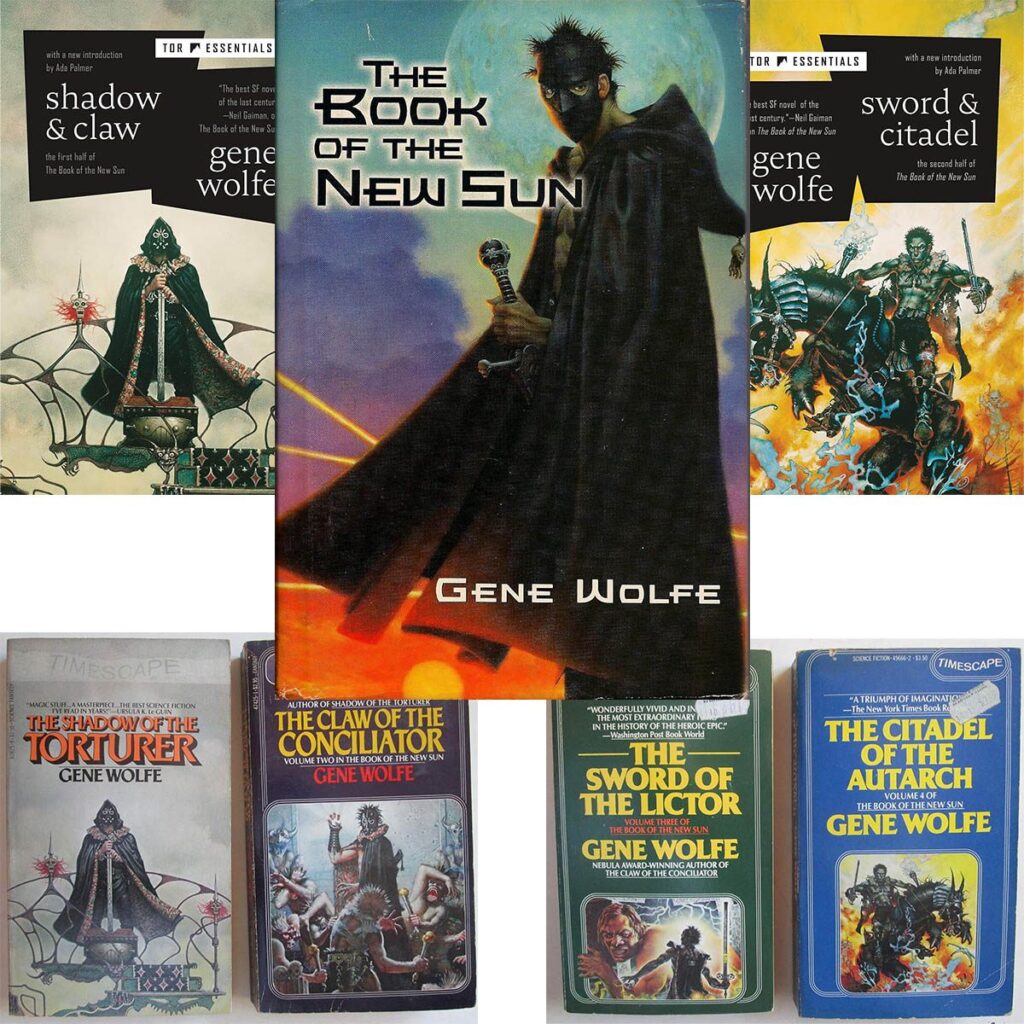
Gene Wolfe – The Book of the New Sun (1982)
I can see why this is regarded highly by so many. It’s SF disguised as epic fantasy, with hints so subtle that if a reader isn’t astute enough or doesn’t know to look for them, wouldn’t even realize that it’s set on an Earth a million plus years into the future, thanks ot the unreliable narration from our hero Severian. Essentially it’s a big ol’ puzzle, and people eat that stuff up. It doesn’t really work as a four part series, as it’s simply one story. None of the individual books have any kind of satisfying conclusions, and at nearly a thousand pages, it’s a bit of a slog. I found myself powering through via sheer force of stubborn will, so I don’t have to be reading this damn book throughout the holidays. An admirable work, but not one that tempts me to read any more Wolfe, even the sequel/coda, The Urth of the New Sun (1987).
John Scalzi – Starter Villain (2023)
I’ve had some Scalzi books in my TBR list for a number of years, and finally cracked open a more recent one that looked like a more breezy comedy, just what I needed. There was a startlingly high body count that I didn’t fully expect, but it still delivered the laughs. Charlie is a classic down on his luck hero, divorced, barely employed, trying to get out of his life rut. When he inherits his recently deceased uncle’s criminal empire, it seems he’s over his head. Thankfully, his uncle thoughtfully provided genetically enhanced cats to look out for him. Given the cat featured on the book cover, I kind of expected more from these felines who can communicate with humans by typing on computer modified for kitty ergonomics, and even have diverse real estate investment portfolios. But the non-human characters with by far the most personality is a group (pod?) of potty-mouthed dolphins who form a labor union. They were kind of the highlight of the book, as well as the image of douchey techbros being catapulted into the ocean. A bit too much of the book was taken up by non-essential characters at an evil villain conference talking way, way too much. But still, a pretty fresh spin, and a satisfyingly fun read.
Anna Kavan – Ice (1967)
It’s appropriate that on a mandatory work trip from Texas to frozen Chicago in December, I read this book, set in a hellish dystopia where an unspecified kind of nuclear war triggers a new ice age. The places and characters are all nameless, with the primary narrator completely unreliable — obsessing over seeking out a woman, possibly a former lover, trying to navigate reality while also repeatedly hallucinating her icy death. Paranoid and panic-stricken amidst war and an impending icy apocalypse. Good times! Some say it’s a allegory of Kavan’s relationship with heroin and struggles with mental health, with the subtext of the misery of her two failed marriages. It’s tense, stressful and confusing, and Brian Aldiss promoted it as the best SF work of the year, even though it’s more of a metaphysical thriller, or what’s become known as slipstream. The closest comparison, aside from Kafka and Beckett, is J.G. Ballard’s Crash (1973), another deeply unpleasant and unsettling book. It is an experimental work that may be worth reading for those looking for something as unique is it is bleak, but I didn’t find it nearly rewarding enough for the anguish, though at least it’s mercifully fairly short.
R.F. Kuang – Babel (2022)
One of the most hotly anticipated new books this year was Katabasis, which came out in August. I will probably try it out next year, but first I wanted to try Kuang’s most acclaimed book, which followed the trilogy The Poppy War (2018-20). Within the BookTube community, dark academia was a subgenre that has become increasingly popular in recent years, with this book cited as one of the highlights. Taking place mostly in 1830s Oxford, it’s historical fantasy rooted in a real time and place, but transformed by a fairly complicated magic system based on metal (silver) and language. Our hero, Robin Swift, is plucked from a certain death from cholera in 1828 Canton by Professor Lowell and brought to London, trained rigorously in Latin and Ancient Greek to be groomed for the prestigious Royal Institute of Translation. Robin is excited to start his new life at Oxford and making friends he has something in common with in fellow immigrants Ramy Mirza (Indian) and Victoire Desgraves (Haitian).
While the book is fairly long (540 pages hardcover), it seems to jump pretty jarringly from the giddy throes of new friendship at a new school, like the first Harry Potter, to suddenly find yourself in the middle of Deathly Hallows, without being shown more depth in the formation of the friendships. The themes of language, colonialism and political violence are by necessity dark, but the sudden breakdown of many of the relationships into drama and conflicts are a bit too overwrought, making the second half a bit of a slog with little respite from the overwhelming sense of dread that the characters are largely doomed, especially since they were trying to prevent the Opium wars with China. Integrating the story into an all-too real history made the characters’ story feel somewhat ineffective, that they would be swept away by more powerful global forces, particularly the single-minded evil of imperial England. It’s definitely an impressive achievement, but the shortcomings in fleshing out characters in the second half gave me the feeling the author is just a bit young to balance such an ambitious project.
Paul Di Filippo – The Steampunk Trilogy (1995)
I first knew Di Filippo from Science Fiction: The 101 Best Novels 1985-2010 (2012), the guide he wrote with Damien Broderick that follows up on David Pringle’s guide. With the well-written, expertly curated recommendations, it’s no surprise that Di Filippo’s own books come highly recommended, including books like Roadside Bodhisattva (2010), Cosmocopia (2014), and Aeota (2019). Published the year before his first official novel, Ribofunk (1996), The Steampunk Trilogy consists of three novellas, all tied together by their settings in alternative Victorian settings where a newt-human hybrid is used to replace the missing Queen Victoria (Victoria), a racist Swiss naturalist encounters anarchists, voodoo, and Lovecraftian horror (Hottentots) and in Walt and Emily, Walt Whitman and Emily Dickinson join a spiritualist expedition into the afterlife and have a fling while sharing poetic verse. Di Filippo expertly handles the Victorian style language, but it’s not for the faint of heart, as the satire is full of bawdy sex and humor that would have your average Victorian clutching their pearls and swooning. It’s a fun genre experiment, but reminds me why I prefer full novels for full immersion.
Favorite Reads of 2025
- Haruki Murakami – Kafka on the Shore (2002)
- Tom Robbins – Fierce Invalids Home from Hot Climates (2000)
- Philip K. Dick – The Three Stigmata of Palmer Eldritch (1965)
- Philip K. Dick – Ubik (1969)
- Ursula K. Le Guin – The Lathe of Heaven (1971)
- Norman Spinrad – Little Heroes (1987)
- T.R. Napper – 36 Streets (2022)
- John Bellairs – The House with a Clock in Its Walls (1973)
- Thomas Pynchon – Vineland (1990)
- Kurt Vonnegut – Mother Night (1961)
- T.R. Napper – 36 Streets (2022)
- William Gibson – Idoru (Bridge #2, 1996)
- John Shirley – City Come A-Walkin’ (1980)
- Michael Bishop – Count Geiger’s Blues (1992)
- Christopher Priest – The Glamour (1984)
- Neal Stephenson – Quicksilver (Baroque Cycle #1, 2003)
- Thomas Pynchon – Shadow Ticket (2025)
- Haruki Murakami – The City and Its Uncertain Walls (2024)
- Terry Pratchett – Mort (Discworld #4/Death #1, 1987)
- Ted Chiang – Stories of Your Life and Others (Arrival – Short Stories, 2002)
- Philip K. Dick – The Collected Stories 4: The Minority Report (2023)
- Christopher Moore – Anima Rising (2025)
- Michael Moorcock – The Final Programme (1965)
- Christopher Moore – Fool (The Fool #1, 2009)
- Lewis Shiner – Frontera (1984)
- Mick Farren – The Tale of Willy’s Rats (1975)
- William Peter Blatty – The Exorcist (1971)
- Jonathan Gould – Burning Down the House: Talking Heads and the New York Scene That Transformed Rock (2025)
- Colin Wilson – The Philosopher’s Stone (1969)
- Susanna Clarke – Piranesi (2020)
- Neal Stephenson – Polostan (Bomb Light #1, 2024)
- William Gibson – Burning Chrome (Short Stories, 1986)
- Mary Wollencraft Shelley – Frankenstein (1818)
- Joe Hill – NOS4A2 (2013)
- Mick Farren – The Quest of the DNA Cowboys (DNA Cowboys #1, 1976)
- Tim O’Brien – The Things They Carried (Short Stories, 1990)
- Percival Everett – James (2024)
- Bruce Sterling – Mirrorshades: The Cyberpunk Anthology (1986)
- Ray Bradbury – The Halloween Tree (1972)
- John Scalzi – Starter Villain (2023)
- Anna Kavan – Ice (1967)
- Kazuo Ishiguro – Klara and the Sun (2021)
- Andrew Cartmel – The Run-Out Groove (Vinyl Detective #2, 2017)
- Gene Wolfe – The Book of the New Sun (1982)
- R.F. Kuang – Babel (2022)
- Robert W. Chambers – The King in Yellow (1895)
- Elizabeth Hand – Wylding Hall (2015)
- Ben Aaronovitch – Rivers of London (Rivers of London #1, 2021)
- Robert Jackson Bennett – The Tainted Cup (Shadow of the Leviathan Book 1, 2024)
- Robert Di Filippo – The Steampunk Trilogy (1995)
- Satoshi Yagasawa – Days at the Morisaki Bookshop (2023)

April 2, 2026
Fester’s Lucky 13: 1986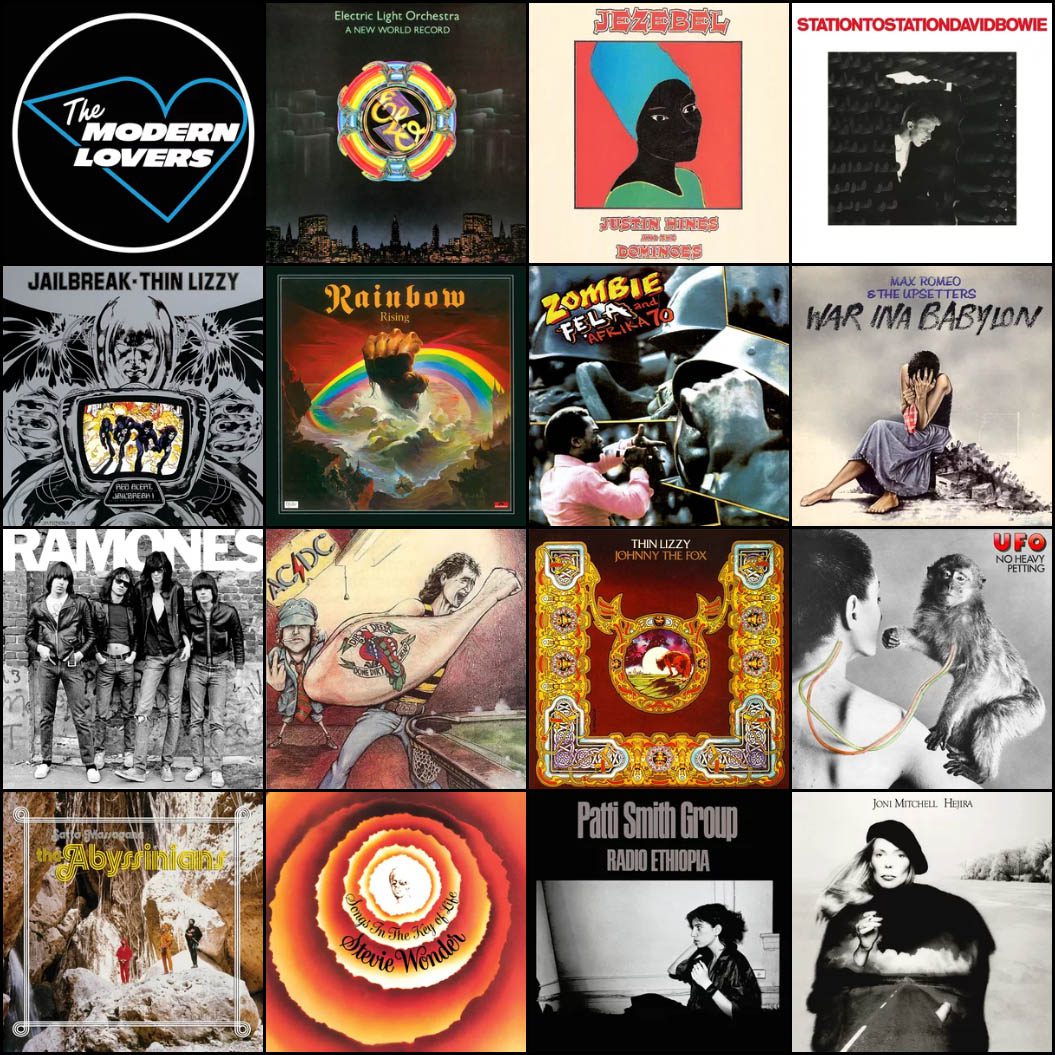
February 27, 2026
Fester’s Lucky 13: 1976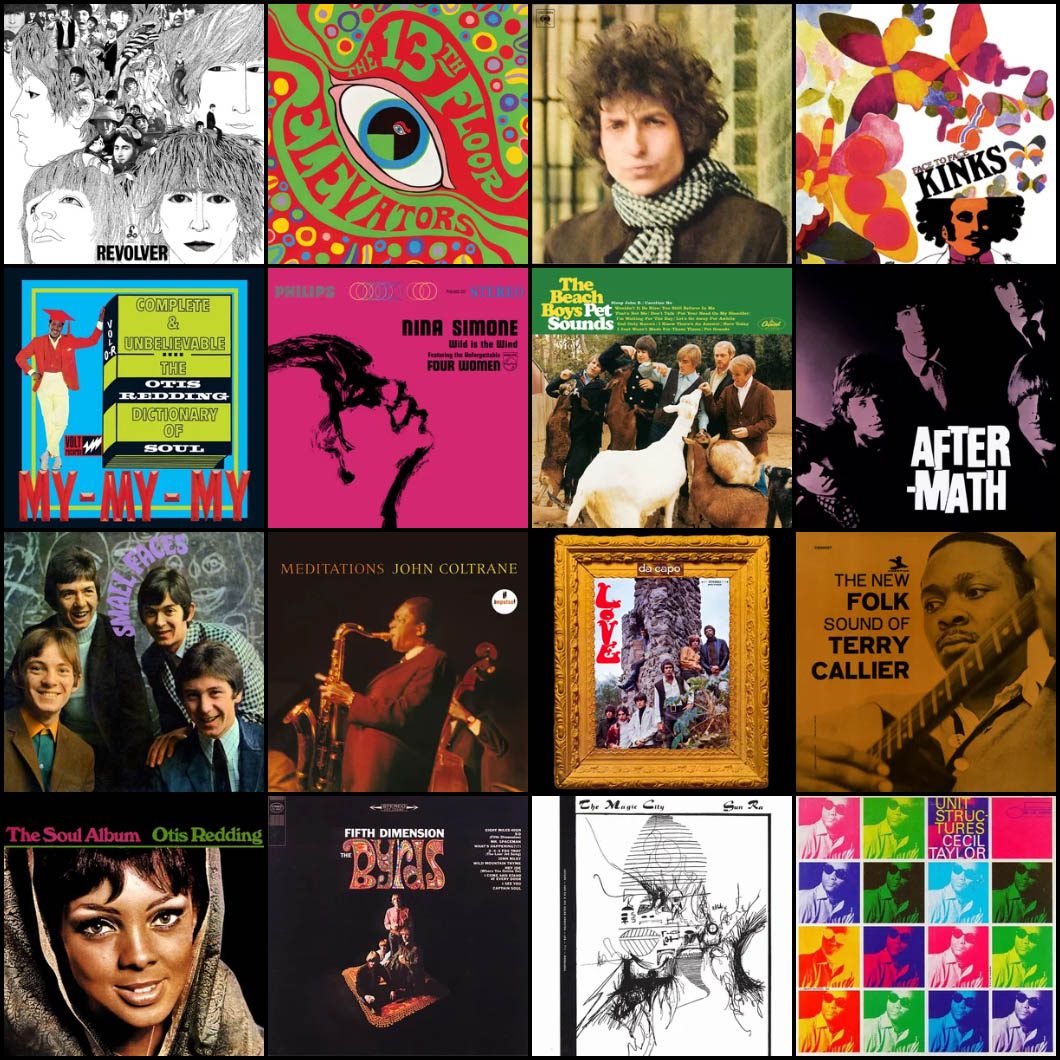
January 30, 2026
Fester’s Lucky 13: 1966