Walking In The Opposite Direction, the documentary about Adrian Borland, has been on my radar of nearly a decade. It was quietly given a digital worldwide release in April. It’s perfectly understandable if you don’t have a clue who Adrian Borland is, unless you’re a longtime Fast ‘n’ Bulbous reader. You’d had to have ignored every single thing that I’ve written about 1980-84 era post-punk, as I reference The Sound all the time as one of my all-time favorites. Borland’s punk band The Outsiders were the first to self-release a record (Calling On Youth) on their own label in May 1977. The bulk of his best work was with The Sound from 1979 to 1987, though he and bandmate Graham Baily also released two EPs and an album, World Of Rubber (Virgin, Dark Entries, 1981) of minimal wave synth-punk as Second Layer. It’s just as experimental and edgy as Suicide, The Normal and Tuxedomoon, and a precursor to coldwave that would regain popularity decades later. Borland spent time in the Netherlands, releasing a series of five solo albums between 1989 and 1997. He was working on his sixth when he was struck by a train in April 1999.
Walking in the Opposite Direction from Adrian Borland on Vimeo.
The Sound were an elusive phantom for many years in that I read enticing entries on their albums in my bible, Trouser Press Record Guide (first published in 1983, and recently with a refreshed web presence) but didn’t hear a note of their music until I finally found used copies of Jeopardy (1980) and From The Lion’s Mouth (1981) after years of scouring used record stores while in college in the Twin Cities. I got them just in time to spin them on my radio show before it ended it’s run. They were not available on CD until Renascent issued them in 2001. Those albums compare favorably against the best of those from contemporaries Magazine, Joy Division, The Cure, Echo & The Bunnymen, Comsat Angels, Psychedelic Furs and Teardrop Explodes. They made a big impression when they toured with U2, who took elements of their sound to the stadiums.
Their influence can also be heard later in bands like Interpol and Editors. They’ve remained underground enough that it’s remarkable a documentary was successfully funded and completed. I plonked the $5.99 to rent it, installed the Vimeo app on my Amazon Fire and watched it this morning. It does a good job in covering Borland’s origins with The Outsiders and the punk scene, as well as some information about creative process that resulted in the first three Sound albums. Korova claimed they had no budget and released demos as Jeopardy, much to the band’s chagrin. The lack of funds was suspicious, since they were a subsidiary of WEA, who put plenty of money behind their labelmate/rival Echo & the Bunnymen. To be fair, it sounds better than any demo I’ve heard, which includes a previous demo issued later by Rensascent as Propaganda. From The Lion’s Mouth was perfect but didn’t sell enough (though 100,000 units worldwide is not bad at all), so the label urged them to go more commercial. It’s hard to know who the label were thinking of in 1981, because their second album was arguably more accessible than one of their closest peers, Echo & the Bunnymen’s Heaven Up Here (1981). The Cure and Comsat Angels had also just put out distinctly uncommercial albums in Faith and Sleep No More that year. U2 (October) and Simple Minds (Sister Feelings Call/Sons And Fascination) were still a couple years off of their commercial breakthroughs. While it seemed like Borland intentionally made a more difficult work with All Fall Down (1982), band members in the movie claim that it wasn’t intentional, but just where their creative muses naturally took them.
Unfortunately that’s the last we hear about the Sound’s music in the movie, as it then focused more on Borland’s struggles with depression and schizoaffective disorder. Nevermind that their Shock Of Daylight mini-LP (1984) was possibly the band’s recorded high point, and their new deal with Statik label, a subsidiary of Richard Branson’s Virgin group, held a lot of promise. Manchester’s The Chameleons had released their excellent debut for Statik, Script Of The Bridge the previous year, so they were in good company. The album was recorded in the studio previously known as Rampart, where The Who recorded Quadrophenia. They released two more great albums before breaking up in 1988.
As far as the movie is concerned, those albums never happened, and they jumped to Borland’s residency in the Netherlands, where his music is revered more than anywhere else in the world, after the band’s breakup in 1988. At this point it’s more about the tragedy of Borland’s declining mental health and eventual suicide, though he did manage to have some moments of happiness, a girlfriend and several solo albums. The label Stichting Opposite Direction reissued his third album Beautiful Ammunition (1994) in 2017, and Cinematic (1995) on June 20th this year. Beyond fans of Borland’s work, the film might appeal to those drawn to the story of Ian Curtis and Joy Division. Hopefully the film will expose a new audience to the lost post-punk legends. Below is my 2001 review of the Renascent reissues.

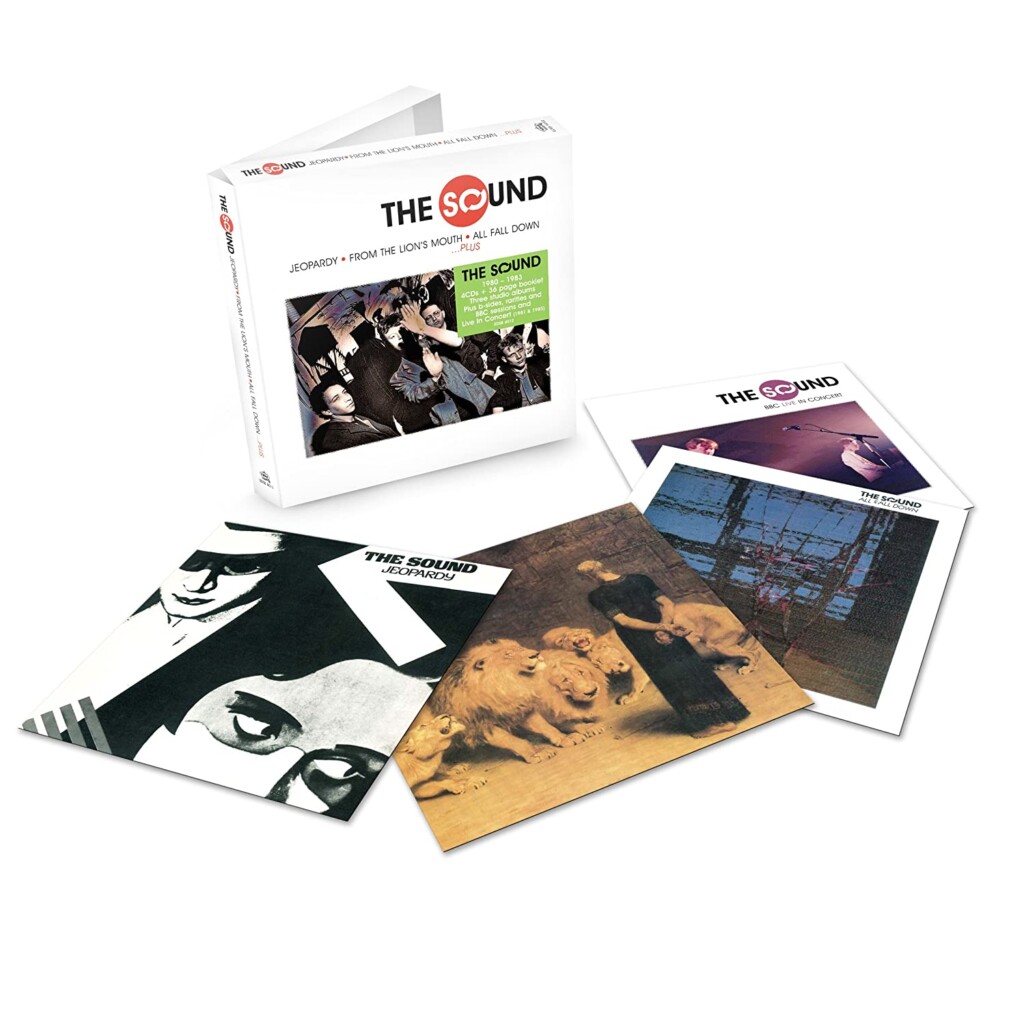

The Sound were regarded by some as the most powerful live band of the early 80s, with Borland’s voice that recalled the Bunnymen’s Ian McCullough, a heavy melodic bass style like Joy Division’s Peter Hook, and a fiery guitar style unmatched by anyone. The band’s official debut, Jeopardy, came out originally on Korova, recorded for only £800. The album starts with “I Can’t Escape Myself,” sounding very bare-bones, until the crushing chorus and guitars makes the needles jump to red. It barely hints at what you’re in for. “Heartland” is a complex pop masterpiece, a kaleidoscopic carnival ride which increases the nighttime urban imagery of Iggy Pop’s “The Passenger” to warp speed — “Setting out/City in your sights/You want an overview of the underground.” “Hour of Need” is reminiscent of Joy Division’s “Passover,” with synthesizers adding extra coloring. “Missiles is a classic example of the peak of Thatcher/Reagan cold war tension and paranoia. They don’t’ just sing about the damage missiles can cause, the apocalyptic guitars vividly demonstrate it in a way that U2 could never match. “Heyday” is another high-energy, spiky dust devil of brilliance, and was their first single that should have made them stars. “Desire” closes the album like it began, stark and stripped down. A nearly perfect album.

From The Lions Mouth is even better. While it doesn’t have the hard-hitting singles of Jeopardy, it has a shimmering, cohesive fusion of lyrics and sound. The album reaches a dark apex with “Possession” (“There’s a devil in me/Trying to show his face”) and the red hot “The Fire” (“Drawn towards the heat/Too fierce to contain”), and “New Dark Age,” with thudding kettle drums of doom. The press went wild for it, but sales were dismal. Possibly because the album was too unique. It didn’t fit neatly into any of the synth pop/new wave/new romantic stuff that was popular in ’81. Nor did it have the bombast that would make Echo & the Bunnymen, U2 and Simple Minds so popular just a couple years later. Korova dumped The Sound onto its parent company, WEA as a write-off, who pressured them to go more commercial.

The group’s contrarian, self-defeating response was 1982’s All Fall Down, which pleased neither the label nor the fans. Aside from stand-outs “Monument,” “Party Of My Mind” and “Where The Love Is,” the songs were fiercely uncommercial, grim and less compelling than earlier work. The Renascent reissues are long out of print, but fortunately Edsel put out a 4CD box set in 2015 for a bargain price.
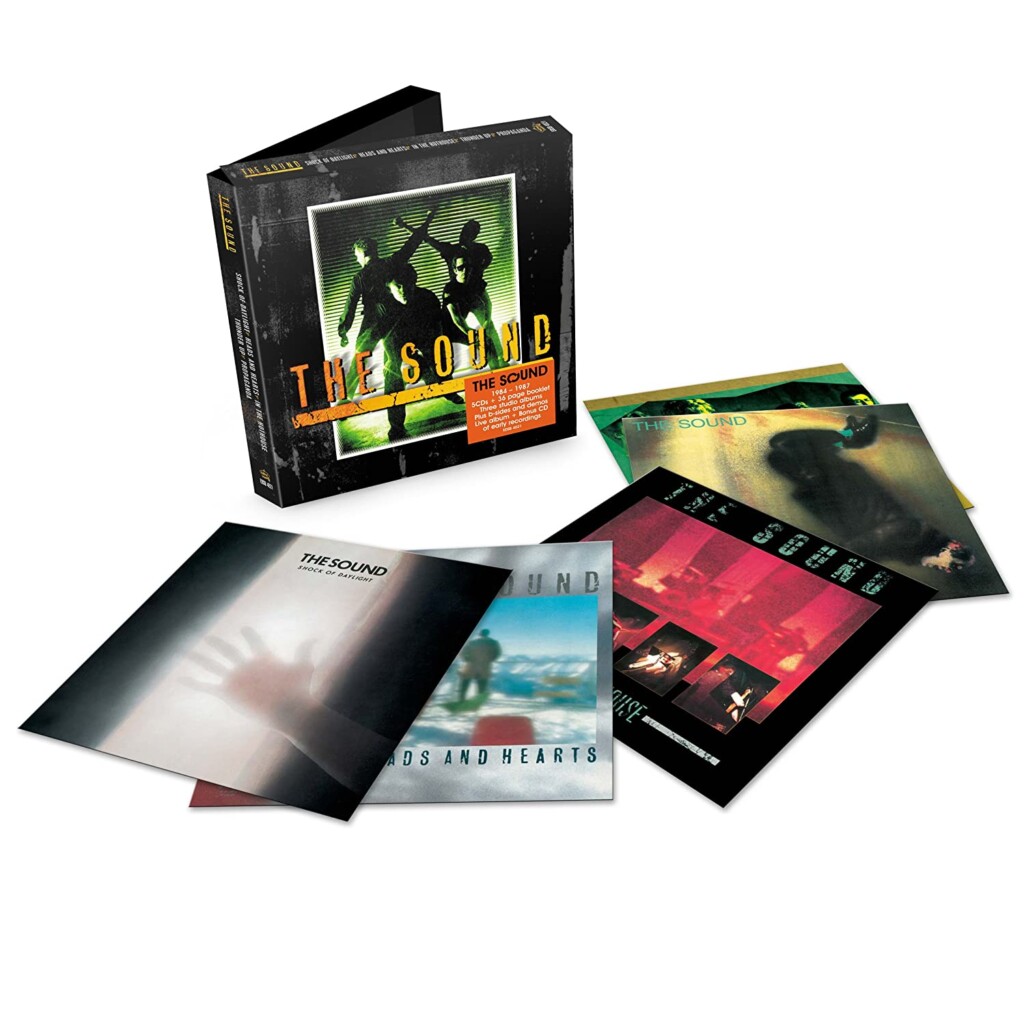
The band carried on, and even managed to bounce back with what some fans consider their best work in the Shock Of Daylight EP (1984). Producer Pat Collier (The Jesus & Mary Chain, The Soft Boys, The House Of Love) gave The Sound their brightest, most up-front sound that best hints at the power of their live shows. It’s also free of the common trendy studio techniques that dated so much other music in the mid-80s.
After a successful European tour, they hit the studio again in November 1984, this time with producer Wally Brill, who gave them more of a pop sheen. Thankfully, it’s nothing too gaudy as to handicap the excellent songs found on Heads And Hearts (1985), such as “Temperature Drop,” “Total Recall” and “Love Is Not A Ghost.” However, Borland’s worsening mental condition did begin to fray at the band’s cohesion. The band were not satisfied with the results, and released the blistering live set, In The Hothouse that same year for a different representation of some of the songs. The Statik label owner Laurie Dunn abandoned the band and moved back to Australia, so the next label was the Dutch Play It Again Sam. For their last album, Thunder Up (1987), they reunited with Nick Robbins who engineered Jeopardy. It was a diverse, solid album, and was even praised by the finicky Trouser Press Record Guide as an exciting, uncompromising work. Unfortunately, the band never received the recognition they deserved. It’s about time their music was finally appreciated. All are available in the second Edsel box set of the band’s work.
Coming soon, a piece on The Opposition, another lost post-punk band.
May 31, 2026
Fester’s Lucky 13: 1996
April 2, 2026
Fester’s Lucky 13: 1986
March 12, 2026
Ranking the Oscar Nominees