Post-Punk musical guides from a prog specialist/classical composer, an autobiography by a guitarist, and a biography about a guitarist.
This isn’t exactly Post-Punk Literature 101, no equivalents to Camus or J.G. Ballard. Just some non-fiction by musicians, about musicians, mostly for musicians, and the most enthusiastic fans of Modern Eon, Comsat Angels, Echo & the Bunnymen, Magazine, Siouxie & the Banshees, The Armoury Show and Public Image Ltd.
The Musical Guide to Modern Eon & The Comsat Angels by Andrew Keeling (2022)
When I wrote my The Greatest Post-Punk Bands You Never Heard piece exactly a decade ago, I certainly had hopes that many of the lost treasures would see proper reissues. But while it had been a whole ten years, I’m chuffed to see the treatment for band at the top of my list, Modern Eon, with not only a double CD reissue on Cherry Red including all the long-lost singles, b-sides and unreleased tracks, but also an entire book to coincide with the reissue. Just as the mid-2000s reissues of The Comsat Angels and The Sound on Renascent helped revive interest and critical attention to those bands, this should hopefully help add Modern Eon at least to the conversation of the essential canon of post-punk classics.
Andrew Keeling’s work in both books (a revised edition of the Comsat Angels guide came out a couple months previously) is some seriously academic level musical analysis that could serve as texts for a post-punk class at Julliard. As a writer and musicologist, Keeling has been known primarily as a King Crimson expert, with guides covering just about their entire catalog. In the role of musician/composer, he collaborated with Robert Fripp, handling the orchestration of the modern classical project The Wind of Silence (2012).
So what drew someone with a classical and progressive rock background to post-punk bands like The Comsat Angels and Modern Eon? Keeling answers this pretty definitively near the end of the Modern Eon guide, where he calls Fiction Tales (1981) “one of the great all-time records affecting heart and soul more than a thousand other releases one may care to name.” He compares the album with Nick Drake’s Pink Moon (1972), Judee Sill’s Heartfood (1973), T2’s It’ll All Work Out In Boomland (1970) and even the music of Henry Purcell or J.S. Bach in terms laying dormant following their deaths waiting for rediscovery by future generations. I certainly don’t need convincing, as the album blew me away when I discovered it over a decade ago.
For those who do need convincing, Keeling gives a top to bottom analysis of everything including the cover design (The Brothers Quay using calligraphy that nods to Nico’s The Marble Index, the enigmatic cover showing “a pointillistic white face on a black background with eyes looking outwards — an apt symbol for the observational epigrams and otherwise found in Alex Che Johnson’s lyrics.” Their style absorbs contemporary influences such as the “clean timbre guitars with repeated high one or two-pitch solo lines” associated with John McGeoch of Magazine and later Siouxsie & the Banshees, U2, The Comsat Angels, The Sound and Joy Division. But elements of Pink Floyd, Genesis, Uriah Heep, Free, Roxy Music, Eno, King Crimson and Ennio Morricone can also be traced in their music. Like Budgie (Banshees) and Stephen Morris (Joy Division), Cliff Hewitt is a more sophisticated drummer than you normally hear in punk and new wave, having likely been influenced by John Miller Chernoff’s book, African Rhythm and African Sensibility (1979) in incorporating African rhythms.
The concept seems to reference the “Strawman” theory that a second fictional person is created by governments and institutions in order to extract taxes and other financial obligations from an individual. Keeling believes “this makes Fiction Tales the most original album of its time, with its seamless flow, going against the grain of the new wave’s penchant for short, extroverted songs, and providing the album with an underlying concept.” The film-like narrative plays out like a mix of an observational Koyaanisqatsi film or Ennio Morricone spaghetti Western, and Iva Zanicchi and Pino Donaggio, who did the music for the Nicolas Roeg/Daphne du Maurier story Don’t Look Now.
“Second Still” builds tension through textural accumulation reminiscent of King Crimson’s “I Talk to the Wind” and “The Grass Still Grows” laments urbanization’s effect on ecology, with bubbling synths that recall Eno’s work in early Roxy Music. “Playwrite” ventures into progressive rock complexity similar to Magazine’s recent explorations, with lyrics that apply William Burroughs’ cut-up method to Expressionist poetry in a similar way that Bowie had been doing on his Berlin trilogy. “Real Hymn” uses a Chinese horn to suggest ancient oracular techniques of the I Ching and “removal of the Jungian persona.” Like “Second Still,” both “Waiting for the Cavalry” and “High Noon” evoke spaghetti Western themes, again reflecting the influence of Morricone, who they actually approached to produce their album. He declined, as he doesn’t mess with rock music.
“Child’s Play” merges a harmony from Uriah Heep’s “Circle of Hands” with Ultravox’s “Vienna.” Keeling singles out “Choreography” as entirely original with it’s mosaic structure. “In A Strange Way” is even more adventurous, their first spontaneous studio composition that’s more of a soundscape, the breathing sound evoking the feeling of scuba diving.
While Keeling can get a bit academic and analytical with his musical diagrams, his passion for the music is obvious when he concludes, “Sometimes music picks you up and turns you over, drilling into mind, heart and soul it refuses to let you go.” Transcending fashion or nostalgia, Fiction Tales is “choc-full of archetyal tales, fictions, songs of change, childhood memories, illusory and psychological states of mind, realities and heartbreak bound together by highly charged music together with benchmark production values far surpassing the mainstream.”
While the music of Modern Eon disappeared with the rise of MTV and corporate pop rock, it seems some younger audiences are again returning to music of authenticity and originality that’s difficult for the majority of modern mainstream audiences to grasp. Younger ears are turning back to music of the past for these qualities. “Fiction Tales may be read polysemantically, its musical content radiating like a becon of light into our present, tumultuous times. Great works of art transcend their time not necessarily having to register with habits of mass consumption to do so.”
The Musical Guide to the Comsat Angels focuses on six albums, and groups together what he considers lessor works (Land, 7 Day Weekend, Chasing Shadows from 1983-86) as well as solo works. By necessity it does not go quite as deep as the Modern Eon book. Like many bands of this era, their peak was, in my opinion released in 1981, with their second album, Sleep No More. It’s hard to say which is Keeling’s favorite because he focuses mainly on the dry musical analysis — dynamics, harmony, melodic motifs and intervallic structure, rising and falling semitones/minor 2nds, minor 3rds, perfect 4ths, rising and falling perfect 5ths and texture.
The extent of his critical judgments are limited to “the brilliance” of Waiting for a Miracle (1980), “the darkness” of Sleep No More, “the melodic beauty” of Fiction (1982), “the directness and power” of My Mind’s Eye (1992), and “the metaphorical significance” of The Glamour (1995). To all the albums he attributes “excellent musicianship; original creative thought; considered production values.” He mentions seeing them live both in 1981 and in 2009, and adds that they achieved a cult following along the lines of The Velvet Underground, and their music is “too considered, too complex and just too damned good to be wasted on the mediocre commercial pop market centered on, during the 1980s, the likes of ABC, Spandau Ballet and so on…”
Overall, Keeling’s work speaks more to classically trained musicians who can follow his diagrams than the general public. The Modern Eon book is still a pleasant surprise, a gift to long-suffering fans who had to witness their critical neglect over the past 40 years. This is at least an important step forward. Given that Simon Reynolds’ epic book, Rip It Up and Start Again: Postpunk 1978-1984 (2005), focuses on the more experimental side and mostly skips over the likes of the Modern Eon, Comsat Angels, The Sound, Opposition, Sad Lovers and Giants, Breathless, And Also the Trees, Lowlife, Asylum Party and even more famous colleagues Echo & the Bunnymen, Teardrop Explodes, The Soft Boys, Wah!, I still have hopes that a more accomplished music writer will fill in that gap someday, someone who covered them in the beginning like Paul Morley, Barney Hoskyns or Andy Gill.
Modern Eon – Fiction Tales (Dindisc/Cherry Red, 1981)

My original blurb:
Hailing from Liverpool like Echo & the Bunnymen, Wah! and Teardrop Explodes, Modern Eon put out a handful of singles and just one album. But that album, the percussive, foreboding Fiction Tales (Dindisc, 1981) is really something. At a time when their peers, including The Sound and Comsat Angels, were at the peak of their powers, Modern Eon’s album measures up very well. The band did not achieve any sort of popularity due to some bad luck with drummer Cliff Hewitt breaking his wrist just before they were to record a Peel Session. Rather than persevere and record their second album, they gave up and Tim Lever ended up with Dead Or Alive. The only discernible impact they had is that their influence could possibly be heard in Sad Lovers and Giants, though the similarities could be a coincidence. While there was an entry for them in the Trouser Press Record Guide, it was so unenthusiastic I didn’t take note (“…not an easy album to like, Fiction Tales does convey originality and stylishness as well as flashes of accessibility; occasional use of odd instrumentation and a good drummer make this more than just a routine genre exercise.”) I only heard them for the first time last year due to a mention on the I Love Music discussion board. [Correction, I previously thought a reissue came out on Dindisc in 2001, but that was not the case]. A complete reissue with all their singles and B-sides is badly needed. | Buy
Cherry Red’s double CD reissue is exactly what I wished for. Compared to the scratch and pop-riddled needledrop version I’ve had to listen to for over a decade, the pristine audio is a revelation. The “Cardinal Signs,” “Visionary” and “Splash!” B-sides are as excellent as expected, with “Visionary” in particular thematically linked with it’s A-Side “Child’s Play,” which has more in common with psychedelic and prog than new wave, though it may have been influenced by The Stranglers’ “Golden Brown”. For some reason, it’s missing BBC recordings “The Foist” and “From the Window,” which Keeling identified as the best of the late Modern Eon songs. But it’s exciting to finally hear previously unreleased tracks “After the Party,” it’s dub version, and “Garland Leaves.” They were demos meant for the band’s second album which never happened, and were the only clue as to how that might have sounded. The experimentation with instrumentation (trumpet on “After the Party”) and the heavy mood on “Garland Leaves” indicates the band was still at the top of their game, and would have come out with even more challenging work just as The Comsat Angels and The Cure did in 1982. It’s too bad that never happened.

Bunnyman: Post-War Kid to Post-Punk Guitarist of Echo and the Bunnymen – Will Sergeant (2012)
I don’t know of Will Sergeant plans to follow up with a part two, but for those who want to know more about his creative growth as guitarist with Echo & the Bunnymen will be disappointed that it ends just after the release of their first single. His childhood was pretty unremarkable, though distinctly unhappy with an angry father suffering PTSD after the war causing his mother to leave for good. However as a teen, Sergeant had the good sense to take advantage of Liverpool’s slowly re-awakening music scene, catching a wide range of great bands like Dr Feelgood, the Heavy Metal Kids, the Sensational Alex Harvey Band, Doctors of Madness and Bebop Deluxe. He also started listening to, along with sixties psychedelic garage rock like Love and The Seeds, Eno, Métal Urbain, Suicide, Television and Pere Ubu (a fusion of prog and “Krautrock” with an Orson Welles like frontman) before eventually picking up a guitar himself, choosing a Fender Telecaster because Wilco Johnson of Dr. Feelgood and The Clash used it.
The origins of the Bunnymen are tightly entwined with their friends in Teardrop Explodes, and they played a lot of early gigs with Manchester bands Buzzcocks, The Fall (their first guitarist, Martin Bramah, was a key influence on Sergeant) and Joy Division. One particularly interesting event was Leeds Futurama festival which included PiL, the Fall, Joy Division, OMD and more. “It is billed as the world’s first science-fiction music festival, God knows why, other than some of the bands that are on the bill wish that they had been born as androids or genetically spliced up in a lab somewhere.” Gigs and record deals pretty much fell in the band’s lap, kind of refreshing to hear compared to all the arduous struggles with success and addiction that riddle most music biographies.
Some fun pop cultural references from his childhood include TV sci-fi puppet shows, Fireball XL5 and Thunderbirds, and BBC Light Programme’s irreverent Goon Show, where Peter Sellers started his rise to worldwide stardom. How the band’s logo, a demon bunny came to be: “His mind is spinning as he remembers the final scene of the 1958 sci-fi horror series Quatermass and the Pit that has been on the telly recently, which he quite freely admits, ‘Shit him up as a kid.’ The premise of the series revolved around an ancient alien spaceship that is unearthed by workmen while tunnelling deep underground during construction of a tube station in London called Hobbs End. The ship is found to be chocker block with dead and crispy giant alien grasshoppers. At the end of the series, a devil rises above the London skyline, backlit in a cloud of haze. The demon looks down on the cowering pitiful humans.”
The book ends with the foreboding line, “Great opportunities are being handed to us on a plate. If this keeps up, and we are not careful, there is a good chance we could turn into a gang of arrogant pricks.”
Some Scouser slang courtesy of Mr. Sergeant:
- “tight as a gnat’s chuff”
- “chopped-hog menace” (in reference to his fantasy customized bicycle he wished he could afford as a kid in the 60s)
- “nudgers”: These delights are ham and cheese rolls, so-called because they look like a nudger (penis).
- “Sassenachs”: Scottish people’s rude term for the English
- “cherry on”: Anyone who’s embarrassing
- “bagsy”: Liverpool word meaning claim
- “cocker”: What Mark E. Smith called everyone, as he was too drunk to remember names.
- “You never know who’s had your sausage down their keks”: While working in a restaurant, Will learned that difficult customers are rewarded with sausages that have been rubbed on kitchen staff’s bollocks ‘n’ butts.
The Light Pours Out of Me: The Authorized Biography of John McGeoch – Rory Sullivan-Burke (2022)
Another Manchester band that the Bunnymen likely shared a few gigs with was Magazine who, from 1978 to 1980, featured the most singularly celebrated guitarist in the post-punk scene, John McGeoch. Born in Scotland, McGeoch seemed to have natural talent for everything he tackled — his studies, martial arts, visual arts, piano, and ultimately guitar. Throughout the book, Burke relies heavily on quotes from a not-so secret society of McGeoch admirers like John Frusciante (Red Hot Chili Peppers), Dave Navarro (Janes Addiction), Ed O’Brien and Johnny Greenwood (Radiohead) and Johnny Marr (The Smiths). U2’s The Edge should have spoken up too, as he owes a lot to McGeoch.
As great as McGeoch’s work was on the first three Magazine albums, three Siouxsie & the Banshees albums (his artistic peak is arguably on Juju), Visage, Generation X’s “Heavens Inside,” The Armoury Show, Peter Murphy and Public Image Ltd., I see his greatest failing, aside from his descent into drugs and alochol, was he never had his own band. He really needed to be an equal partner with a co-songwriter, and as important as innovations were to making those Magazine and Siouxsie albums great, he was just passing through. Alas, such is the nature of some forms of genius — delicate and fleeting.
Class of 1981 Post-Punk

Steve Wide presents A Field Guide to Post-Punk & New Wave. (2020)

Heavy on design, light on substance, I learned absolutely nothing from this book, which is to be expected. Nevertheless, it’s a cute mini-coffeetable style book that’s fun to flip through while listening to all the music this book completely missed (The Comsat Angels, The Sound, Modern Eon, Pere Ubu, Television, The Raincoats, The Slits, Young Marble Giants, Contortions, Essential Logic, Killing Joke, The Feelies, The Chameleons, etc.). Granted, it’s not an encylopedia, but if it’s going to site Oingo Boingo’s Only A Lad as an influential album, that it really shouldn’t have skipped the above artists.
In it’s defining album section, it covers fourteen albums. The artists are all solid choices, though there’s some odd choices for albums. I suppose chronologically, The Cure’s “A Forest” single from their second album, Seventeen Seconds (1980) was significant, both Faith (1981) and Pornography (1982) are both more revered examples of The Cure at peak darkness. Siouxsie and the Banshees’ The Scream (1978) was an interesting debut, but it was Juju (1981) that truly blew minds and influenced generations of bands. It’s mind-boggling how one would choose Public Image Ltd’s Public Image: First Issue (1978) over the towering Metal Box (1979).
The above are covered in a separate artists section, along with Japan, Elvis Costello & The Attractions and Depeche Mode, with just seven honourable mentions: Echo & the Bunnymen, The Cars, Talk Talk, New Order, XTC, The Human League and The Psychedelic Furs. The final pages of the slim 95 page book cover lifestyle, fashion, influences, parallel scenes, how to be a post-punk/new wave band and discography, all in the most superficial manner possible. Had this book come out when I was a kid I would have loved it, and learned something at the time. With, well, the Internet, it can’t really serve that purpose for anyone anymore, but it is pretty.
May 31, 2026
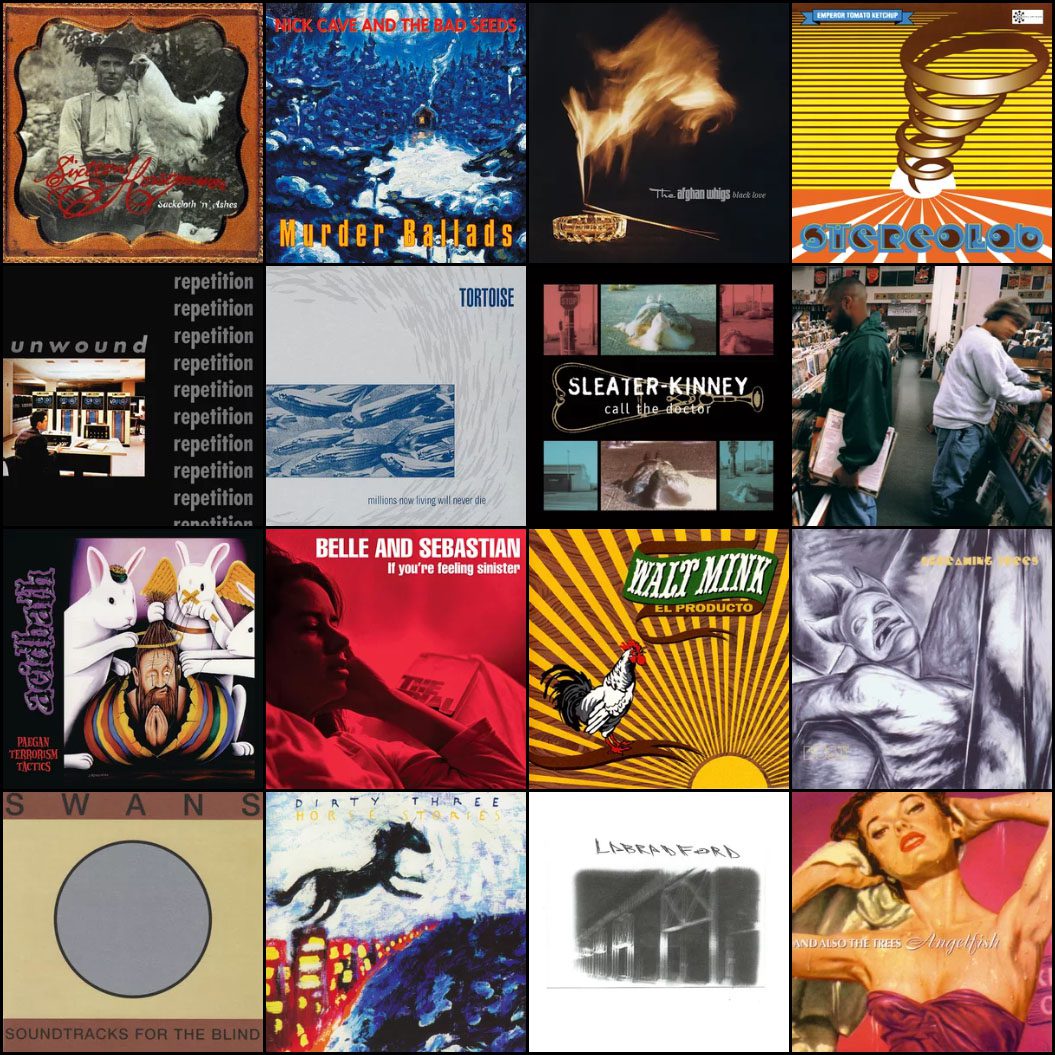
Fester’s Lucky 13: 1996
April 2, 2026
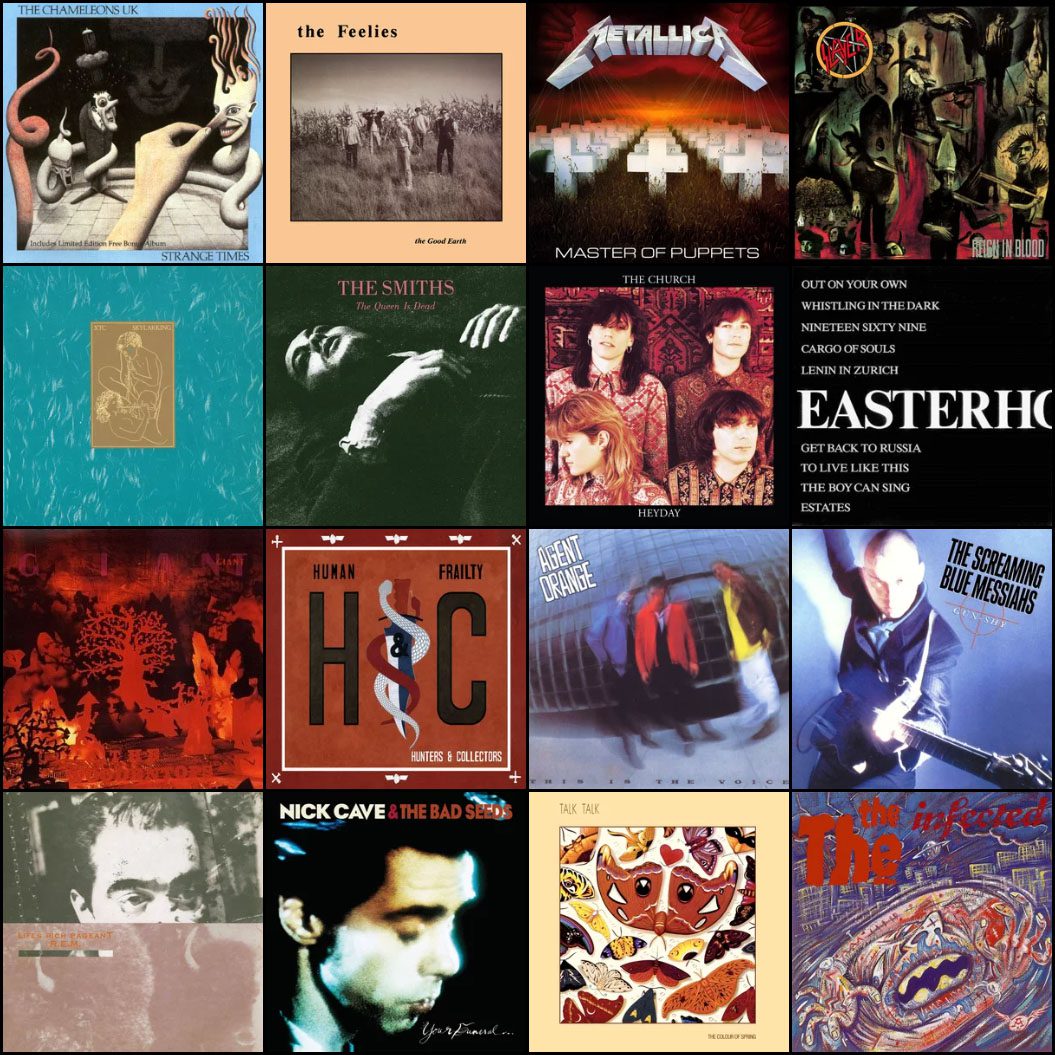
Fester’s Lucky 13: 1986