Every year The Fall’s body of work seems ever more impossible to get a handle on, a constantly growing mountain of endless variations on a seemingly singular theme – repetition. The fact that the band has pulled this off for 28 years and is still winning over new fans is a testament to their genius. John Peel’s (RIP) favorite band has released so many great albums, it’s impossible to get a consensus on what’s their best. Some prefer the primitive, almost rockabilly-like early albums, Live At The Witch Trials (1979), Dragnet (1980) and Grotesque (1980), which were all re-released last year. Non-completists will find a succinct summary of that era on It’s The New Thing! The Step Forward Years (1978-80). Despite the simplicity of their style, The Fall stood apart from their contemporaries, never acknowledging kinship with other bands. They didn’t even acknowledge the existence of the mighty Joy Division, even though dock worker Mark E. Smith would often pass by a similar-looking bloke with the same donkey jacket on his way to work named Ian Curtis, who loved the same bands (The Doors, Velvets, Stooges, Can), and even rehearsed in the same building and shared bills.
At first The Fall were pretty political, and participated in Rock Against Racism benefits. They soon distanced themselves from trendy jingoism and became more elliptical and non-linear, kind of like Dylan. As Simon Reynolds noted in Rip It Up And Start Again: Post-Punk 1978-1984, they were big fans of literature (Philip Dick, Burroughs, Yeats, Camus, Lovecraft, Algernon Blackwood, Arthur Machen) and psychedelic drugs, Smith described The Fall as “head music with energy.” They’d spend days in Heaton Park picking psilocybin mushrooms (the same that Iggy Pop consumed while recording Funhouse), tripping and exploring music and their inner demons. Of course, amphetamines was also a major factor in Smith’s twitchy paranoia, shamanistic pretensions, and nearly OCD allegiance to repetition, repetition, repetition. Not just in cyclical rhythms and verses, but album after album forms a nearly singular groove. If The Fall were competing to become the definitive Manchester band, one wonders how it would have turned out if it was Smith who threw himself a necktie party instead of Curtis. But that just wasn’t in the cards — Smith is a survivor, like a cockroach. He had better records to make.
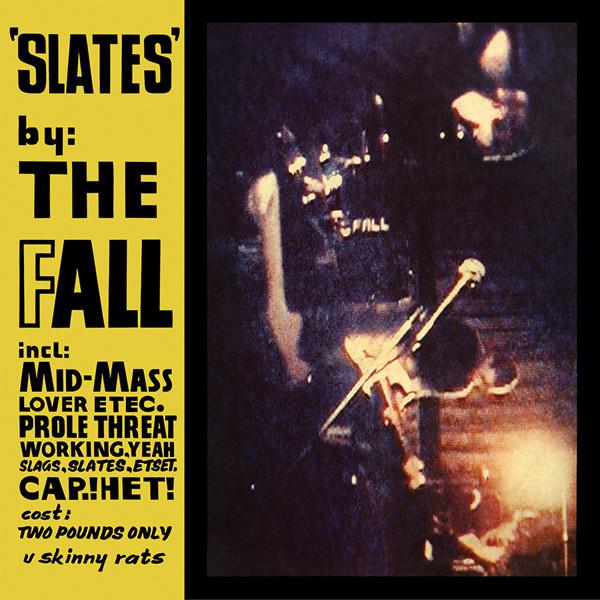
In listening to the singles compilation from that next era, Palace Of Swords Reversed 1980-1983, you’d think they had become relentlessly catchy, with songs like “Totally Wired,” “How I Wrote ‘Elastic Man'” and “The Man Whose Head Expanded.” There was also an added layer of sophistication, with second guitarist Marc Riley adding inventive, dissonant riffs on top of Craig Scanlon’s skeletal licks. Often overlooked in the shadow of the following year’s Hex Enduction Hour, Slates EP is when The Fall shifted up a gear, and for some, their concise peak. Mark Sinker wrote in The Wire’s “The 100 Best Records Ever Made,” “Smith’s unfooled bile seemed perfectly dialectically visionary, wearily energized, utterly untimely: his un-musicality a higher music…a guitar-sound jabbing barbs into your skin, razor-edge squeals into your head – Man With Chip’s voice yabbers scarily on through a thick fog of textured noise.” Smith’s withering invective is unbeatable here, with the devastating London put-down “Leave the Capitol” and “Slates, Slags, Etc.,” where Smith lets loose a spray of ire about spilled drinks and shitty new wave bands, as the band cranks out an awesome two-chord jam. “An Older Lover,” is ominously creepy, as it slithers to a pulsing, subdued rhythm that skips a beat every now and then, demonstrating the band’s uncredited virtuosity. “Everybody hears the hum at 3 A.M.” sings Smith on “Prole Art Threat,” which could be the result of hearing damage from being blown away by a Fall show earlier in the evening, as they belt out savage rockers like this song. The reissue fills the EP out with four Peel session tracks, and the essential single “Lie Dream Of A Casino Soul” and “Fantastic Life.”

Adding original drummer Karl Burns for a double-pummel attack, The Fall traveled to Reykjavik, Iceland to record some of their next album. The result, Hex Enduction Hour is considered by some as their masterpiece. What better way to kick it off than with one of their greatest songs, “The Classical.” With the distorted bass high in the mix, the band lurches like The Birthday Party with tribal drumming. Dinky toy keyboards can be heard, barely, as the din peaks in a wall of noise while Smith rails against the vacuous popular culture of London and the New Romantics Spandau Ballet and Duran Duran, “too much romantic here, I destroy romantics, actors, kill it.” The original sound introduced by that song alone would be copied by many bands. “Hip Priest” stalks the rhythm slowly and deliberately, like a serial killer, while sonic details are given space to breathe, like the clacking bones of a xylophone. The band’s usual gripes about current culture is balanced with Smiths fascination with ancient mysticism. The lava walls of the Reykjavik studio seemed an appropriate place to meditate on primordial black magic on “Iceland.” The spare bass and piano track drive the song to unbearable tension, never climaxing. It makes previous Fall records sound old fashioned. The dark, distorted organ of Velvet Underground’s “Sister Ray” haunts the album like a ghoulish spector, such as the frenzied cacophony of “Fortress/Dear Park.” “Winter” is split into two parts, featuring an elliptical bass riff and almost pretty guitar textures as Smith tells a dark tale of an insane child taken over by an alcoholic spirit. “Just Step S’ways” actually has a catchy, bass-driven melody that you can almost sing along to – “Just step outside this future world today.” In “Who Makes The Nazis?” Smith succinctly answers, “intellectual half-wits,” complete with a garbled chorus, “nnnggduuuhhh!” Classic. The bonus disc includes two Peel Sessions, the hilarious single, “I’m Into C.B.,” and six live tracks.
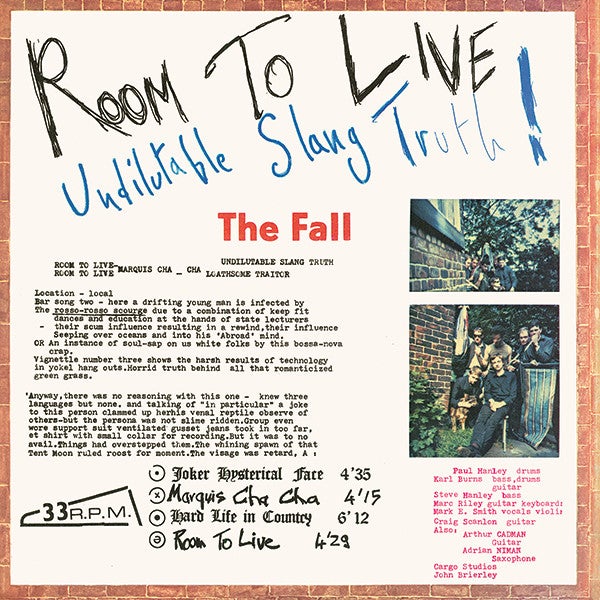
My initial experience with Hex was as part of Hip Priests And Kamerads, which adds selections from Room To Live, which is between the length of an EP and full album, stupidly leaving out a couple key Hex tracks. So for me, Room To Live is an essential companion piece. Recorded just a few months later, it doesn’t measure up to its predecessor, but is certainly a worthwhile piece in the Fall’s peak period. “Marquis Cha-Cha,” features some truly complex percussion and an actual funky guitar and bass, making it one of their more entertaining songs about the Falklands war. The rest of the mini-album was more loosely structured, with the unrehearsed band avoiding the big sound of Hex and instead attempting improvisation. “Joker Hysterical Face” sounds like a relatively tight, classic Fall opener, while “Hard Life In Country” is more formless, while “Room To Live” features some saxophone in tribute to Smith’s favorite prog band, Van Der Graaf Generator. The spare “Detective Instinct” is little more than a bass riff with haunting, echoey guitar patterns. “Solicitor In Studio” drags a bit before erupting into feedback. The sentiments of “Papal Visit” are still relevant, but the musical ideas are somewhat dried up.
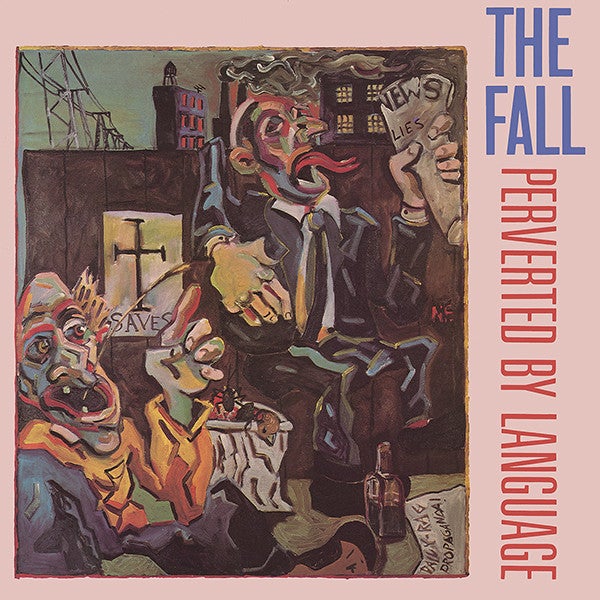
Perverted By Language introduces Smith’s new American wife, Brix on guitar and vocals, replacing Marc Riley. Her songwriting assistance and Smith’s elevated mood don’t exactly make for a post-punk Tupelo Honey, but its misanthropy is certainly muted, and the melodies more apparent, as the band continues to experiment and evolve. For example, on the Brix-sung “Hotel Blöedel,” there are acoustic guitars, and Smith actually plays violin and contributes spoken words to her vocal melodies, resulting in a beautiful, gothic sound. “Hexen Definitive” also has a lighter, almost twangy touch that hasn’t graced a Fall record before. Elsewhere, “Neighbourhood of Inifinity” has more familiar chugging metronomic beats, while “Tempo House” showcases Smith’s masterful vocal delivery in a live-in-the-studio context. “Garden” is the greatest highlight, an enchanting “All Tomorrow’s Parties” drone with Smith ranting about a “Jew on a motorbike.” Overall, Perverted is a necessary transitional album before the band enters, arguably, their greatest peak with The Wonderful And Frightening World Of The Fall (1984) and This Nation’s Saving Grace (1985). The reissue includes the great singles “The Man Whose Head Expanded” and “Kicker Conspiracy,” and several alternative takes and live tracks.
April 2, 2026
Fester’s Lucky 13: 1986
February 27, 2026
Fester’s Lucky 13: 1976
January 30, 2026
Fester’s Lucky 13: 1966