In between Oxford, Cambridge and Hogwarts, there was the mysterious PPU (Post-Punk University) it’s star pupils who matriculated in 1980.

Unfortunately, it seems lesser genre spinoffs like New Romantics (with after school classes held at the Blitz club in Covent Garden in 1979-80) and students who flunked out attended nighttime adult education classes in Goth at the Batcave from 1982-85, got more of the glory, or at least impact in fashion and culture.
The Cure
The star valedictorian was actually a transfer student from an art college headed by Wire, completing their first year with the formative Three Imaginary Boys (1979). The Cure didn’t get full credit, do to the failure to include their best songs so far, “Boys Don’t Cry,” “Jumping Someone Else’s Train” and the misunderstood Camus referencing “Killing an Arab.” After studying the foreboding power of Joy Division shows and lending his guitar playing to pals Siouxsie & the Banshees, who were also evolving quickly, Robert Smith put the band on a more focused track that later became known as the Gloom Trilogy. The peak, Pornography (1982) nearly killed them, so they took a year sabbatical before their lesser acclaimed The Top (1984), a messy but interesting psychedelic experiment. They wouldn’t have graduated on time if not for the school accepting the singles compilation Japanese Whispers (1983), which hinted at what would later make them post-graduate superstars.
The Sound
Salutatorian The Sound had a breathtaking body of work. If it weren’t for the strength of The Cure’s singles, they might have stolen the top spot. Adrian Borland and team actually had the valuable experience of the open university of Punk from 1976-79. As The Outsiders, their Calling On Youth album was one of the first self-released full length punk album in May 1977, preceded only by the Buzzcocks’ Spiral Scratch EP. While that and Close Up (1978) were solid efforts, the band really clicked when they recorded Propaganda in 1979, which was never released. They changed their name to The Sound and entered the PPU (post-punk university) in 1980, starting strong with Jeopardy (1980). Into the Lions Mouth (1981) is their peak which should have won awards and accolades, but languished in obscurity, slowly gaining an audience after reissues starting in 2001. All Fall Down (1982) is underrated even by fans, and makes more sense if considered as what Wire might have done right after 154 (1979). The lack of success caused a wobble, and a delayed graduation. Shock of Daylight EP (1984) and Heads and Hearts (1985) were less experimental, but did a fantastic job in creating their own take on Big Music that would have other contemporaries rocking stadiums. Sadly, it wasn’t to be for The Sound, and after the solid Thunder Up (1987) and several solo albums, Borland took his own life in 1999.
The Comsat Angels
PPU cum laude graduates The Comsat Angels operated in somewhat similar sonic territories as The Sound, integrating subtle psychedelic elements into their doom laden post-Joy Division post-punk Also like The Sound, their greatest achievement was their sophomore year thesis, Sleep No More (1981). While less accessible than the elegantly moody soundscapes of Waiting for a Miracle (1980), it was a masterclass in tension and bleakness. They got as much criticism for their fearless adventure into the extreme as The Cure got acclaim for doing the same thing a year later. Life continues to be unfair.
Echo & The Bunnymen
Graduating magna cum laude, Echo & the Bunnymen spent their third year abroad, touring heavily surpassing even the mighty Cure in ticket and album sales at the time. While I have a soft spot for their debut, they’re one of the few where their fourth album is their most successful and critically acclaimed. Over the years Ian McCulloch himself hasn’t been shy about repeatedly calling it “the greatest album ever made.” The band expanded their references to the likes of Jaques Brel and Scott Walker, and while their bombastic use of strings and the sweeping romance of “Seven Seas” and “The Killing Moon,” threaten to be too much, they stay on the line.

Siouxsie & The Banshees
The last of the honors graduates are Siouxsie & The Banshees, another transfer from the Punk Open Uni. Siouxsie Sioux was first clocked as part of the Sex Pistols entourage and was the target of Bill Grundy’s drunken, lascivious come-on during daytime television. Steve Jones was only calling Grundy out, but typical of hypocritical British society, TV viewers didn’t bat at eye at Grundy’s gross behavior. While many considered her just a fashion plate, joke’s on them, her band outlasted them all. As prescient as The Scream (1978) and Join Hands (1979) were, the key addition that put the Banshees over the top of greatness was John McGeoch, fresh from post-punk pioneers Magazine. While Siouxsie reigned imperiously as the proto-goth queen, the Banshees were mostly a potent mix of post-punk, new wave and psychedelia.
The Birthday Party
Having released a formative album as The Boys Next Door in 1979, they were expelled from their Melbourne glam punk/new wave academy for excessive violence, drugs, and shagging the headmaster’s wife. They changed their name to The Birthday Party and relocated to London assuming they’d find kindred souls at PPU. They did somewhat, with The Pop Group, P.i.L and Killing Joke, but they still frightened the average Brit audience, and ended up moving on to Berlin, where they imploded and Nick Cave started The Bad Seeds, and his journey toward becoming a Bing Crosby style crooner.
The Fall
Less obviously brooding than their Manchester neighbors Joy Division, Mark E. Smith nonetheless had buckets of bile and sarcasm to spew, so much that he kept on truckin’ over four decades with over 30 albums until his tenure on Earth ended. A contender among several for possible career highlight was the apocalyptic Hex Enduction Hour (1982), recorded partially in Iceland, which would help spark it’s own post-punk scene. The Slates EP (1981) was was chosen by The Wire magazine as one of the best records of all time, so extra credit for that.
Killing Joke
The influence of Killing Joke seemed to continually escalate throughout the 80s, from Metallica to the industrial metal of Ministry owing basically everything to them. But nothing the band did later, or any of their acolytes beat the debut album. They made the opening bars of just synths sound more menacing than everyone since Suicide, and the savage, nearly tribal rhythms from Youth and Paul Ferguson were the perfect backing for Jaz Coleman sounding like an uncaged animal. And Geordie deserves just as many props as Keith Levene for coming up with innovative, unique guitar shapes in post-punk.
Bauhaus
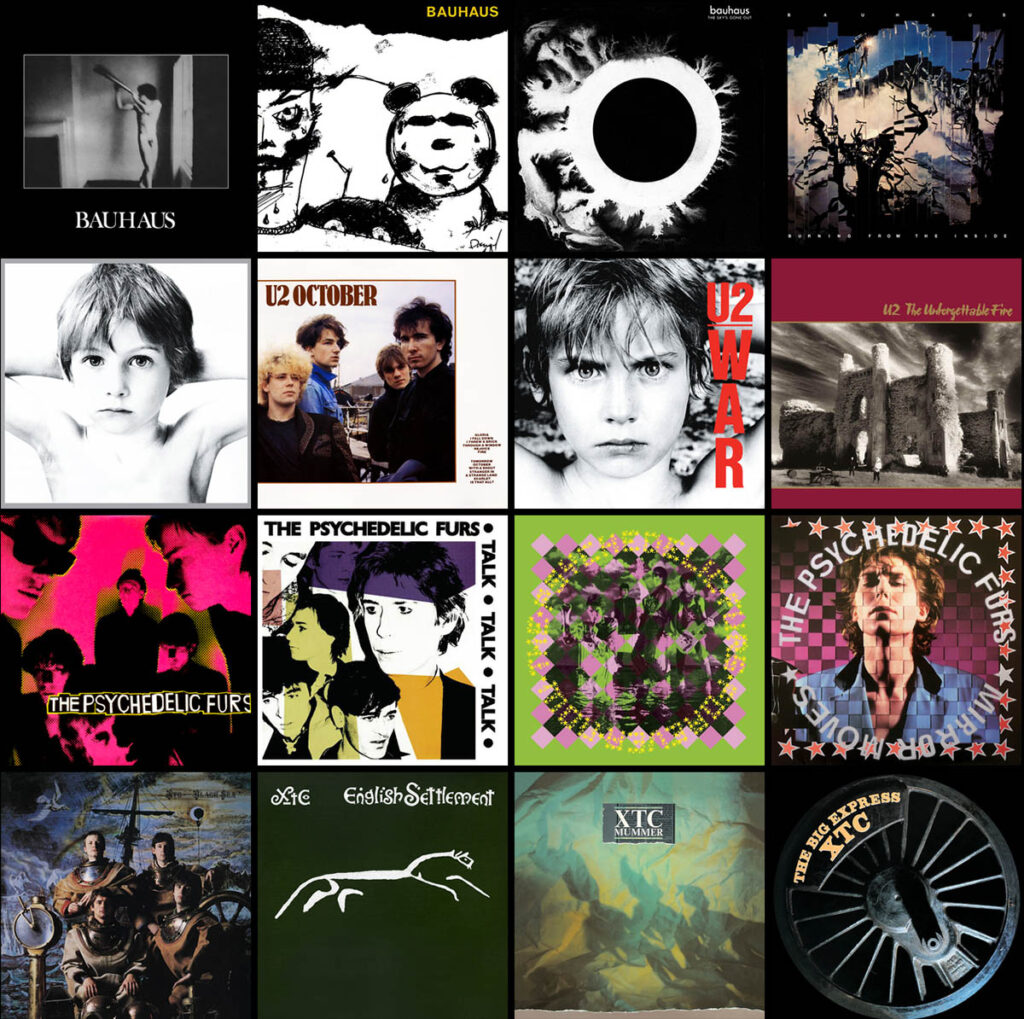
When I was in high school, I acquired a grubby, tenth generation copy of a Bauhaus tape. I assumed the mix was the 1979-1983 compilation from 1985, but it wasn’t, because it had their cover of John Cale’s “Rosegarden Funeral of Sores,” which wasn’t on it. And who can forget “Bela Lugosi’s Dead,” which rivals Public Image Ltd.’s “Death Dance” as the most creepy, sinister dub song ever. Mix in “Dark Entries” among the singles with the cream of the albums, it had the best flow and was the primary way I listened to the band for years. I always liked Bauhaus far more than any of the purely goth bands they supposedly inspired, because their more energetic mix of glam and punk was far more entertaining and creative to my ears. Burning From the Inside (1983) reflected a slight decline, but the band had more to offer in their various projects with Tones On Tail, Love And Rockets, and Peter Murphy’s solo albums.
U2
It’s easy to forget how great U2 once were, because their albums from the past couple decades are so horrifically bad. Talk about a band crashing to earth. But once upon a time they were a post-punk band with an extra injection of wide-eyed exuberance and youthful energy, best demonstrated on their debut Boy (1980) and also their very short live album Under A Blood Red Sky (1983). That live set and the “New Year’s Day” video were my introduction to the band and I’ll never get sick of those. It seemed at first that they would be a bridge between the moody sounds of Joy Division and Echo & the Bunnymen with more stadium friendly Big Music with Big Country and Simple Minds. Well that is precisely what they were, but they were able to tap into a rare crossover vein that sucked from the mainstream zeitgeist and became a global brand. I prefer their first collaboration with Brian Eno on The Unforgettable Fire (1984), failed experiments and all, to the more cumbersome and po faced The Joshua Tree (1987).
The Psychedelic Furs
The Pretty in Pink soundtrack (1986) was the first introduction to a lot of Americans to big British names like OMD, New Order, Echo & the Bunnymen, The Smiths and of course Psychedelic Furs, who re-recorded their 1981 track that the movie was named after with a punchier version. Of course, “Love My Way,” “The Ghost in You” and “Heaven” got some spins on radio and MTV, but it seemed only hardcore anglophiles knew the first two, and by far best albums. The self-titled debut (1980) may not have had hits, but it did offer an innovative mix of 60s psych, Velvet Underground, Berlin Bowie and new wave filtered through early Ultravox, interlaced with Duncan Kilburn’s unique saxophone parts. Talk Talk Talk (1981), produced by Steve Lillywhite, provided the best balance between the trippy, driving wall of sound, and their more melodic pop sensibilities.
XTC
Sandwiched between the acclaimed albums Drums and Wires (1979) and Skylarking (1986), 1980-84 was XTC’s most underrated era, but a very fruitful time and PPU. They had stopped touring after their fourth album Black Sea (1980) and dug deep into their studio craft, creating unique sonic identities for each album, with the complex prog pop of English Settlement (1982), the bucolic Mummer (1983) and the harsher industrial revolution sounds of The Big Express (1984). As the band’s stature grows over the decades, so does their undergraduate work.
The Church
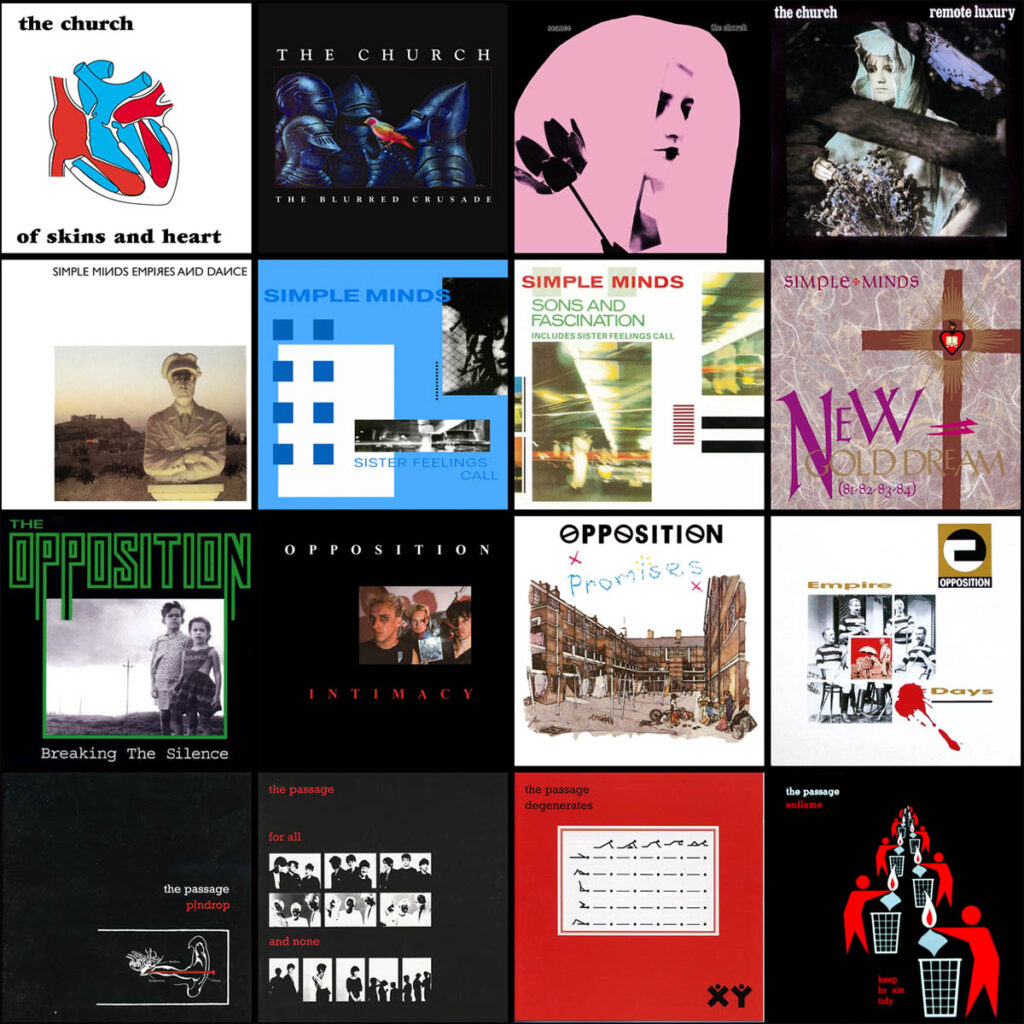
Anchoring PPU’s International Studies branch in Sydney, Australia is The Church. In sharp contrast to the fertile garage punk scene sparked by fellow Sydney band Radio Birdman and The Saints in Brisbane, The Church created their own signature hybrid of psychedelic post-punk and jangle pop, which would eventually also be a key influencer on dream pop. Like The Cure, they released one of their best songs right at the start with “This Unguarded Moment.” Had it become an international hit, things might have been a bit different for them, but that would come eight years later. The band fine-tuned their approach to texture and atmosphere over the next few albums, and their biggest success would come in their graduate studies with Heyday (1986) and Starfish (1988), which kicked off a long, fruitful career of solid psych, art rock and dream pop.
Simple Minds
Like U2, Glasgow’s Simple Minds would both expand and simplify their sound so much as to be unrecognizable once they crossed over into mainstream success. But early on their mix of post-punk and new wave was pretty distinctive, starting with their formative pre-collegiate albums in 1979, Life in a Day and Real to Real Cacophony. On Empires and Dance (1980) they made a very European art rock spin on synthpop and dance, ending up with an early influence on coldwave. Peter Gabriel clocked them and took them on tour. Sister Feelings Call and Sons and Fascination were released on the same day in 1981, both produced by Canterbury prog hero Steve Hillage. Their fourth album gave a glimpse of the mainstream success they would eventually attain with well-written songs like “Promised You a Miracle,” the ballad “Glittering Prize” (a warm, pretty ballad) and the widescreen Big Music template of “New Gold Dream (81-82-83-84).” Their grad album Sparkle in the Rain (1984) had even bigger hits while still getting positive critical reviews, but that ended when they truly blew up with a song they didn’t write, “Don’t You (Forget About Me)” for the soundtrack for John Hughes’ The Breakfast Club (1985), then Once Upon a Time (1985), which Trouser Press described as “appalling.”
Opposition
Opposition are another great band lost between the cracks, and nearly as great as The Sound and Comsat Angels. Formed in London’s southern suburbs in 1978, their 1980 single “This Year” was influenced by ska/reggae through the lens of Two Tone and the Ruts. Sessions from that period were issued as Lost Songs in 2005. That lineup broke up and they re-formed as a trio with Marcus Bell, taking on a darker post-punk direction. Opposition could easily be credited for being the architects of the shimmering guitar sounds later employed by The Chameleons, had anyone actually noticed them. A listen to “Breaking The Silence” and “Very Little Glory” from debut Breaking the Silence (1981) will leave no doubts that they were trailblazers, and “In My Eyes” displays their angry power. Their greatness was recognized by at least one industry executive, as they were signed to Charisma records and released a string of consistently great albums — Intimacy (1983), Promises (1984) and Empire Days (1985). Unfortunately the label did no better than Breathless did in promotions, and all they had to show for their efforts was a strong cult following in France and the Netherlands. Marcus Bell and Mark Long recorded some dance pop in a side project called SO, achieving a minor 1988 hit, “Are You Sure.” They released two more albums in the 90s, broke up, and got back together and released the solid Blinder (Mrs. Jones, 2003), and have continued releasing solid albums up to Hope (2021).
The Passage
The Passage also remained under the radar until they were highlighted in Simon Reynolds’ definitive book Rip It Up And Start Again: Post-Punk 1978-1984. They took a more aggressively avant-garde approach to post-punk as art rock taking influences from fellow Manchester bands Joy Division (who initially opened shows for The Passage back in 1978) and The Fall and incorporating the full-on art damaged post-industrial electronica of Cabaret Voltaire. Pindrop (1980) and For All And None (1981) are suitably difficult and impressive, while Degenerates (1982) finds them the most balanced between experimentation and accessibility. Enflame (1983) delves deeper into a slick electropop sound while still remaining challenging along the lines of Associates’ Sulk (1982). Obsessed with the colors red, black and white long before The White Stripes made it a theme, each member was associated with a color, and the lyrical themes of love, fear and power, for real! The four albums were reissued on LTM in 2007.
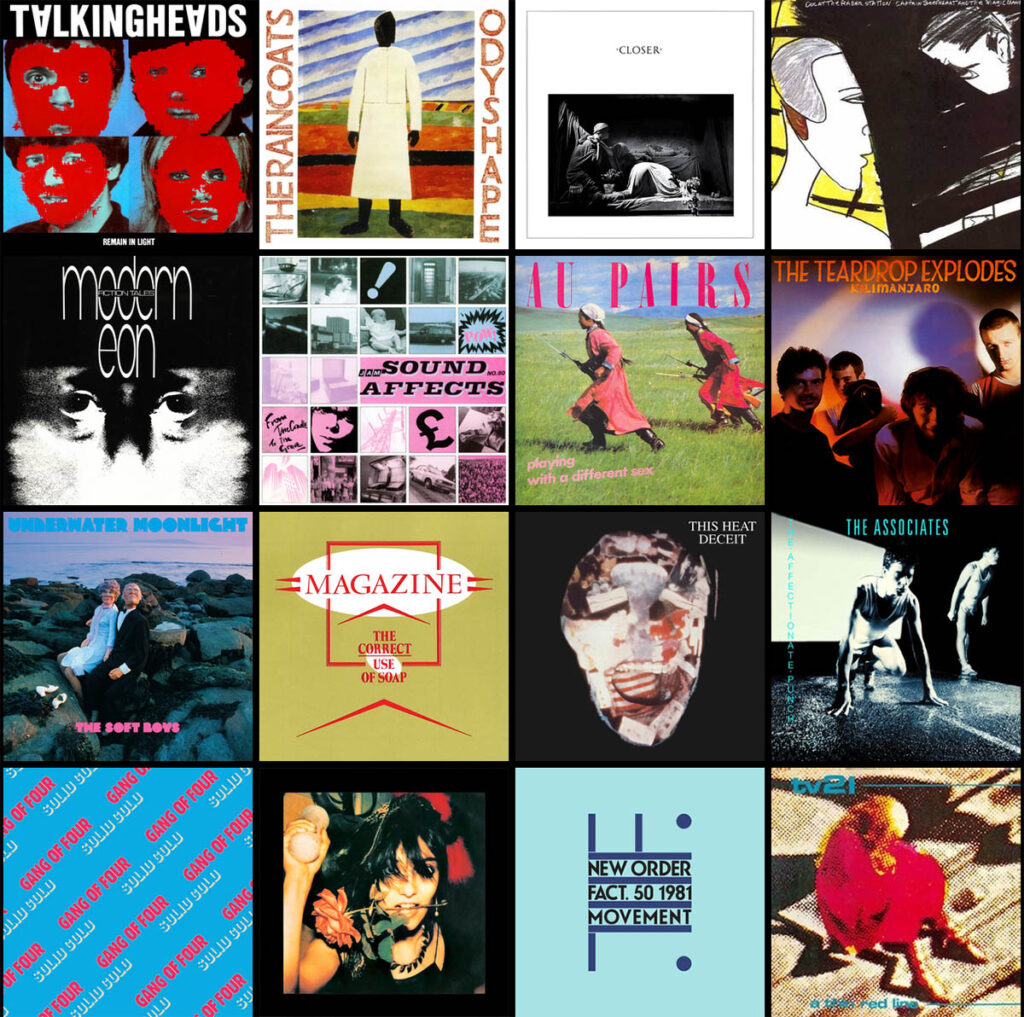
The scope of Post-Punk U doesn’t end with their graduates, as there’s a number of cohorts, visiting lecturers and dropouts who released significant albums. Heading the CBGB’s American internship program are Talking Heads, whose Eno produced Fear of Music (1979) and Remain in Light (1980) made a big impact on post-punk. The Raincoats may not have earned enough credits to graduate, but their 1979 self-titled debut and Odyshape (1981) made a profound influence. Towering above all of course are Joy Division. After Ian Curtis committed suicide, the rest of the band changed their name to New Order and forged their own future beyond PPU’s curriculum. Visiting lecturer Don Van Vliet showed the kids how it’s done with Captain Beefheart & the Magic Band’s Doc at the Radar Station (1980), and after one last album, Ice Cream for Crow (1982), retired from music and switched to being a professional visual artist.
Liverpool underclassmen Modern Eon released the extremely impressive lost classic Fiction Tales (1981). Drummer Cliff Hewitt broke his wrist just before they were to record a Peel Session. Rather than persevere and record their second album, they gave up, dropped out of PPU and Tim Lever ended up with Dead Or Alive. More post-mod power pop, new wave and art punk, The Jam’s fifth album Sound Affects (1980) did touch on post-punk and showed the possibilities of the genre in infiltrating the pop mainstream. Birmingham’s Au Pairs took Gang Of Four’s neo-Marxist funk and added a feminist spin, but only released one other album after their brilliant Playing With a Different Sex (1981). Similarly Liverpool’s The Teardrop Explodes began as contemporaries with Echo & the Bunnymen, but were unable to do their homework, their third album remaining incomplete. Despite all the psychedelic drugs rattling in his brain, Julian Cope managed to forge a successful solo career later.
Captain Beefheart acolytes The Soft Boys put together the classic Underwater Moonlight (1980), a fun mix of post-punk, psych and jangle pop. Robyn Hitchcock left for a solo career, but they did reunite and release Nextdoorland (2002). Magazine’s Real Life (1978) could be considered one of the first post-punk albums along with Iggy Pop’s The Idiot (1977), Wire, Siouxsie & the Banshees, Public Image Ltd., and Pere Ubu. Guitarist John McGeoch continued studies at PPU when he went on to zhuzh up Siouxsie & the Banshees. This Heat has strong roots on prog, art rock and jazz fusion with Charles Hayward of Gong and Quiet Sun, and were an influence on the more experimental and improvisational side of post-punk. Formed back in 1976, The Associates were Bowie acolytes along the lines of Tubeway Army and Ultravox, but advanced enough by their debut The Affectionate Punch (1980) that they were admitted into the PPU program. After a compilation of singles, they veered off into brittle sounding synthpop and art pop with Sulk (1982) and left the school.
Gang Of Four from Leeds peaked with an early classic on their debut Entertainment! (1979). Solid Gold (1981) was nearly as good, but starting with Songs of the Free (1982) they started taking their funk and dance influences more literally. Public Image Ltd. were also early influencers with Public Image released in December 1978, and the colossal Metal Box (1979). John Lydon was a prickly bastard at the best of times, and the band abandoned him save for Keith Levene, who heroically handled all the music for The Flowers of Romance (1981), with drum assistance from Martin Atkins. Lydon was the only original member left by This Is What You Want… This Is What You Get (1984). Before New Order went full-on synthpop, their first album, Movement (1981) sounded very much like Joy Division. The best work they ever did was in the transitional phase on early singles “Ceremony,” “Temptation” and “Procession.”
TV21’s early singles in 1980 were similar to the post-mod pop of The Jam, while their sole album, produced by Ian Broudie, which ventured into psychedelic post-punk, is considered one of the great lost albums, an equal to contemporaries The Teardrop Explodes and Echo & the Bunnymen. They were featured on the cover of Melody Maker in 1981, and one wonders what would have happened had their singles been put out by Postcard along with their slightly more fashionable Scottish contemporaries Orange Juice and Josef K. The band thought it was overproduced. In retrospect, it’s hard to say that stripping it down to more along the lines of The Sound’s debut, Propaganda (a demo released as their first album) would have improved on an album that sounds pretty great to my ears. Coincidentally, “Ticking Away” and “It Feels Like It’s Starting To Rain” could have fit well with the slower tunes on The Sound’s second album, From The Lion’s Mouth. At the end of 1981, the band had drifted into the fashionable synthpop sound, heard on their last single, “All Join Hands.” It didn’t really work, and the friction between five different songwriters was too much to sustain, and the band imploded on a subsequent tour supporting The Rolling Stones, despite Mick Jagger being an enthusiastic fan. A couple members played small, brief roles in The Bluebells and The Waterboys, and Neil Baldwin and Ally Palmer were in Shame. Fans had to wait until 2009 to find out what could have been, when the band released their sophomore album, Forever 22, after first getting together in 2005 at a John Peel tribute. The band had more great music in them, even if it took 28 years to cough it up.
PPU had other students, graduates and drop-outs like Virgin Prunes, Sad Lovers and Giants, The Chameleons, And Also The Trees, Breathless, Lowlife, Asylum Party, and For Against.
May 31, 2026
Fester’s Lucky 13: 1996
April 2, 2026
Fester’s Lucky 13: 1986
February 27, 2026
Fester’s Lucky 13: 1976