Alltime favorite books, #19. “A screaming comes across the sky. It has happened before, but there is nothing to compare it to now.”
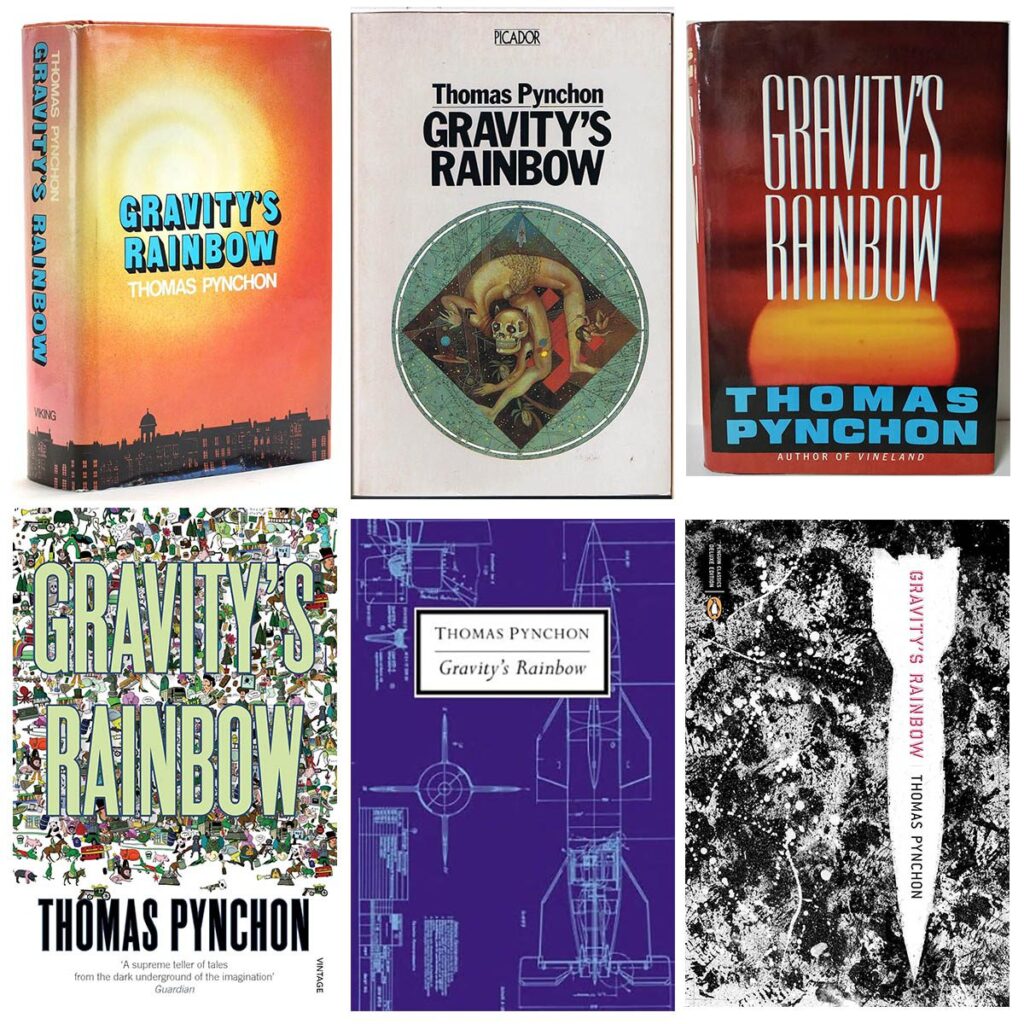
There’s an allure of cognitively challenging books that merit multiple study guides and a lifetime of re-reads. Modernism had the likes of James Joyce, Leo Tolstoy and Herman Melville among others, while post-modernism had Don DeLillo, Cormac McCarthy, David Foster Wallace and of course Thomas Pynchon. I’ve dabbled with most of these, but connected with Pynchon mainly for his ethical values, esoteric interrogation with both American high and low culture (comics, spy novels, movies, mysticism, tarot, music) that interests me, and his transgressive humor.
The legendary stories about this book far outweighs the number of readers who have actually read it, such as Laurie Anderson writing him for permission to base an opera on it. He surprisingly wrote back and gave her his blessing, only that it had to be done with solo banjo. It was voted unanimously by the jury to win the Pulitzer, but the 14 member board refused to award the book with no explanation. The New York Times reported that privately some members considered it “unreadable,” “turgid,” “overwritten,” and in parts “obscene.” editors of The New York Times Book Review said it was “one of the longest, darkest, most difficult and ambitious novels in years … bonecrushingly dense, compulsively elaborate, silly, obscene, funny, tragic, poetic, dull, inspired, horrific, cold and blasted.” “The central plot,” they wrote, “concerns the search for a V‐2 rocket a symbol of the sexual love of death, which Pynchon suggests is the driving paranoid force behind modern history.” It was awarded the National Book Award.
Runner-ups included John Cheever’s “A World of Apples” and Gore Vidal’s “Burr”. Professor Benjamin DeMott, professor of English at Amherst College said it was unusual to have so strong and unanimous recommendation among fiction jurors as his group gave the Pynchon book. He said his report on behalf of the jurors had said: “No work of fiction published in 1973 begins to compare in scale, originality and sustained intellectual interest with Mr. Pynchon’s book.”
After a break from reading for pleasure during college, I dove into some heavy stuff, powering through James Joyce’s Ulysses (which he says he wrote in a way that would give scholars something to do for decades), but failed at Finnegan’s Wake and Tolstoy’s War and Peace. I read and liked Pynchon’s first two books, so Gravity’s Rainbow was an enticing challenge. The first third of the book is a labyrinth of characters and plotlines that seemed design to warn off readers not fully committed. Near the end of WWII in Europe, Tyrone Slothrop is an American intelligence officer who can predict where the V-2 rocket will lands based on his sexual encounters in London. Previously the V-1 rockets gave a warning, hence the Brit’s nicknames “buzz bombs” and “doodlebugs.” But the V-2’s flightpath leaves the atmosphere then comes down faster than the speed of sound (the parabola described as gravity’s rainbow) and impacts before anyone can hear it. While seemingly mystical, Slothrop was subjected to experiments as a child in Germany by Dr. Laszlo Jamf that involved the synthetic plastic Impipolex G, also used in the construction of the V-2. This was a bizarre arrangement with his uncle bartering him to the scientist in exchange for a scholarship to Harvard. The plastic associated a Pavlovian arousal in Slothrop, as the book almost taunts us with the Freudian connection between phallic rockets and actual dicks throughout. Later, behavioral psychologist Edward Pointsman believes there’s a causal relationship, but it remains ambiguous.
This is not told in a linear fashion, but in a fragmented, chaotic way, with 400 characters coming and going like ghosts, where science and mysticism interact, themes of predestination vs free weill, sex and death, paranoia, technology and power expressed in the confusion between reality and delusion. It’s lewd, grotesque and disturbing, and also profound, beautiful and funny. There are scenes in a post-bombing wasteland called the Zone where it’s unclear if it’s the real world, possibly a tribute to Burrough’s Interzone in Naked Lunch.
My takeaway is that while Cormac McCarthy’s Blood Meridian puts forth that war has been around forever and is an inevitable part of nature, in this book, war is business — the logical result of a military-industrial complex that worships profit over all else.
“Written down in the Manual, on the file at the War Department. Don’t forget the real business of the War is buying and selling. The murdering and the violence are self-policing, and can be entrusted to non-professionals. The mass nature of wartime death is useful in many ways. It serves as spectacle, as diversion from the real movements of the War. IT provides raw material to be recorded into History, so that children may be taught History as sequences of violence, battle after battle., and be more prepared for the adult world. Best of all, mass death’s a stimulus to just ordinary folks, little fellows, to try ‘n’ grab a piece of that Pie while they’re still here to gobble it up. The true war is a celebration of markets. Organic markets, carefully styled “black” by the professionals, spring up everywhere.”
As the book begins with the line “A screaming comes across the sky. It has happened before, but there is nothing to compare it to now,” it’s relevance stretched 50 years well into the 21st century as the business of weapons and war become even more advanced and insidious.
19. Thomas Pynchon – Gravity’s Rainbow (1973)
20. William S. Burroughs – Naked Lunch (1959)
May 31, 2026
Fester’s Lucky 13: 1996
April 2, 2026
Fester’s Lucky 13: 1986