31 albums that I posted on the socials over the month in chronological order, that evoked fun in the sun, backyards, beaches, parks, and after dark.
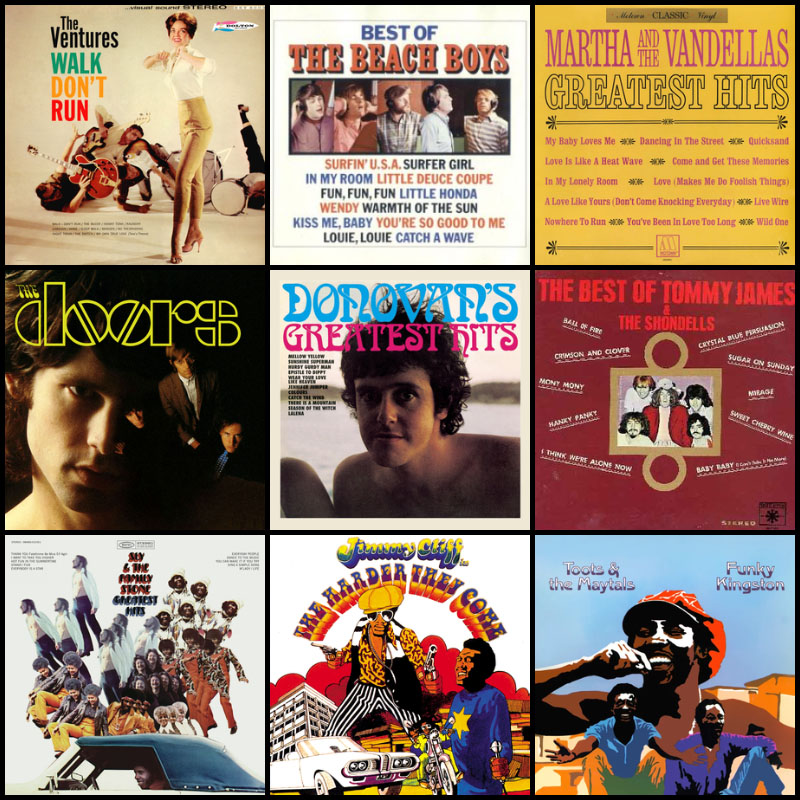
The Ventures – Walk Don’t Run (Dolton, 1960)
In 1960, The Ventures THE band that created the twangy template of what summer music should be, invoking surfing waves, beach parties and tiki torches.
The Beach Boys – Best of the Beach Boys (1966)
While Pet Sounds is their best album, Today! and Summer Days, both from 1965 have more summer vibes. But really, you have to go with a compilation to get all their best summer anthems. When you grow up with this being the only Beach Boys record in the house, this is THE album. For many others, that’s Endless Summer (1974), but then you won’t get “Little Honda.”
Martha & the Vandellas – Greatest Hits (1966)
Of all the Motown artists, Martha & the Vandellas is most evocative of summer with not only their best song, “Heat Wave,” but also “Nowhere to Run” and “Dancing in the Street.”
The Doors – The Doors (Elektra, 1967)
The Doors may not be associated with the beach, even though they started when Jim Morrison and Ray Manzarek bumped into each other on the Santa Monica Beach, but they do epitomize summer after dark, as experienced on the Sunset Strip, where they played the Whisky a Go Go alongside Love and Buffalo Springfield, as well as The Troubadour. They also haunted spots all around LA, from Laurel Canyon to West Hollywood, where they set up camp at the Alta Cienega Motel and hung out at the dive Barney’s Beanery. I wasn’t born yet, but that’s in my top three of places I’d visit if I could time travel, as well as swinging London during the brief peak of the psychedelic UFO club.
Donovan – Donovan’s Greatest Hits (Epic, 1969)
Many of us Yanks didn’t appreciate how viscerally insulting Bob Dylan’s patronizing, asshole treatment of Donovan was in the Don’t Look Back documentary. Yes, Donovan looked up to Dylan as even the Beatles did. But he was also the MAN when it came to psychedelic folk in the UK, and his body of work is no joke. As a kid, my introduction to both artists were greatest hits albums that my mom had, and for a long time I preferred Donovan. His psychedelic folk pop produced some of the best songs in the 60s, from “Sunshine Superman” to the mind-blowing “Hurdy Gurdy Man” and the wonderfully eerie “Season of the Witch.”
Tommy James & the Shondells – Best of (1969)
While Crimson & Clover (1969) is Tommy James’ best album with the title track and “Crystal Blue Persuasion,” you gotta have “Hanky Panky,” “I Think We’re Alone Now” and “Mony Mony.” This Michigan band may have been considered a bit square, but artists like Billy Idol and Joan Jett (and uh, Tiffany) ensured the songs remained in the public consciousness, for good reason.
Sly and the Family Stone – Greatest Hits (1970)
A prime example of a compilation that elevates an artist beyond what they achieved with their first four albums, with a flow that’s unmatched even by most other comps, starting with “I Want to Take You Higher,” “Everybody is a Star,” “Dance to the Music,” “Everyday People,” “Hot Fun in the Summertime.” Damn. This has more uplifting anthems than James Brown, Stevie Wonder, Marvin Gaye and the Jackson 5 combined from that same period of 1967-70. Utopian visions from an culturally integrated band of what could have been before the drugs and politicians went bad.
The Harder They Come (1972)
The movie is a pretty grade-C Jamaican gangster flick, but the soundtrack is amazing, with Jimmy Cliff, Toots & the Maytals, the Melodians and Desmond Dekker, paving the way for Bob Marley’s crossover to the mainstream.
Toots & the Maytals – Funky Kingston (Mango, 1973)
Toots Hibbert was there before reggae even existed, putting out ska and rocksteady singles throughout the 60s, fusing the soul of Curtis Mayfield with the grit of Otis Redding and the funk of James Brown. The Maytals deserved to be just as big as Bob Marley & the Wailers, and for a hot second in 1973, it seemed like they just might be.
Justin Hinds & The Dominoes – Jezebel (Island, 1976)
One of the most underrated reggae albums ever, from the greatest year for reggae, this is my favorite. There’s just a sweet soulfulness that exudes sunshine on this album.
Blondie – Blondie (Chrysalis, 1976)
Blondie’s debut is kind of underrated. Because of how overplayed later singles are, this one sounds more fresh to me, invoking summer fun via Brill Building girl group pop and surf rock. It takes the pop culture trash left behind by New York Dolls’ Too Much Too Soon (1974) and The Dictators’ Go Girl Crazy (1975) and make something new (wave) out of it.
Third World – 96 Degrees in the Shade (Mango, 1977)
Engineered by the great Sylvan Morris, this is one of the best sounding reggae albums of that era, with some of the best musicians. With their crossover with soul, pop and some jazzy chops, they’re like a Jamaican Steely Dan. The albums evokes both smooth, relaxing sounds, and sweltering summer heat.
Starting with their self-titled debut in 1976 through their third album, Journey To Addis (1978), Third World incorporate a more polished production with infusions of blues, soul, rock and funk. Not unlike Toots and Marley really, but just taking it in a jazzier direction along the lines of Steely Dan. Keyboardist Michael ‘Ibo’ Cooper and guitarist Stephen ‘Cat’ Coore are classical musicians who formed Inner Circle in 1968, and left to form Third World in 1973. While the debut was really good, things really click on the second album when vocalist William ‘Bunny Rugs’ Clark joins the band fresh off a solo album produced by Lee Perry. And of course, Sylvan Morris lent a hand on the board. Cat Coore’s guitar lines and the smooth but agile musicianship is infinitely listenable. Considered by some as not ghetto enough, and therefore inauthentic that is such a steaming pile of bullshit. There’s room for diversity within reggae, and Third World were top tier musicians who pushed the limits of expectations and inspired other bands like Steel Pulse, Zap Pow and Aswad. I wish there were even more Third World acolytes.
Radio Birdman – Radios Appear (Tralfalgar, 1977)
One of the towering pillars of what became an incredibly varied and deep Australian garage punk scene, this band has a direct connection to the Motor City via Deniz Tek, who emigrated from Ann Arbor to Sydney after being exposed to the Stooges, MC5 and Ramones. Named after misheard lyrics from the Stooges’ “1970” — “Radio burnin’ up above,” they took those influences, processed and integrated them into a uniquely brooding but propulsive sound that would become a big influence on practically every punk-adjacent band that emerged from down under in the next decade. The band’s logo looks great on a t-shirt, for those who want something not as overworm by clueless fashionistas like the CBGBs, Ramones and Motörhead shirts. “Aloha Steve & Danno” might also be one of the first instances of surf punk!
Ramones – Rocket To Russia (Sire, 1977)
The most surf ‘n’ summertastic Ramones album, with “Rockaway Beach,” “Surfin’ Bird” and “Do You Wanna Dance?” Also my favorite by them. Leave Home is close, with “California Sun”
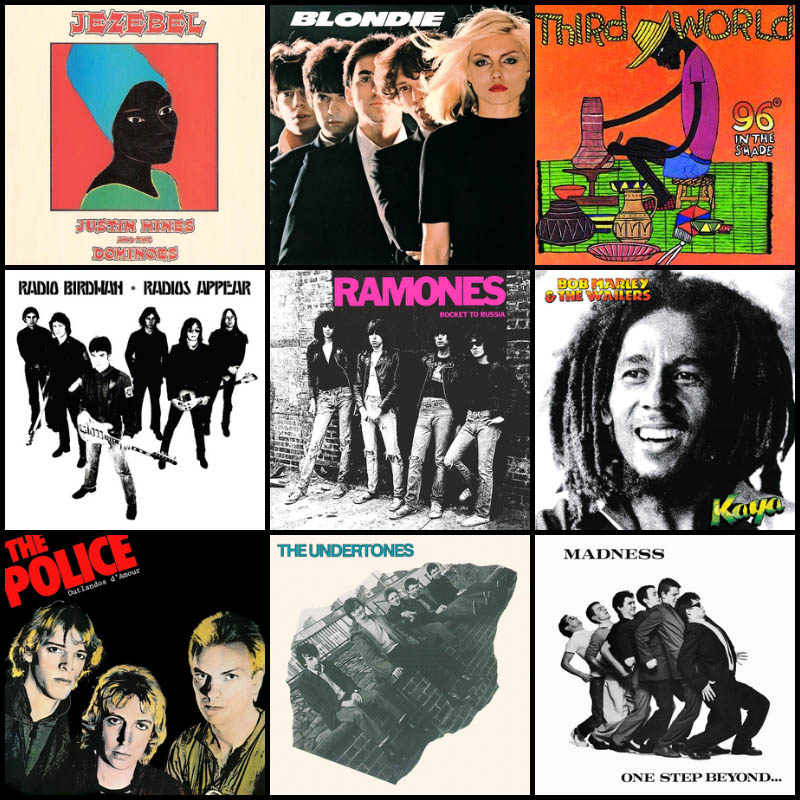
Bob Marley & the Wailers – Kaya (Tuff Gong/Island, 1978)
A Bob Marley album that’s under the radar? Not exactly, unless you’re one of the 15 million people who own Legend but never heard this. It’s all relative, but Catch A Fire (1973), Natty Dread (1974) and Exodus (1977) — hailed by Time Magazine as the best album of the 20th century — usually hog the critical acclaim. Recorded in the same early 1977 sessions as Exodus, the truth after all these years is that there is no drop in quality. It’s just a sunny, laid back album about love ‘n’ ganja. In other words, a perfect summer album.
The Police – Outlandos D’Amour (1978)
1978 saw some big debuts that make great summer jams – Van Halen, The Cars, Dire Straits. My pick is The Police, thanks to their really original spin on reggae-infused reggae based on Andy Summer’s jazz fusion experience, creating guitar shapes that shimmer and float, leaving plenty of space to let the warm Caribbean breeze blow in. Stewart Copeland’s drumming and Sting’s taut songwriting, his reedy voice hovering over the top. A rare band that the masses love and musicians still admire.
The Undertones – The Undertones (Sire/Rykodisc, 1979)
The Irish Ramones would soon evolve into more sophisticated forms of pop, but for now, they were all 1-2-3-4 SUMMER FUN.
Madness – One Step Beyond (Stiff, 1979)
While their first single, “The Prince/Madness” was released on 2 Tone, that was the end of their involvement with the label, which I’ll cover soon. Of all the bands in the 2 Tone scene, Madness may not have been the best, but they had the most longevity in terms of releasing a series of albums that had a creative progression, and avoiding getting stuck in the nostalgia circuit. Even last year, they were still at it with their thirteenth album, Theatre of the Absurd Presents C’est La Vie, an audacious mash-up of art, psych & prog pop, music hall, cabaret, baroque and funk. One Step Beyond was nearly a perfect debut, fun, goofy, but slyly innovative.

X – Los Angeles (Slash, 1980)
Thirteen years after The Doors ruled the Sunset Strip, punk was marauding the streets of L.A. The best of the batch were X, and Ray Manzarek recognized this, passing the torch by producing and contributing organ and keyboards, where they also do a lively cover of “Soul Kitchen.”
Soundtrack – Dance Craze: The Best of British Ska…Live! (2 Tone, 1981)
The 2 Tone ska revival in the UK was the first and best wave, because pretty much every single band involved were brilliant and had original spins on the genre to the point where none of it was really ska, but it was inspired by it. The live Dance Craze soundtrack to the movie is as good as anyplace to start that have most of the bands, especially for the inclusion of Bad Manners’ “Lip Up Fatty” and “Inner London Violence.” Also essential are the following albums:
This Are Two Tone (2 Tone, 1983)
The Selecter – Too Much Pressure (Chrysalis, 1980)
Specials – The Specials (Chrysalis, 1979)
English Beat – I Just Can’t Stop It (Sire, 1980)
Agent Orange – Living In Darkness (Posh Boy, 1981)
Surf punks are go! Bringing in a hardcore punk edge, Agent Orange actually became an important band for another sport created by surfers who wanted to glide on a board on land — skateboarding, as well as BMX biking to an extent. A cover of Dick Dale’s “Miserlou,” was their statement of purpose. Actually Dale just rearranged the song that was popular with Arabic, Greek and Klezmer musicians in the 1920s. The band didn’t release another album until five years later, with the underrated psychedelic post-punk This is the Voice (1986).
The Go-Go’s – Beauty & the Beat (IRS, 1981)
“We Got the Beat” ruled the airwaves in 1981 a sort of surfy new wave/punk hybrid of “Wipeout” and “Louie Louie” in it’s perfect simplicity.
Tom Tom Club – Tom Tom Club (Island, 1981)
On a break from Talking Heads, rhythm section Jerry Harrison and Tina Weymouth accidentally achieved way more success than their main band ever did with the hit singles from these joyful Compass Point sessions.
Men At Work – Business As Usual (Columbia, 1981)
Australia has awesome beaches too, and while this is not a surfy album per se, it does pay homage to The Police’s airy pop reggae, with their own ebullient down under version new wave pop.
Grace Jones – Nightclubbing (Island, 1981)
While Tom Tom Club were the accidental stars of Compass Point, Grace Jones was the Bitch Qween. After a series of meh disco albums, she tapped into her Jamaican roots and hooked up with a killer band via the Compass Point All-Stars including legendary riddim section Sly Dunbar and Robbie Shakespeare, Mikey Chung on guitar, Wally Badarou on keyboards, Sticky Thompson on percussion. The expanded deluxe sets of both this and Warm Leatherette (1980) are essential.
King Sunny Adé and His African Beats – Juju Music (Island, 1982)
The Yorùbán king of jùjú blows open the gates of the West and blazes a trail for future Afro Pop stars. After Bob Marley died in 1981, Chris Blackwell searched for a new global star to take the reigns. In hindsight that was the wrong way to market Nigeria’s King Sunny Adé. But at least it did introduce some Western audiences to the magical Yoruba genre, Jùjú, which emerged in the 1920s in Lagos. The first in a trilogy of releases on Island’s Mango imprint, which would introduce collaborations with the likes of Stevie Wonder and along with traditional talking drums, innovations like adding pedal steel guitar and bubbling synths, clarinet, vibraphone, guitar and dub for a dense tapestry of sophisticated, polyrhythmic, cosmopolitan dance music. Jubilant, buoyant music for sunny days and warm summer nights.
Lyres – On Fyre (Ace Of Hearts, 1984)
Part of a long-running tradition of Boston garage rock with roots in DMZ, The Lyres also created some new surf classics for the 80s with the one-two punch of “Don’t Give it Up Now” and “Help You Ann.” Also recommended, Lyres Lyres (1986).
The Soft Pack – The Soft Pack (Kemado, 2010)
Every few years the muses choose an unassuming young band that don’t have an obvious excess of talent, and gift them with an album’s worth of perfect songs, then unceremoniously abandon them. Like with The Strokes and then possibly Interpol, and then they chose a band from San Diego, originally called The Muslims, who released a promising demo-quality EP. After changing their name, they released a batch of tunes that struck the perfect balance between garage rock simplicity and meditative surf twang. At the surface one might think it’s just a minor entry in a long history of those genres, but there’s been nothing quite like it before or since. Sadly, that includes their follow-up, Strapped (2012), and they were gone as suddenly as they appeared.
The Vaccines – What Did You Expect From The Vaccines? (Columbia, 2011)
This UK band’s brand of garage punk and power pop offered several earworms, though not as consistently as The Soft Pack’s debut the previous year. This was as good as it got, as their subsequent five albums are dismal to dire. Yet this first one stands the test of time. “Put a wetsuit on, do me wrong, do me wrong, do me wrong.”
Syd Arthur – On An On (Dawn Chorus, 2012)
While Tame Impala’s “Feels Like We Only Go Backwards” was the big psych summer jam in 2012, in hindsight, Syd Arthur’s “Ode to the Summer” is even better. The band doesn’t rely on retro production effects, but rather achieve liftoff as a virtuoso band already at a crazy telepathic level of tightness on their full-length debut. Referred to as Canterbury prog mainly because they literally came from Canterbury, England, they mix in psychedelia, Afro pop and subtle textural influences of electronic music the band listened to in their teens. The jazzy flow, addictive guitar tones and Liam Magill’s unique reedy voice all contribute to a floaty, ethereal listening experience. Other tracks like “Edge of the Earth” and “Paradise Lost” create the sense of being lost in the forest, tripping balls, to emerge into a bucolic meadow with the sun shining warmly.
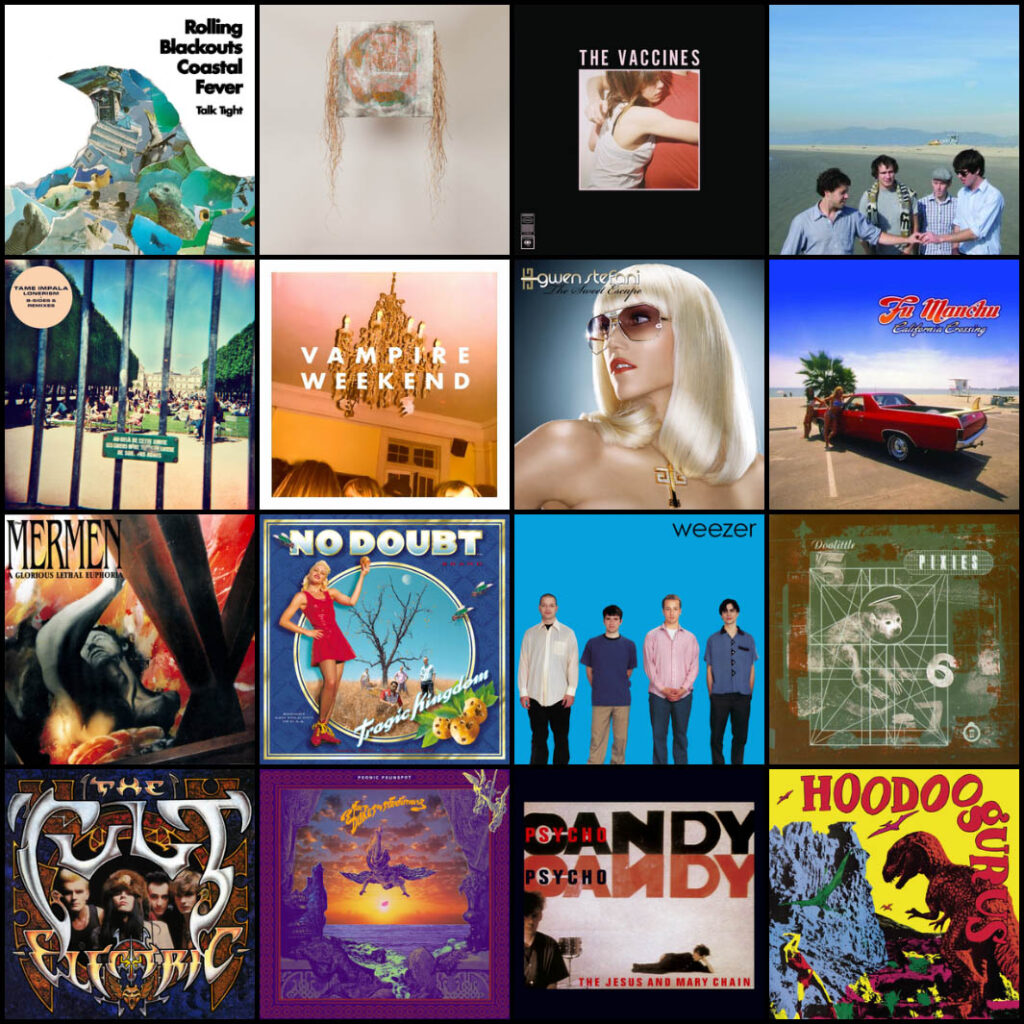
Rolling Blackouts Coastal Fever – Talk Tight (Ivy League, 2016)
What made his Melbourne jangle surf band such a jolt of fresh energy? Let’s start with the fact that they have three members sharing guitar, songwriting and vocal duties. This could create a chaotic, shambolic sound, and while early tracks do have a giddy, fragmented quality, the writers sound completely locked in tune with each other, so I can’t easily tell who’s songs are who’s they all sound like RBCF. The band has been described as “motorik jangle” thanks to Joe Russo’s bass locked in with Marcel Tussie’s precise propulsion which is actually rooted in his background with Afrobeat. And then there’s the guitars, guitars, guitars! Fran Keaney’s acoustic guitar is aggressively percussive, while Joe White paints wide swaths of sound. With his 1959 hollowbody Gretsch, Tom Russo produces a distinctively sharp chime, a post-Shadows and Hank Marvin surf twang. Together they create a rich array of textures and intertwined leads. While so many bands feel obligated to rely on synths (a technology that’s already a half century old) to sound contemporary, it’s refreshing to just roll around in guitar heaven with a pop band.
Bubbling Under:
Tame Impala – Lonerism (Modular, 2012)
Vampire Weekend – Vampire Weekend (2008)
Gwen Stefani – The Sweet Escape (2004)
Fu Manchu – California Crossing (2001)
The Mermen – A Glorious Lethal Euphoria (Mesa, 1995)
No Doubt – Tragic Kingdom (1994)
Weezer – Weezer (1994)
Pixies – Doolittle (Elektra, 1989)
The Cult – Electric (1987)
The Dukes Of Stratosphear – Psonic Psunspot (1987)
Jesus and Mary Chain – Psychocandy (1985)
Hoodoo Gurus – Stoneage Romeos (1983)
More:
The Shadows – The Shadows (Columbia, 1961)
The Jimi Hendrix Experience – Are You Experienced? (1967)
Lynyrd Skynyrd – Pronounced… (1973)
Led Zeppelin – Houses of the Holy (1973)
Dick Dale and his Del-Tones – Greatest Hits (1975)
Creedence Clearwater Revival – Chronicle (1976)
Steve Miller Band – Book of Dreams (1976)
Boston – Boston (1976)
ZZ Top – The Best of ZZ Top (1977)
The Cars – The Cars (1978)
Van Halen – Van Halen (1978)
Cheap Trick – At Budokan (1979)
Avengers – Avengers (1979)
The Raybeats – Guitar Beat (Bar/None, 1981)
Oingo Boingo – Only A Lad (A&M, 1981)
The Unknowns – The Unknowns (AZ, 1982)
The Riptides – Tombs of Gold (1982)
Kid Creole & the Coconuts – Kid Creole Redux (1983)
Prince – Around the World in a Day (1985)
Paul Simon – Graceland (WB, 1986)
The Original Sins – Big Soul (1987)
The Buttertones – Buttertones (Lolipop, 2013)
Mother Island – Cosmic Pyre (Go Down, 2015)
April 2, 2026
Fester’s Lucky 13: 1986
February 27, 2026
Fester’s Lucky 13: 1976