Celebrating the life and death of the world’s greatest record store.
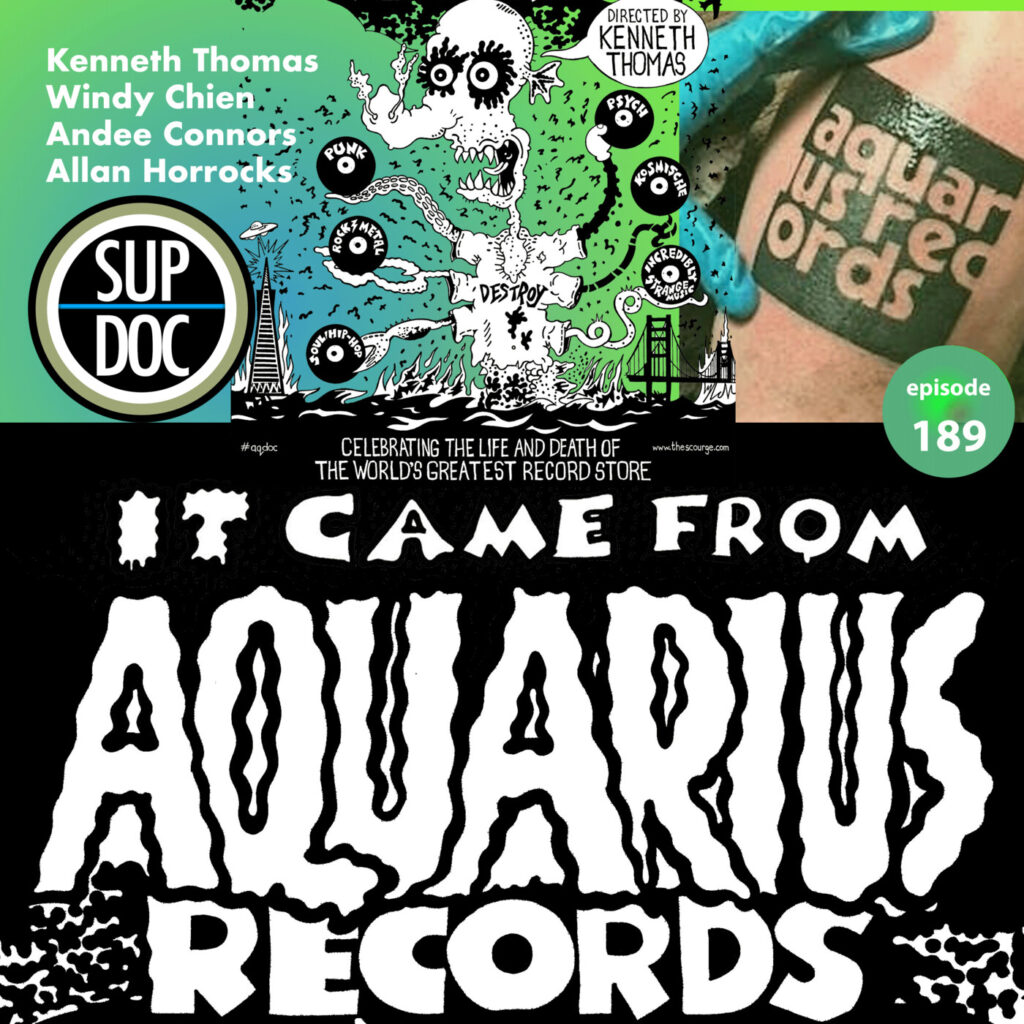
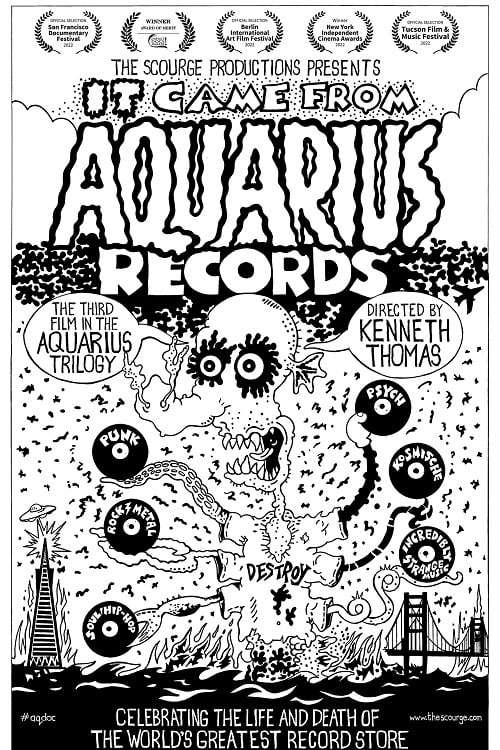
While this documentary is dated from 2022, I found it on a list of new releases for August 13. Sure enough, it became available on Tubi TV to stream for free, with commercials. What I thought would be a warm and fuzzy nostalgia trip, and an educational history of the legendary Aquarius Records going back to 1969, ended up more like a profoundly depressing emotional spiral.
The film itself is fine. It does well with interviewing most of the owners throughout it’s history, and even the inexplicable tangents about random bands like Circle from Finland and Boredoms from Japan that Aquarius championed made some kind of sense in replicating what it’s like to actually browse at a record store and go down rabbit holes. It would have been nice to see more footage of the look and feel of the store between 1969 and 1996 in it’s various locations before it’s final resting spot at 1055 Valencia Street in the Mission District, under the ownership of Windy Chien. She was really the one take a store that’s only real legacy was being one of the original good record stores that catered to tastes beyond the mainstream, to one that become know worldwide for their meticulous curating work. Their twice monthly new release email list featured colorful, thoughtfully written descriptions of new releases and reissues. They became one of the authoritative sources of not only the product, but knowledge of underground and obscure metal, psych, kosmische and “incredibly strange music.” When employees Andee Connors and J. Allan Horrocks bought the store in 2003, they carried on that tradition prolifically, eventually writing nearly 30,000 reviews.
I know it’s from the benefit of hindsight, but it was incredibly demoralizing to see the Aquarius end abruptly in July 2016, as they were on the cusp of a new era of vinyl fetishism. It’s something I used to ridicule, because I believed it made the most sense to promote digital download sales through portals like Bandcamp. But the industry missed that opportunity to seamlessly transition buying habits from physical to digital in 1999-2002, and instead wasted time harassing and suing their best customers. So as unlikely as it seemed to me, this outdated, flawed medium of vinyl is what people have chosen as the primary alternative (or supplement in many cases) to streaming.
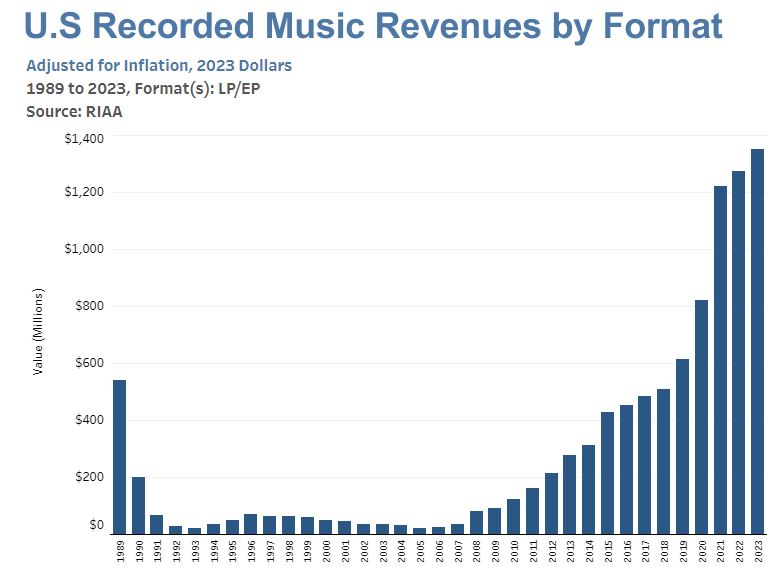
After reaching a nadir in 2005 of about 900,000 vinyl albums sold, it’s been on a steady upward trend ever since. In 2016, sales reached 10.3 million, and $451.2 million in revenue, the highest since 1988. What no one could have predicted was that during the Pandemic, people really needed some emotional comfort, and that retail therapy ended up being a truly dramatic spike in vinyl sales, doubling from 19.8 million units and $614.4 million in revenue in 2019 to 36.7 million in 2021 and $1.2 billion in 2021. It’s still growing, with 43.2 million/$1.4 billion in 2023, and projected to reach $4.12 billion by 2030, according to Verified Market Research, the highest since 1984. Adjusting for inflation. vinyl price increases haven’t been as dramatic as many think. While it’s currently just under $30, in 1978 at it’s peak, the equivalent price was $28, the peak year of sales with 341.3 million units and $11.6 billion in revenue. How much of that went up music exec’s noses? Since it’s lowest point at $11 in 1992, average prices jumped to $17 the next year, to over $20 by 1995. But used vinyl was cheap as dirt, at least at the stores that didn’t entirely stop selling them.
Of course, the profit margins are a much different story, as for years there were no parts being manufactured to enable new record pressing plants to be built. That has finally started to change, but in many cases, records were, for smaller bands doing small pressings, resulting in negative profit. It was just a gesture of goodwill for fans who wanted physical product. While a handful of major artists like Taylor Swift essentially takes over Nashville’s United Record Pressing factory to churn out a million plus records in a year, it remains to be seen how much money smaller artists will be able to make. There’s already concerns with major label fuckery ruining it for everyone once again. It’s always been a delicate balance until it’s not, when the behemoths suck as much profit as possible without concerns for long term sustainability.
The point is that any collectors and record retailers who were lucky enough to accumulate hordes of vinyl since the 90s have been able to not only sustain new pop-up record stores that quickly became brick and mortar stores and survive, and even flourish. It’s a sadly missed opportunity for an incredible brand like Aquarius. I visited the store every time I was in San Francisco since 1996, and it’s small, even for an indie store. Probably less than 1/10th the size of Rasputin in Berkeley, which was even better than Amoeba when I first visited it in ’96. They simply didn’t have the space to acquire large collections and turn over used product, which is absolutely the key to success for any indie store. They needed to move one more time, to a bigger, more cost effective space. In the Bay Area that probably meant Oakland or even further out. Wherever it landed, it would have been a desirable destination, considering some people fly from other parts of the world. Of all their fans across the world, just one investor with deep pockets could have saved them. Or even crowdfunding. Unfortunately passion for music does not always equate to business savvy. And to be fair, Andee and Allan preferred working with CDs which take less space in limited sized rooms, are easier to ship, etc. It would also be difficult to compete with Amoeba in acquiring used records for inventory.
According to their blog, “why…do you like it?”, they said they are working on “the long-awaited big book of selected aQuarius reviews,” promising updates as work progresses. There’s been no posts for two years, so I hope it still happens. It would be a major event, the Trouser Press Record Guide of psych, metal and weird music for 1996-2016.
In the end, of course I recommend this documentary to anyone who cares about record stores. Yes, it can be emotional, triggering the grief from all the great record stores we’ve lost over the past decades, starting with the Astroid from my childhood in Dubuque, IA. Of the dozens of stores that affected my life, only a few still exist, like Cheapo Records and Electric Fetus in the Twin Cities, and Reckless Records and Dusty Groove in Chicago.
Two specialist stores I have fond memories of were just a block down the street from me at the time in Chicago on Belmont — a tiny goth record store called Armageddon in the late 90s, and down the block, Metal Haven in 99-07, and then at Montrose and Damen in 2007-10. In 2016, Mark Weglarz tried one last time, opening a restaurant/record store combo, Metal Haven Grill. It sadly died a quick death. Why can’t we have nice things? In Austin, known to be a music city, there aren’t as many record stores as I’d expect. I fear the city overall isn’t cultivating music related culture and business nearly as successfully as Nashville is. I can only hope there there will be enough stores who can keep the balance of harnessing the mainstream market while still lovingly cultivating underground music genres, keeping it weird.
May 31, 2026
Fester’s Lucky 13: 1996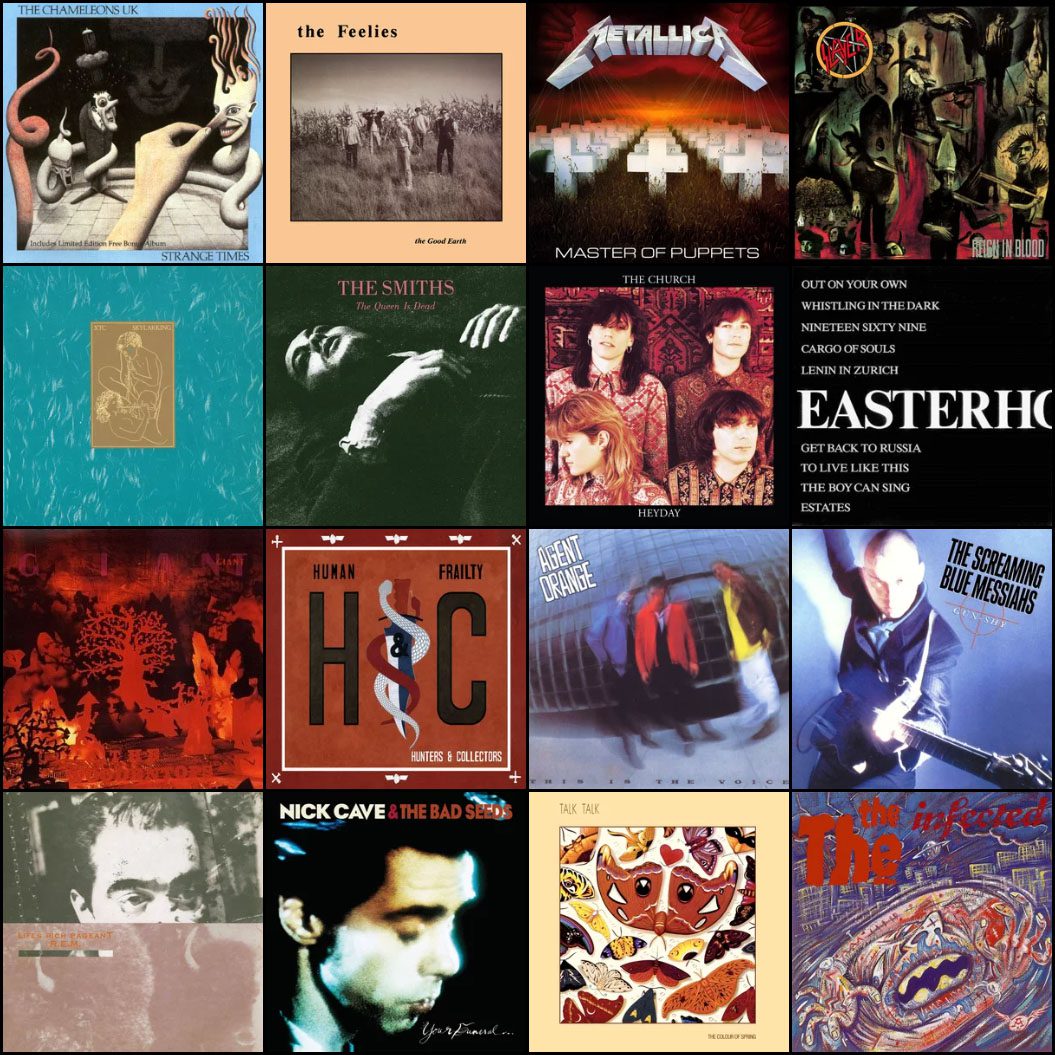
April 2, 2026
Fester’s Lucky 13: 1986
March 12, 2026
Ranking the Oscar Nominees